
Scientists Create One of the Largest Simulations of the Universe Ever Made
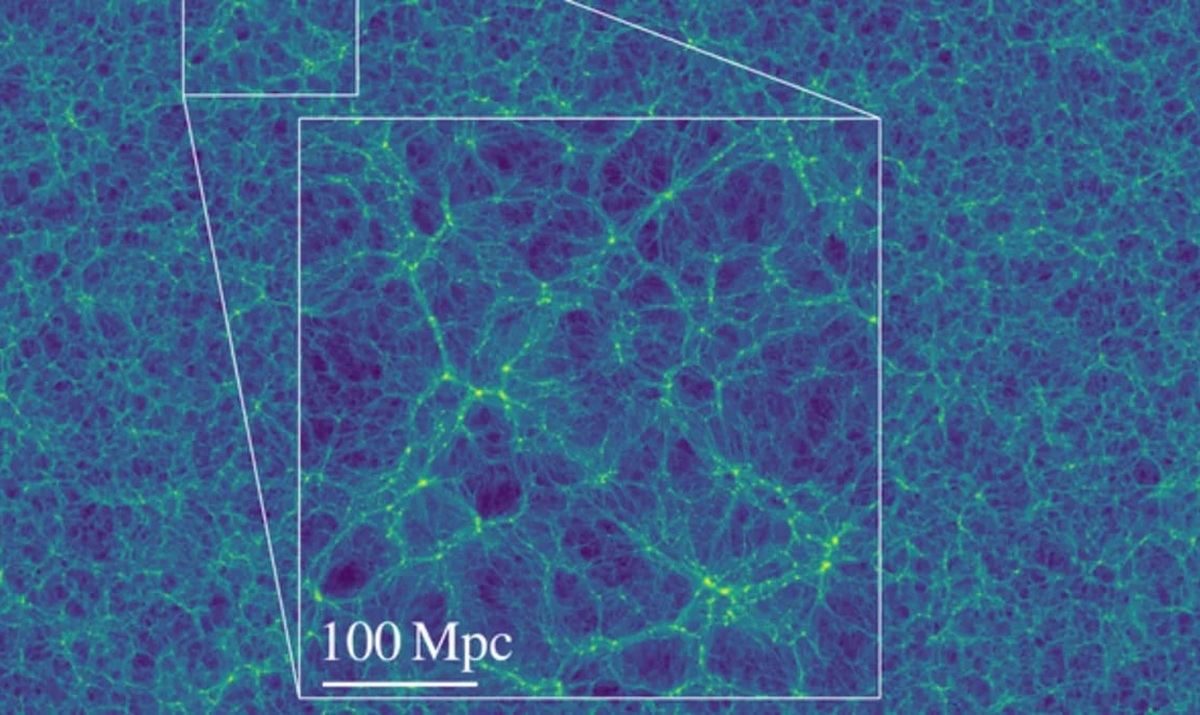
Astronomers have revealed one of the largest cosmological simulation datasets ever created, opening new opportunities to study how the universe has evolved over billions of years.
The dataset was developed through the FLAMINGO project, an acronym for Full-hydro Large-scale structure simulations with All-sky Mapping. Total data produced exceeds 2.5 petabytes, equivalent to around 500,000 HD movies. This scale reflects modern astronomy’s need to align increasingly precise sky observations with equally sophisticated theoretical models, according to the Netherlands Research School for Astronomy (NOVA).
New-generation telescopes and sky surveys now capture the universe in unprecedented detail. However, understanding this data requires simulations capable of reproducing both large-scale cosmic structures and the complex physics within galaxies. FLAMINGO was designed to bridge this gap.
‘This simulation allows us to track the growth of cosmic structures across vast regions of space while still modelling the complex physics of galaxy formation,’ said Joop Schaye, a study author from Leiden University in the Netherlands.
‘By publishing this data, we hope researchers worldwide can use FLAMINGO to test new ideas about how the universe works,’ he added.
FLAMINGO operates like a ‘virtual universe’ starting shortly after the Big Bang and evolving over time. The simulation tracks how small fluctuations in matter gradually grow into galaxies, galaxy clusters, and the vast cosmic web that shapes today’s universe.
What sets FLAMINGO apart from previous simulations is its ability to model dark matter, ordinary matter, and the effects of dark energy simultaneously within a consistent framework.
This approach allows scientists to study interactions between cosmic processes across various scales. The same simulation can depict gas turbulence forming stars within galaxies while mapping galaxy cluster distributions over billions of light-years. This helps researchers reproduce the observable universe with higher accuracy.
The dataset’s immense size also makes FLAMINGO effective for studying rare cosmic phenomena. Massive galaxy clusters, luminous quasars, and other rare cosmic objects are often difficult to capture in smaller simulations due to their rarity.
With FLAMINGO’s scale, the likelihood of finding such phenomena increases, enabling scientists to better understand the most extreme environments in the universe.
Beyond supporting new discoveries, the project aims to help astronomers interpret data from next-generation observatories. As sky surveys become more detailed, researchers need robust theoretical frameworks to compare with observational results.
Simulations like FLAMINGO allow scientists to test various models of dark matter, dark energy, and galaxy formation in greater depth.
The research team has also opened access to the dataset for public use, enabling global collaboration. This step is crucial as modern astronomy increasingly relies on global partnerships and shared computing resources.
‘Open access to such a large dataset can significantly accelerate scientific progress,’ said Matthieu Schaller, another study author from Leiden University.
‘We aim to provide resources that support diverse astrophysics research,’ he added.
Overall, FLAMINGO marks a major shift in how scientists study the cosmos. Researchers now not only rely on direct observations but can also conduct experiments within highly detailed ‘virtual universes’, challenging physical assumptions, testing predictions, and uncovering previously hidden patterns.
The FLAMINGO simulation data has been submitted to the journal Astronomy & Computing on 28 April 2026 and is also available via the arXiv preprint server.
Chinese scientists have created HyperMillennium, the world’s largest cosmological simulation with 4.2 trillion particles to unravel dark matter mysteries.
The HyperMillennium cosmological simulation is the largest in the world, aiding scientists in understanding the universe’s evolution, dark matter, and galaxy formation.