
Science and Digital Innovation in COMPASS 3.0: Realisation of Merdeka Curriculum-Based Technology
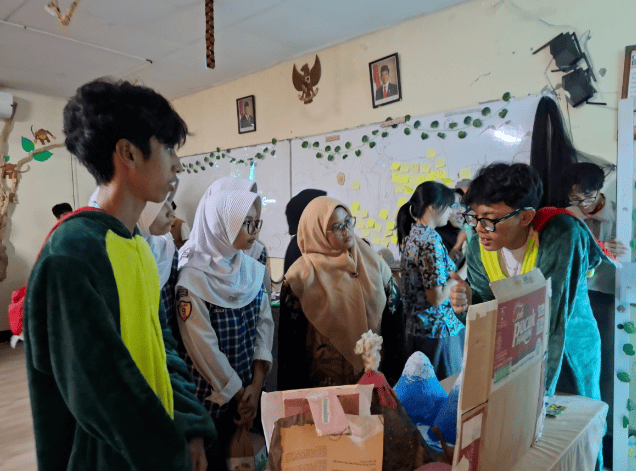
Covering topics from Ramadan to geopolitics, SMA Budi Luhur successfully organised the annual collaborative education fair titled COMPASS 3.0 (Collaboration of Meaningful Projects of Social, Science, and Art 3.0) on Thursday 12 February. The theme was “From Past to Fast”, and the event served as a platform for creativity for Year 10 students to integrate social studies, science, arts, and the STEM (Science, Technology, Engineering, Mathematics) approach in an applied manner.
As part of implementing the Merdeka Curriculum, COMPASS 3.0 emphasises Project-Based Learning. Unlike in previous years, visitors this time are invited to embark on a chronological journey, from the formation of the Earth to the acceleration of digital technology as a reflection of the continuity of history.
“This activity is not merely an exhibition of works, but a character laboratory for students. Through COMPASS 3.0, we want to demonstrate that deep understanding of science and mastery of future technology can go hand in hand through cross-disciplinary collaboration,” said the Head of SMA Budi Luhur, Drs. I Nyoman Jiwa, M.M in a written statement on Friday 6 March.
In the event, visitors are presented with several immersive zones that are educational, beginning with exploring the Earth formation process to the Neozoic Era through simulations of the Big Bang theory, plate tectonics, animal evolution, miniature climate change, the evolution of clothing and prehistoric artefacts, and palaeontological excavation simulations.
Thereafter, visitors are treated to the era of ancient civilisation through explorations of Mesopotamia, Greece, Egypt and Rome via miniatures such as a Greek Temple with an automatic door lever, a Colosseum and a Sphinx, as well as experiments in science applied to the writing of the Sumero-Akkadian Cuneiform script.
Visitors are also taken to the early modern era through zones depicting world wars and the industrial revolution via a Hiroshima diorama, miniature warships, aircraft, weaponry, and experiences of historic food sources as symbols of wartime logistics, combined with the development of mass biotechnology in food production during the industrial era, including products such as perfumes from aromatherapy candles and handmade soaps, as well as various recycling creations.
To broaden the educational impact, SMA Budi Luhur also invited representatives from five year-8 schools to participate in product demonstrations and educational games. Additionally, to ensure quality standards, SMA Budi Luhur collaborated with Universitas Budi Luhur, which supplied assessors from the Visual Communication Design (VCD/DKV) field to validate the accuracy of concepts and the aesthetics of students’ works.
Through COMPASS 3.0, SMA Budi Luhur reaffirms its commitment to delivering adaptive and relevant education. The project demonstrates that the Merdeka Curriculum can shape character and strengthen students’ literacy to meet the challenges of a fast-changing era. (P-4)