
SBM ITB Holds Organizational Streamlining Forum as Business Sustainability Strategy
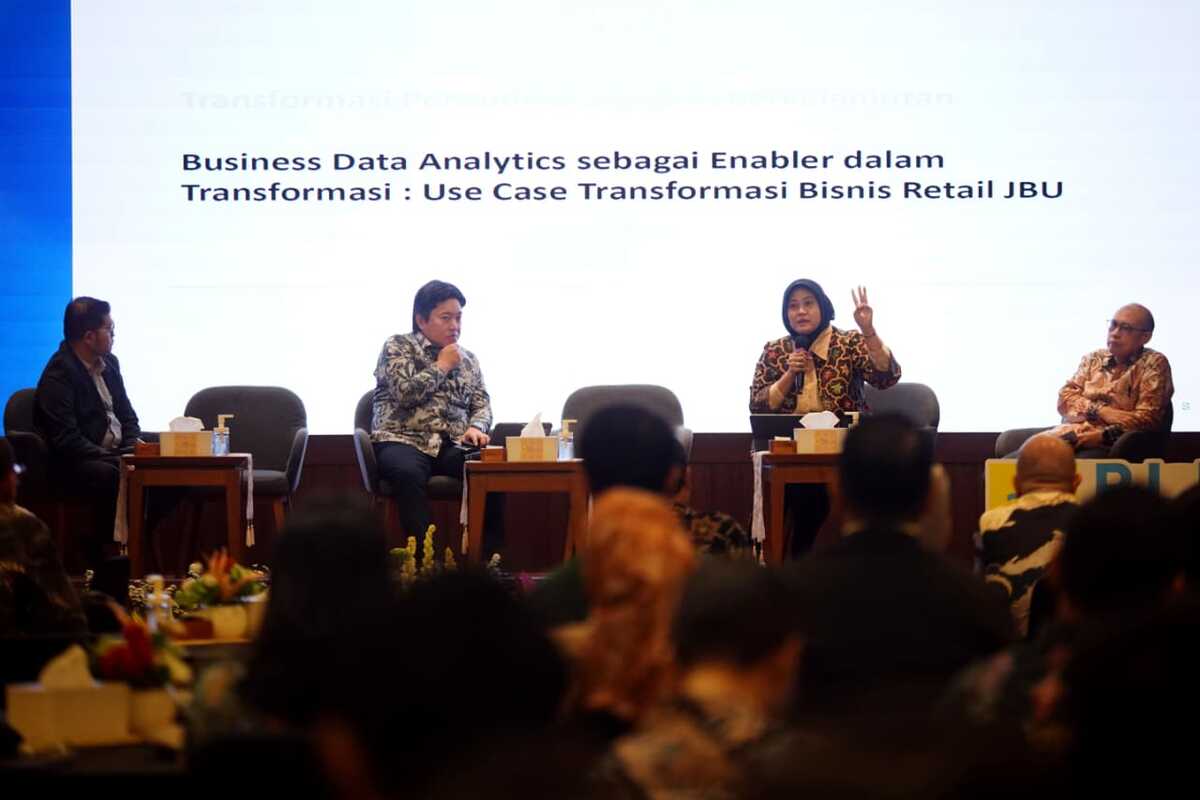
The School of Business and Management at the Bandung Institute of Technology (SBM ITB) held a discussion forum on organisational streamlining as part of the fifth edition of HCM Talks on Friday 27 February. The forum, themed “Navigating the Future of Human Capital: Business and Organisational Streamlining through Lean HR and People Analytics,” brought together practitioners and academics to discuss organisational restructuring strategies as a means of maintaining business sustainability.
The discussion featured Associate Partner at McKinsey & Company Martin Santoso; Chairman of the Nation Brand Team at the Ministry of Tourism and lecturer Priyanto Rudito; and Senior Vice President for Business Transformation and Optimisation at Pertamina (Persero), Mia Khrishna Anggaraini. Academic perspectives were provided by Utomo Sarjono Putro, Chair of the Strategic Decision Making and Negotiation expertise group at SBM ITB. The discussion was moderated by Achmad Fajar Hendarman from the People and Knowledge Management expertise group at SBM ITB.
In his presentation, Martin Santoso emphasised that organisational streamlining extends beyond the mere consolidation or separation of organisational units. According to him, such steps should be positioned as a strategic transition towards optimising company performance.
“Organisational streamlining should be an enabler that drives transition towards organisational optimisation for business sustainability, not merely structural change,” said Martin.
Priyanto Rudito added that organisational transformation should be conducted in stages through the concept of Getting Better, Broader, and Bolder. He explained that fundamental improvements to the business model should be the initial stage before the organisation expands and scales up operations.
“In the context of state-owned enterprises, transformation encompasses the management of organic and inorganic growth, which must be supported by operational excellence and real implications for human capital management,” said Priyanto.
From a corporate perspective, Mia Khrishna Anggaraini presented Pertamina’s experience of organisational transformation, including structural changes prior to 2018 and the formation of holding and sub-holding structures. According to her, the organisational streamlining process should begin by strengthening the foundation to enable the company to grow sustainably.
“Streamlining emphasises a strategic approach. The foundation must be improved first so that the organisation becomes stronger, then develops into something larger and broader. This is not merely a corporate action, but an effort to unite all stakeholders so they remain stable and adaptive,” she said.
Utomo Sarjono Putro viewed the discussion as opening opportunities for research agendas and collaboration between academics and state-owned enterprises. He emphasised that data-driven transformation and organisational restructuring face significant challenges amid global uncertainty.
“Academics have research capacity and methodology, whilst SOE practitioners have experience and real-world context. Collaboration between the two can produce impactful innovation,” said Utomo.
Meanwhile, Achmad Fajar Hendarman highlighted the importance of managing the human aspect during the transformation process. He identified changes in mindset as a key challenge that must be anticipated through mature resistance management.
“The challenge is not merely how to cut structure, but how to improve business processes. Transformation is not only structural in nature, but also concerns the mindset and perception of all stakeholders,” Achmad stated.
The forum concluded that organisational streamlining is a strategic process for optimising business processes and operational models, rather than mere structural efficiency. Through such an approach, companies are expected to be able to create long-term value and maintain business sustainability amid global competitive dynamics.