
Satisfaction Rate with Lebaran 2026 Homecoming Services Reaches 84.5 Percent
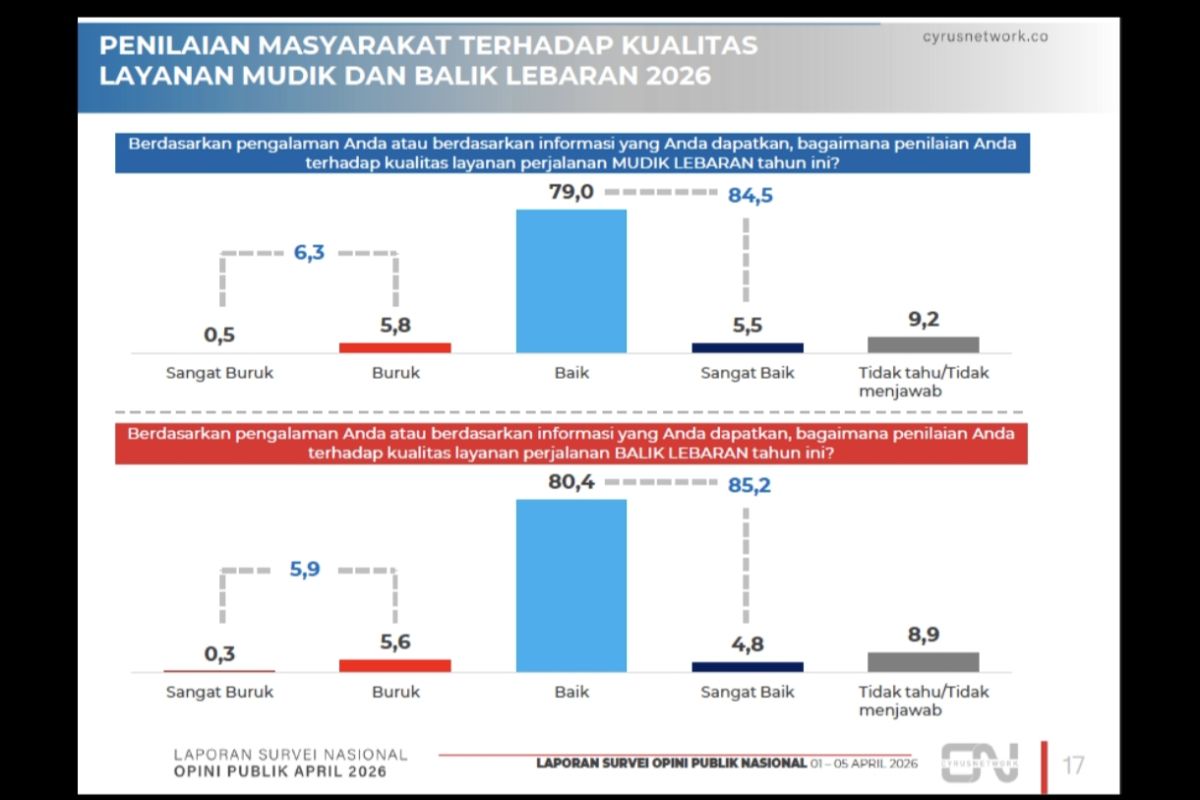
Jakarta (ANTARA) - Public satisfaction with the quality of Lebaran 2026 homecoming services is better than the previous year, reaching 84.5 percent, according to a national survey by Cyrus Network.
Lead Researcher of Cyrus Network, Syahril Ilhami, stated during an online presentation in Jakarta on Tuesday that 79 percent of respondents rated the homecoming services as good and 5.5 percent as very good, while 85.5 percent said the 2026 homecoming organisation was better than in 2025.
“Based on respondents’ experiences and information obtained, 79 percent of respondents rated the quality of 2026 homecoming services as good and 5.5 percent as very good. Positive ratings are also evident in the handling of return traffic, with 80.4 percent of respondents rating it as good and 4.8 percent as very good,” he said.
These positive ratings are also reflected in the satisfaction levels with the performance of agencies involved in organising the homecoming and return traffic.
The survey also noted that the movement patterns of homecomers are still dominated by travel within the same province.
“The majority of homecomers move within the same province, at 70.8 percent. This is divided into the same regency at 32.3 percent and between regencies at 38.5 percent, while cross-province travel accounts for 29.2 percent,” he said.
This situation correlates with the choice of transportation modes, which are still dominated by private vehicles, particularly motorcycles.
According to Ilhami, reasons for using motorcycles include faster travel, cost savings, and limited transport alternatives.
“The main reasons for using motorcycles include faster travel at 39.6 percent, more cost-effective at 19.1 percent, no other alternatives at 17.1 percent, more comfortable at 12.6 percent, and more relaxed at 11.6 percent,” he said.
The dominance of private vehicles also impacts the low utilisation of ticket and toll discount programmes. Only 8.7 percent of respondents utilised these programmes, while 84.3 percent did not feel the benefits.
The survey was conducted from 1 to 5 April 2026, involving 1,260 respondents from 126 villages or urban villages across 38 provinces, using multistage random sampling with a 95 percent confidence level and a margin of error of around 2.82 percent.