
SAI Cipedak Students Raise Palestinian Issue Through Educational Installation
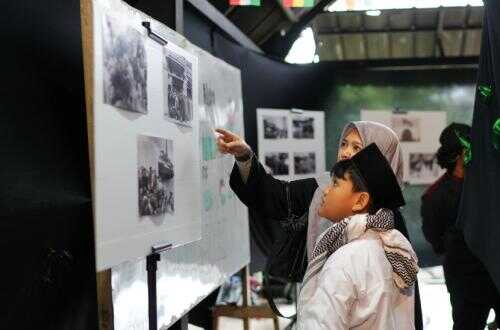
More than 1,000 people crowded Sekolah Alam Indonesia Cipedak at its Mampang Campus on Saturday, 28 February 2026. They traversed the “Timeline of Palestinian History” installation, which served as the culmination of cross-level project-based learning.
The event, titled “We Are (also) Palestinian: Timeline of Palestinian History,” showcased the results of student exploration conducted over several weeks. The school presented Palestinian history not merely as classroom material, but as a learning space concerning empathy and social justice.
Principal of Sekolah Alam Indonesia Cipedak Endah Mawarti stated that the activity was rooted in the humanistic values upheld by the school. “The school is grounded in humanistic values. Here, we aim to foster solidarity with the Palestinian people as part of learning about empathy and social justice,” Endah said in a press statement on Monday, 2 March 2026.
The school used Palestine as a learning context for historical literacy and social awareness in accordance with the developmental stages of students. Each level addressed the same theme with different approaches.
Upon entering the exhibition area, visitors walked through a visual installation arranged like a journey through time. Each corner presented different perspectives on Palestine, ranging from family spaces, dream homes, historical landscapes, to issues of identity and diplomacy.
At the early childhood and lower primary levels, the project was conveyed through stories of families, homes, and hopes. At higher levels, students traced history, conflict dynamics, and international diplomacy presented in the form of presentations and drama.
The series of works demonstrated a common thread: that learning extends beyond textbooks. Students positioned themselves not only as receivers of information, but also as conveyors of humanitarian messages.
The activity involved collaboration from the entire school community. Teachers guided the exploration process, whilst parents participated in providing materials, exhibition props, and technical support for implementation.