
Safeguarding Food Stability, Java Region's GPIPS Focuses on These 3 Key Aspects
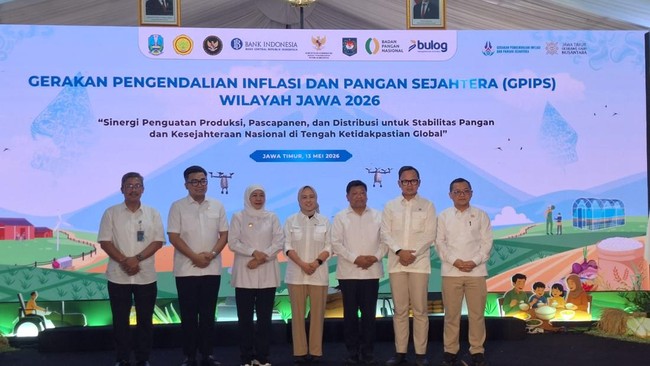
Sidoarjo, CNBC Indonesia - The government’s commitment to food security serves as the philosophical foundation for all policies, positioning food self-sufficiency as one of the pillars of national independence. This drives Bank Indonesia, TPIP, and TPID to initiate the Gerakan Pengendalian Inflasi dan Pangan Sejahtera (GPIPS).
Bank Indonesia Deputy Governor Aida S. Budiman stated that GPIPS represents an evolution from the Gerakan Nasional Pengendalian Inflasi Pangan (GNPIP), due to challenges in price stability and food security. Therefore, strengthening synergy and more integrated programmes from upstream to downstream are required.
“Through GPIPS, food inflation control is not only focused on short-term price stabilisation but also on strengthening production, post-harvest, and food distribution to support sustainable national food security,” Aida said during the launch of GPIPS for the Java region in East Java on Wednesday (13/5/2026).
There are three main aspects highlighted in GPIPS compared to previous programmes. First, strengthening programme alignment with government priorities, particularly in supporting increased production, strengthening distribution, and stabilising strategic food to support the Asta Cita agenda towards food self-sufficiency.
Second, strengthening more concrete and inclusive programme implementation through the involvement of farmer groups, business actors, MSMEs, and regional food SOEs, including enhancing the role of farmer institutions and regional food off-takers. Third, strengthening Inter-Regional Cooperation, including KAD schemes with B2B models, to enhance distribution efficiency and maintain supply balance across regions.
“Strengthening short-term interventions (such as affordable markets) is also carried out with the ‘three right’ principle, namely on time, on location, and on target, so that the effectiveness of food inflation control becomes more optimal,” she explained.
GPIPS 2026 focuses on two main aspects: strengthening productivity and smooth food distribution to maintain price stability and national food security. The three priority commodities focused on across all regions are rice, chillies, and shallots.
Meanwhile, additional commodities are adjusted to the characteristics of each region, from Sumatra, Java, Kalimantan, Sulampua, to Balinusra.