
Russian Oil Suddenly in High Demand: From Dead to Overflowing with Profits
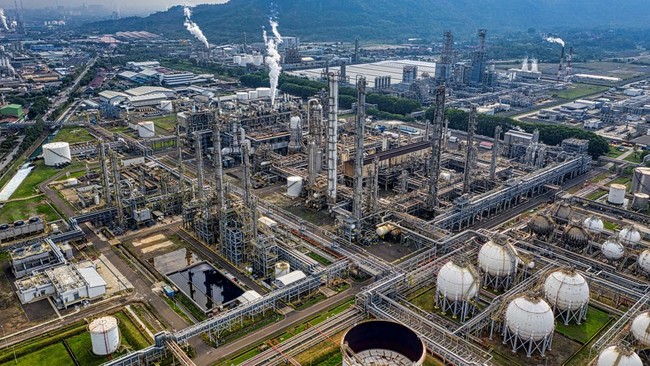
Russian oil has suddenly become highly sought after, transforming from a struggling commodity to a source of abundant profits. Jakarta, CNBC Indonesia - Russia remains one of the world’s oil giants and is benefiting from the Iran war. Production continues unabated, exports keep flowing, and tanker ships still sail from the Baltic to the Pacific.
Several Southeast Asian countries are now hunting for Russian oil amid the energy crisis caused by the US-Israel war against Iran, which has entered its eighth week.
Following the Philippines, Vietnam, and Malaysia, Indonesia is also approaching Russia to secure supplies.
India has already more than doubled its imports of Russian oil, while many European and Western countries that previously imposed sanctions are now joining the scramble for the Red Bear Nation’s oil.
This surge in interest is driven by the rise in global oil prices due to disruptions in the Strait of Hormuz, a route typically used for around 20% of the world’s oil shipments.
Has the Oil Crisis in Russia Passed?
The high demand for Russian oil cannot be separated from the lifting of trade sanctions on the country by US President Donald Trump. The removal of these sanctions has revived Russia’s energy sector, which faced severe pressure following sanctions over the Russia-Ukraine war.
The December 2025 edition of the Russian Oil Tracker report depicts the pressures that forced Russian oil to be sold at discounts to remain absorbed by the market.
At the same time, early 2026 opened with a spike in global prices due to escalating tensions in the Strait of Hormuz. This combination has put Russia in an attractive position: revenues were squeezed in 2025, but geopolitical turmoil offers opportunities for higher prices in 2026.
In Monday morning trading on 20 April 2026, global oil prices surged sharply after renewed disruptions in the Strait of Hormuz.
According to Refinitiv data, Brent rose to US$94.99 per barrel, jumping 5.10% from Friday’s close. WTI climbed to US$88.77, up 5.87%.
Reuters reported that markets reacted after the United States and Iran accused each other of violating the ceasefire, accompanied by disruptions to ships in the area. Hormuz is a strategic route where around one-fifth of the world’s oil supply typically passes. When this route is disrupted, a risk premium immediately enters the price.
For Russia, Such Global Price Surges Provide Additional Breathing Room
Throughout 2025, Moscow’s main problem was not volume alone, but selling prices.
In the report’s base scenario, Russia’s oil export revenues are estimated to fall to US$156 billion in 2025 from US$189 billion in 2024. For 2026, revenues are projected to drop further to US$106 billion if sanction pressures continue. Thus, every rise in Brent becomes a crucial factor, as it can improve national revenues even though discounts on Russian oil remain significant.
On the physical side, Russia is still exporting on a massive scale.
Citing CEIC, Russia’s crude oil exports stood at 4.524 million barrels per day in 2024, a slight decline from 4.586 million barrels per day in 2023. Before the pandemic, Russia had reached 5.241 million barrels per day in 2019, one of the highest levels in a decade. The pandemic pressured that figure to 4.617 million barrels per day in 2020, then partially recovered thereafter.
Russia has lost some markets but not its export capacity.
Looking further back, the decade-long trend shows the resilience of Russia’s energy structure. In 2013, crude exports were recorded at 4.689 million barrels per day, rising above 5 million barrels per day in 2016-2019, then falling after the pandemic and sanctions. In other words, the West has succeeded in changing Russia’s trade routes but has not fully shut off the export tap.
November 2025 data provides the clearest picture of that financial pressure. Russia’s monthly export revenues fell to US$11 billion, the lowest since the invasion began. The value of crude was US$7.1 billion, while refined products were US$3.9 billion. At the same time, seaborne exports dropped 7.2% monthly and 5.4% annually. When volumes weaken and selling prices are low, revenues are directly eroded.
Geographically, Russia’s main buyers are now concentrated in Asia. India is the largest destination with around 1.4 million barrels per day, or 40% of Russia’s seaborne crude exports in November 2025.
China is in second place with about 1.105 million barrels per day. Turkey is important as a buyer of refined products like diesel and fuel oil. Dependence on a few large buyers forces Russia to be more flexible on prices, payment terms, and logistics.
Shadow Fleet
It is this logistics issue that has given rise to the shadow fleet phenomenon. This term refers to the fleet of tankers used to transport Russian oil outside the Western shipping system.
These ships generally use shell companies, flag changes, complex ownership trails, non-Western insurance, and ship-to-ship transfers at sea to make the origin of cargoes difficult to trace. The shadow fleet grew after the G7 and European Union imposed embargoes and price caps on Russian oil. If Russia relied on Western ships and insurance, its exports could stall. Thus, an alternative network was built.
The report estimates that around 173 shadow fleet tankers were active in transporting Russian oil in November 2025. The breakdown is about 99 ships for crude oil and 74 for refined products.
Around 78% of that fleet is over 15 years old. For crude alone, the proportion of old ships reaches 79%, while for refined products it is 77%. This means many ships operate at technically mature ages, with high maintenance costs and greater accident risks.
Why is the shadow fleet important? Because without this fleet, Russia would struggle to move millions of barrels per day to India, China, and other markets.
However, there is a price to pay. Shipping costs are higher, transit times longer, sanction risks greater, and the potential for oil spills increases. Up to 19 December 2025, a total of 621 ships had entered the collective sanctions list of Western countries. Every ship hit by sanctions forces Russia to find new vessels, change routes, or offer additional discounts to buyers.
On the price side, Russia’s main grades…