
Russian Mercenaries Repelled, Putin Suffers Crushing Defeat Here
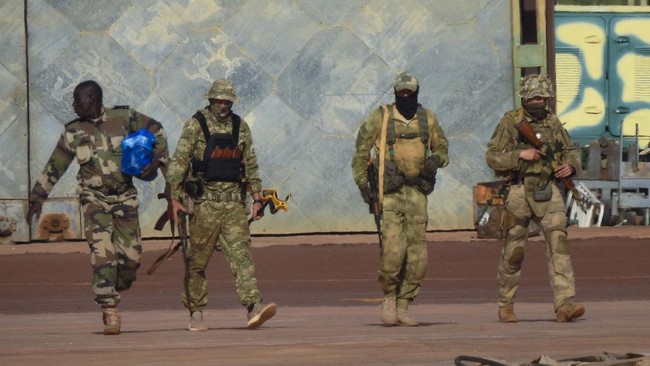
Russian mercenaries backed by the Kremlin have been repelled from the strategic city of Kidal in northern Mali. This defeat represents a severe blow to Russian President Vladimir Putin and reveals the beginning of cracks in Moscow’s influence in Africa’s Sahel region.
A CNN International report states that the Africa Corps, the successor to the Wagner Group now under Russia’s Ministry of Defence, was forced to abandon Kidal last month under intense pressure from Tuareg rebel groups and Al Qaeda-linked militants. Ironically, the Russian forces departed amid jeers from the rebels who had previously sought to destroy them.
This defeat is considered humiliating for the Kremlin. For several years, Russia has sought to position itself as the primary security partner for African countries following the decline of Western influence in the region.
Videos circulating on social media show a convoy of Russian vehicles being mocked by Tuareg fighters as they left their base in Kidal.
The major offensive began on 25 April when Tuareg separatist groups united under the Azawad Liberation Front (FLA) allied with Al Qaeda-linked militants. This combined attack is described as one of the boldest in more than a decade in Mali.
The alliance succeeded in capturing several military bases in northern Mali and forced the Russian Africa Corps to negotiate for a safe passage out of Kidal. Kidal had previously been seized by Malian forces alongside Russian mercenaries in 2023.
That victory was once seen as a symbol of Moscow’s success in displacing Western dominance in the Sahel. The Sahel is a vast region below the Sahara Desert encompassing countries such as Mali, Burkina Faso, Niger, Chad, and Sudan, now known as one of the world’s deadliest centres of terrorism.
Mali’s crisis has worsened following the death of Mali’s Defence Minister, Sadio Camara, in a suicide bomb attack near the capital Bamako. Camara was a key figure in the Malian junta regime’s close ties with Russia.
The Al Qaeda-affiliated group Jama’at Nusrat al-Islam wal-Muslimin (JNIM) claimed responsibility for the attack. This situation has cast doubt on Russia’s promises to stabilise Mali.
Senior analyst from the Armed Conflict Location & Event Data Project (ACLED), Héni Nsaibia, also assessed that Russia’s security strategy has failed to resolve the root causes in the Sahel. “Russia’s military support is quick, but it does little to address the main drivers of militancy such as weak governance, corruption, socio-economic marginalisation, ethnic tensions, and low state legitimacy,” said Nsaibia.
Russia has expanded its influence in Africa through a security cooperation model in exchange for access to natural resources. This approach was bolstered by the Wagner Group, which was active in Libya, Mozambique, and the Central African Republic.
However, the transition from Wagner to the Africa Corps has not stemmed the rising insecurity in Mali, Burkina Faso, and Niger. Amid this situation, Mali, along with Burkina Faso and Niger, is now seeking new alternatives by expanding defence cooperation with countries such as China and Turkey.