
Russian Investor and John Lundin Dispute in Banyuwangi Expands, Money Laundering Allegations Emerge
The dispute between Russian investor Alexander Iakovlev in Banyuwangi, East Java, and John Ivar Allan Lundin (John Lundin) continues to unfold. What began as an alleged breach of contract in a ship purchase has now evolved into a more complex matter, including accusations of money laundering practices.
Information gathered by TIMES Indonesia indicates that the case is also proceeding in courts in Jakarta. Initially, the dispute revolved around a ship that was not delivered to Russia and an alleged debt of approximately Rp20 billion. However, recent developments suggest this is no longer a mere commercial disagreement.
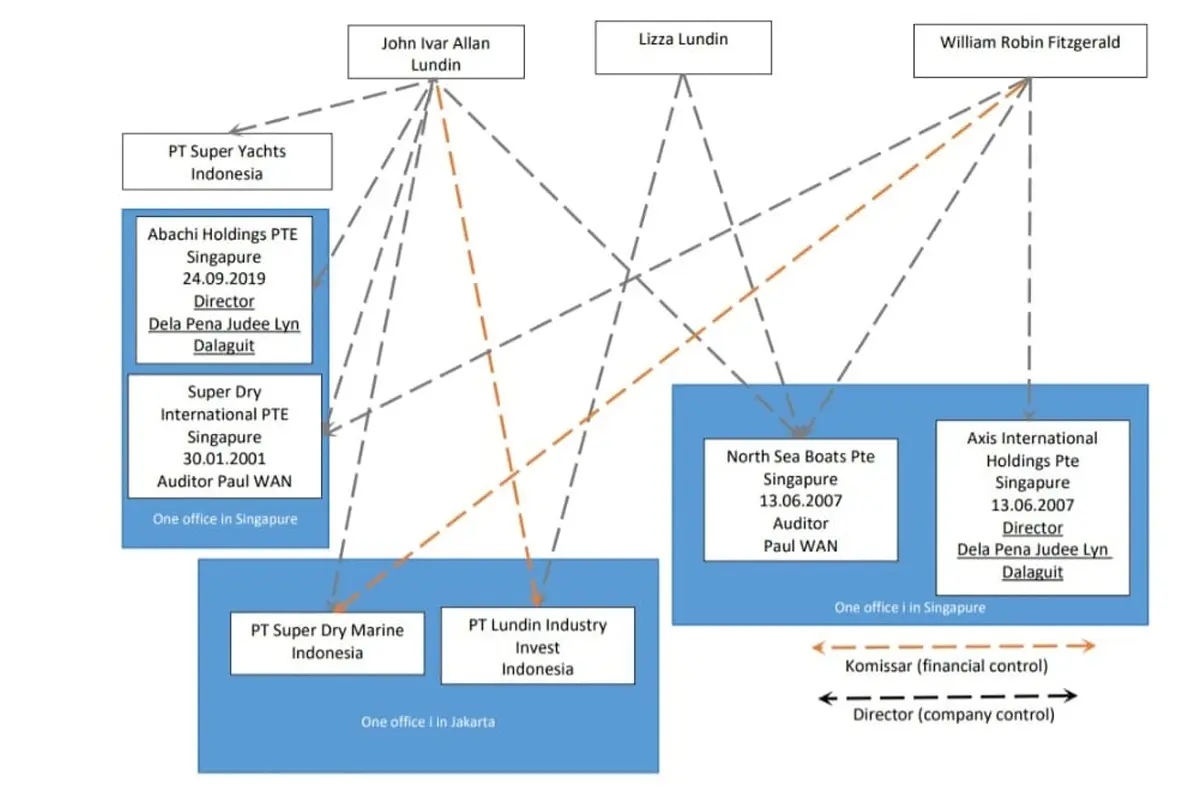
Court files and corporate records point to a broader network of companies. PT Lundin Industry Invest is linked to several other entities, such as PT Super Dry Marine Indonesia, Super Dry International Pte Ltd, North Sea Boats Pte Ltd, Abachi Holdings Pte Ltd, and Axis International Holdings Pte Ltd.
Several sources note that these entities show signs of interconnection, from shared office addresses in Singapore and Jakarta to recurring names in company management structures. These findings raise suspicions of a corporate structure interconnected across jurisdictions.
From the Russian investor’s perspective, this controversy is not simply about a failed ship delivery. They question who truly controls the business, where the funds are flowing, and where the ultimate profits end up.
With these indications, the controversy between the Russian investor and John Lundin is predicted to extend beyond the undelivered ship. It veers towards questions of who really controls the business, where the money flows, where the final profits land, and why Indonesia appears to bear the operational and legal exposure while Singapore is closer to the centre of gravity.
A corporate structure diagram emerging in connection with this case makes the picture harder to ignore. The diagram shows a wider Lundin–SuperDry orbit, marked by shared directorships, overlapping ownership positions, and what appears to be a single business contour wrapped in various legal entities across jurisdictions.
The circulating corporate structure diagram also illustrates a vast business network. It reveals interconnections in directorships, overlapping ownership, and indications of a single business ecosystem spread across various legal entities in multiple countries.
This situation raises several fundamental questions: why is Indonesia the operational base while some entities are located abroad? Where are taxes actually paid? Who is the true beneficial owner? And does this structure potentially open loopholes for tax avoidance or even obscuring fund flows?
The Russian investor side suspects the possibility of an international scheme leading to tax avoidance and money laundering practices. They believe patterns like this often start from simple issues before escalating into larger problems, through high-level investigations or special operations. Sometimes it all begins from something far more ordinary.
First, the ships do not arrive. Then the money gets stuck. Then, as the dispute is revealed in open court, parent companies surface, shared offices are identified, foreign interests become visible, responsibilities blur, and money seems to disappear between jurisdictions.
From there, the Russian investor side detects suspicions of an international scheme for tax avoidance and possible money laundering.
However, these accusations are denied by John Lundin’s side. Through his legal representative, Reza Auliansyah, they assert that there is no money laundering practice as alleged.
“Regarding the money laundering allegations, please prove it through legal channels. Do not make statements that amount to slander and defame, as that also has legal consequences,” said Reza on Friday (3/4/2026).
Regarding the companies mentioned in the network—PT Super Dry Marine Indonesia, Super Dry International Pte Ltd, North Sea Boats Pte Ltd, Abachi Holdings Pte Ltd, and Axis International Holdings Pte Ltd—Reza said he could not yet provide further details.
“We cannot give an official comment on that because there has been no explanation from the client,” he said.
To date, the case is still ongoing. What was initially viewed as a bilateral business issue is slowly developing into one touching on cross-border legal aspects, corporate transparency, and suspicions of global financial governance.