
Russia Supplies Satellite Imagery to Iran to Attack the US, Here's Why
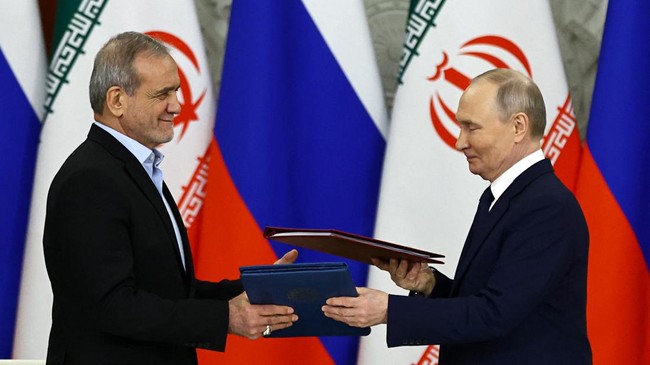
Russia has expanded intelligence sharing and military cooperation with Iran, providing satellite imagery and more advanced drone technology to help Tehran target US forces in the region, according to sources familiar with the matter.
Citing a report from The Wall Street Journal, Russia is seeking to maintain its closest partner in the Middle East in the war against US and Israeli military forces and to prolong a conflict that benefits Russia militarily and economically.
The technology provided includes modified components for Shahed drones, intended to improve communication, navigation, and targeting, the sources said. Russia has also drawn on its experience using drones in Ukraine, offering tactical guidance on how many drones to use in operations and at what altitudes they should strike, the sources said, including a senior European intelligence officer.
Russia has given Iran the locations of US military forces in the Middle East as well as those of its regional allies. The cooperation has deepened since the start of the war, with Russia recently providing direct satellite imagery to Iran, said two sources, the officer and a Middle East diplomat.
The assistance is similar to the intelligence information provided by the US and European allies to Ukraine in recent years, analysts said. In the Gulf, Moscow’s aid is believed to have helped Iran in recent attacks on US radar systems in the region. Those attacks included early-warning radars for the Terminal High Altitude Area Defense (THAAD) system in Jordan, as well as other targets in Bahrain, Kuwait, and Oman.
Satellite imagery can provide more detailed information on the movements of ground and sea targets, to aid targeting before strikes as well as damage assessments after strikes.
“If there is detail in the imagery provided by Russia, for example, about specific types of aircraft, ammunition locations, air defence assets, and naval movements, which has intelligence value for Iran, it would be very helpful to them,” said Jim Lamson, a visiting researcher at King’s College London and former CIA analyst specialising in the Iranian military.
The data provided by Russia comes from a fleet of satellites that provide intelligence for military operations, said an official. That fleet is operated by the Russian Air Force, better known by its Russian acronym, VKS.
Iran has been more successful in targeting US military assets and Gulf states in this war than they were during the 12-day war last year. The country’s attacks—using drones to overwhelm radars before missile strikes—appear very similar to Russian tactics in Ukraine, analysts said.
“Iran’s targeting in the Gulf is more focused on radars and command and control,” said Nicole Grajewski, a professor at Sciences Po, a research university in Paris. “Iran’s attack packages are very similar to what Russia is doing.”
US special envoy Steve Witkoff, who has led US negotiations with Moscow, said Russia denies providing intelligence to Iran to aid their attacks. President Trump said he believes Moscow may have helped Iran a little.
“No assistance provided to Iran by any other country has affected our operational success,” said White House spokesperson Olivia Wales. “The United States military has struck over 7,000 targets and destroyed more than 100 Iranian naval vessels, which has caused their missile attacks to drop by 90% and their drone attacks to drop by 95%.”
Russia and Iran do not have a formal military alliance, but Tehran is Moscow’s closest partner in the Middle East. Russia is one of Iran’s main military suppliers. The relationship has had its ups and downs since the collapse of the Soviet Union, but has grown closer since Russia launched its invasion of Ukraine.
The two countries have formed commissions and working groups to share military and defence knowledge. Military delegations regularly visit each other while their troops train together. Russia has even built and launched one of Iran’s newest satellite systems.
Most importantly, Iran supplies Moscow with Shahed drones for the war against Ukraine.
When Russia began using Shahed drones on the battlefield, a delegation of several dozen Iranian officers gathered in Crimea to watch footage of their impact on Ukrainian cities and front-line positions. Ukraine says Russia has used more than 57,000 Shahed-type drones since the start of the war.
Since then, Moscow has begun producing them domestically, and has adapted them to navigate and target more accurately and to withstand electronic warfare jamming. Now, some of those innovations are being shared back with Iran.
The assistance Russia can provide to Iran is limited not only by the ongoing conflict in Ukraine, but also by the Kremlin’s reluctance to anger Trump.
Although Moscow could do more to increase its aid, the assistance currently provided plays an important, albeit limited, role in helping Iran’s war efforts, Lamson said.
“The category of assistance—including satellite data and advice on drone tactics—provided by Russia is limited but still valuable for Iran’s war and ability to strike specific military sites,” he said.
This war has benefited Russia in several ways, reducing the supply of US interceptors needed by Ukraine for its air defence. The closure of the Strait of Hormuz, through which one-fifth of the world’s oil and liquefied natural gas transits, has increased oil prices, the lifeblood of Russia’s economy. The Trump administration has eased restrictions on purchasing Russian oil to lower prices.
This war has also had negative impacts