
Rupiah Weakens Ahead of Weekend, US Dollar Rises to Rp 16,960
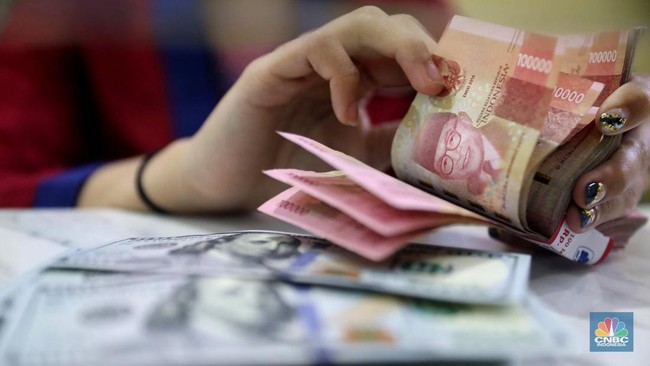
Jakarta, CNBC Indonesia — The rupiah exchange rate closed weaker against the US dollar on the final trading day of the week, Friday (27/3/2026). This occurred alongside the strengthening of the US dollar in the global market.
According to Refinitiv data, the Garuda currency closed in the red zone with a 0.38% weakening to the level of Rp16,960/US.Thismovementreversedthepreviousday′stradingonThursday(26/3/2026), whentherupiahmanagedtoclosewithaslight0.06.
Pressure on the rupiah had actually been evident since the start of trading. In the morning, the rupiah opened 0.09% weaker at Rp16,910/US$.
Meanwhile, the US dollar index (DXY), which measures the strength of the US dollar against six major world currencies, was observed to strengthen slightly by 0.07% to 99.971.
The rupiah’s weakening ahead of the weekend was influenced by several sentiments, particularly from external factors.
From the global market, the US dollar strengthened again after hopes of easing conflict in the Middle East began to fade. Market participants assessed that the chances of a peace agreement between the US and Iran remain small, thus increasing concerns about a longer war. This situation led to renewed demand for the US dollar as a safe-haven asset.
Market concerns were also heightened because the Strait of Hormuz remains at risk of disruption. If this route remains obstructed, global energy supplies could face further pressure and trigger a surge in oil prices. This risk ultimately increases concerns about global inflation and supports the strengthening of the US dollar.
Domestically, Bank Indonesia (BI) recorded that economic liquidity or broad money supply (M2) in February 2026 continued to grow positively, albeit at a slower pace. The M2 position was recorded at Rp10,089.9 trillion, or 8.7% year-on-year growth, after 10.0% growth in January 2026.
“This development was driven by growth in narrow money supply (M1) of 14.4% (yoy) and quasi-money of 3.1% (yoy),” said Ramdan on Friday (27/3/2026).
According to Denny, the M2 development in February 2026 was mainly influenced by net claims on the Central Government (Pempus) and credit disbursements. Net claims on Pempus grew by 25.6% (yoy), an increase from January 2026 growth of 22.6% (yoy).
Credit disbursements in February 2026 grew by 8.9% (yoy), continuing the growth from January 2026 of 10.2% (yoy).