
Rupiah Edges Slightly Stronger, US Dollar Exchange Rate Now at Rp18,010
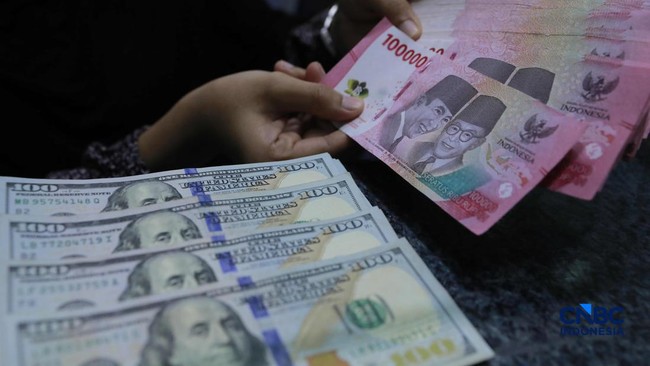
The rupiah exchange rate managed to slightly strengthen against the US dollar at the close of trading on Friday (5/6/2026), after moving volatilely within the Rp18,000/US$ area throughout the day.
According to Refinitiv data, the rupiah closed up 0.06% at the level of Rp18,010/US.ThisstrengtheningprovidedasmallrespiteforthenationalcurrencyaftertheprevioustradingsessiononThursday(4/6/2026), wheretherupiahclosed0.45—its weakest level in history against the US dollar.
Despite the closing gain, the rupiah’s movement throughout today’s trading remained under pressure. The currency initially opened 0.17% weaker at Rp18,050/US, beforefluctuatingwithintheRp18, 000 − Rp18, 050/US range all day. Meanwhile, the US Dollar Index (DXY), which measures the greenback’s strength against six major world currencies, remained stable at 99.258 as of 15:00 WIB.
The government has recently released the state budget (APBN) realisation up to the end of May 2026. Finance Minister Purbaya Yudhi Sadewa stated that the budget deficit reached Rp180.4 trillion, or 0.70% of GDP. This figure is a slight increase from the end of April 2026, which stood at Rp164.4 trillion or 0.64% of GDP. Nevertheless, Purbaya assessed that the deficit remains safe and in line with the 2026 budget design.
“If we calculate it using external methods, it would be approximately 1.8% of GDP. From that perspective, our state budget is very secure,” said Purbaya during the APBN KiTA press conference on Friday (5/6/2026). In addition to the controlled deficit, the primary balance recorded a surplus of Rp58.6 trillion, indicating that the state budget still has room to maintain fiscal sustainability amidst financial market pressures.
Separately, Bank Indonesia (BI) has emphasised that it possesses several instruments to maintain exchange rate stability. At least seven steps have been prepared by the central bank to mitigate pressure on the rupiah.
First, BI will strengthen interventions in the foreign exchange market, both domestically and abroad. These interventions will be conducted through spot transactions and Domestic Non-Deliverable Forwards (DNDF) in the domestic market, as well as Non-Deliverable Forwards (NDF) in international markets, including continuous, around-the-clock operations in global financial centres.
Second, BI will optimise the Bank Indonesia Rupiah Securities (SRBI) instrument to ensure that rupiah-based assets remain attractive to investors. The influx of capital is expected to help strengthen the stability of the rupiah exchange rate and support the adequacy of foreign exchange supply within the country.
Third, BI will also purchase Government Securities (SBN) in the secondary market. This step is part of the fiscal and monetary synergy to maintain adequate liquidity in the money and banking markets.
Fourth, BI will maintain adequate liquidity in the banking and money markets by keeping the growth of primary money (M0) above 10%, in line with monetary expansion.
Fifth, BI is strengthening foreign exchange market transaction policies by lowering the threshold for cash purchases of foreign exchange against the rupiah without underlying documentation to US$25,000 per participant per month, effective June 2026. BI is also expanding yuan and rupiah transactions domestically as part of Local Currency Transactions (LCT).
Sixth, BI will strengthen interventions in the offshore NDF market. This will be achieved by expanding the participation of banks in offshore NDF transactions for selling foreign exchange against the rupiah in international markets for qualified PUVA Main Dealers.
Seventh, BI will strengthen supervision of banks and corporations with high US dollar purchasing activities. This supervision will be conducted through close coordination with the Financial Services Authority (OJK).