
Rupiah Could Strengthen If BI Takes This Step
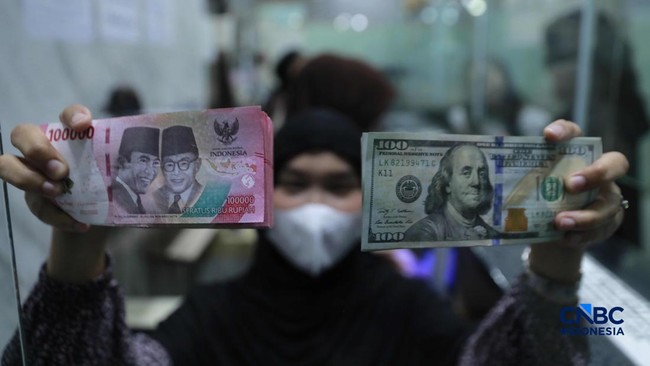
Jakarta, CNBC Indonesia - The Federal Reserve’s decision to hold interest rates steady reaffirms that global uncertainty remains the primary reality facing all countries, including Indonesia.
Fed Chair Jerome Powell indicated a more cautious approach—not rushing to cut rates, yet not fully aggressive—signalling that inflationary pressures and global risks have not fully subsided. This situation could impact Indonesia.
Head of Economics at Trimegah Sekuritas Indonesia, Fakhrul Fulvian, assesses that if global policies shift to being less forward-looking and more reactive to actual inflation and risks, volatility will become ‘the new normal’. This means countries like Indonesia must be far more agile and firm in maintaining stability.
In the domestic context, Fakhrul emphasises that the rupiah is currently in an overshooting phase, where exchange rate pressures move beyond short- and medium-term fundamentals and are in the process of finding a new equilibrium point.
“The rupiah is currently in an overshooting phase—seeking its new stability amid global pressures. In such a phase, the market needs clear signals that authorities are ready to maintain stability. Once Bank Indonesia (BI) shows readiness to implement monetary tightening, get ready for the rupiah to strengthen again,” said Fakhrul, quoted on Monday (4/5/2026).
Therefore, he believes BI needs to start showing a stronger tightening bias as part of efforts to maintain credibility and dampen external pressures.
“A hawkish response from Bank Indonesia is important, not just to hold exchange rate pressures, but also to manage market expectations. This is not about chasing the Fed, but about maintaining trust in domestic stability,” he stated.
On the fiscal side, Fakhrul highlights the importance of certainty in the direction of the state budget (APBN), including adjustments to priority programmes like Free Nutritious Meals (MBG). He views the government’s ongoing rationalisation and calibration of spending as a positive signal for the market.
“Budget adjustments, including in the MBG programme, show that the government is responsive to fiscal dynamics and not trapped in rigidity. This is crucial for maintaining APBN credibility amid rising global pressures,” he said.
Furthermore, he stresses that the market currently needs clarity on fiscal targets and financing strategies, especially in the context of potential pressures from energy prices and domestic spending needs.
“Certainty on APBN targets is key. The market must see that the government has room and flexibility to make adjustments without sacrificing fiscal discipline. This will be the main anchor for investor confidence,” explained Fakhrul.
Fakhrul also added that various ongoing reforms, both in the fiscal sector and financial markets, are beginning to show positive impacts, although not yet fully reflected in short-term market stability.
“Reforms already implemented—from market transparency, fiscal management, to policy coordination—must continue to be communicated consistently and measurably; don’t let the market and public be left in the dark. This is important so that the market understands that Indonesia’s economic foundations remain strong amid global volatility,” he asserted.
According to him, the synergy between BI and the Ministry of Finance is now entering a more decisive phase, where policies must not only be right but also appear credible and ready for execution.
Head of Economics at PT Bank Mandiri Tbk, Andry Asmoro, revealed that the April FOMC meeting firmly rejected monetary policy easing in the near term.
He believes the combination of inflation driven by oil prices, tariff effects, and a divided Fed voice will keep policy rates in the 3.50%-3.75% range until 2027, with risk distribution tilted towards aggressive surprises.
“Specifically for emerging markets and Indonesia, this implies sustained pressure on US dollar funding costs, a stronger DXY bias, and limited room for BI to pursue aggressive easing without endangering rupiah stability,” said Andry in his report, quoted on Monday (4/5/2026).
So far, Andry sees an aggressive tone in the Fed’s statements, combined with rejection of monetary policy easing tendencies, indicating that the US central bank is in a “wait and see” mode.
With inflation still high and new supply shocks driven by the energy sector added on top of unresolved tariff hike impacts, the threshold for continuing rate cuts has clearly risen. However, Andry assesses that Fed rate cuts depend on clear de-escalation of tensions in the Middle East and tangible progress on core inflation towards 2%.