
Rupiah Closes Strongly, US Dollar at Rp17,330
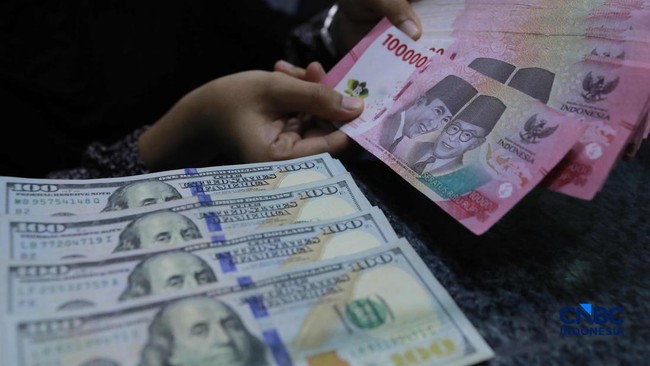
Jakarta, CNBC Indonesia — The rupiah exchange rate closed stronger against the US dollar on Thursday’s trading (7/5/2026).
According to Refinitiv data, the Garuda’s currency managed to end the day’s trading in the green zone with an appreciation of 0.29% to the level of Rp17,330/US$.
Throughout the day’s trading, the rupiah had actually been strengthening since the opening. The rupiah opened with an appreciation of around 0.46% to the level of Rp17,300/US$. However, this strengthening slightly diminished by the end of trading.
On the other hand, the US dollar index or DXY, which measures the strength of the greenback against six major world currencies, was observed to correct by around 0.12% to the level of 97.901 as of 3:00 PM WIB.
The rupiah’s strengthening throughout the day’s trading occurred amid the weakening of the US dollar in the global market. Pressure on the greenback emerged in line with improving global risk sentiment after the market responded positively to the prospects of a peace agreement in the Middle East.
Hopes for the easing of the conflict have made investors more daring to enter risk assets again. This condition reduces demand for the US dollar as a safe haven asset, thus causing the dollar index to weaken as well.
Market participants welcomed the prospects of a peace agreement in the Middle East, although the fate of the Strait of Hormuz remains not entirely clear. Iran is reportedly reviewing a peace proposal that could end the war, although several major US demands have not yet been resolved.
From the domestic side, sentiment also came from statements by Deputy Finance Minister Juda Agung regarding the possibility of activating the bond stabilization fund or BSF.
The BSF is a special fund prepared by the government to purchase Government Securities (SBN) that are sold by investors in the secondary market when the bond market experiences pressure.
According to Juda, the BSF is part of the Bond Stabilization Framework of the Financial System Stability Committee (KSSK). However, the activation of the BSF version of the Ministry of Finance does not have to wait for a crisis condition. This scheme can be used when the market is at a cautious level.
“No, it’s not a crisis. There are levels, normal level, cautious, alert, crisis. Well, at the cautious level we can activate it,” said Juda when met at Bappenas on Thursday (7/5/2026).
The source of the BSF funds comes from the government’s fiscal reserves, including the Budget Surplus Balance (SAL) and other fiscal reserve funds that can be used when market conditions are under pressure.
“No, the government has SAL, there are funds that are indeed for fiscal reserves and so on. That can be used in pressured conditions,” he explained.
Nevertheless, Juda emphasised that the current market condition is still normal because the market mechanism is still running well. Therefore, the BSF has not been activated in the near future. He also stated that the implementation of the BSF is the authority of the Ministry of Finance.