
Rupiah at Rp17,000/USD: Causes and Analysis of the Rupiah's Decline
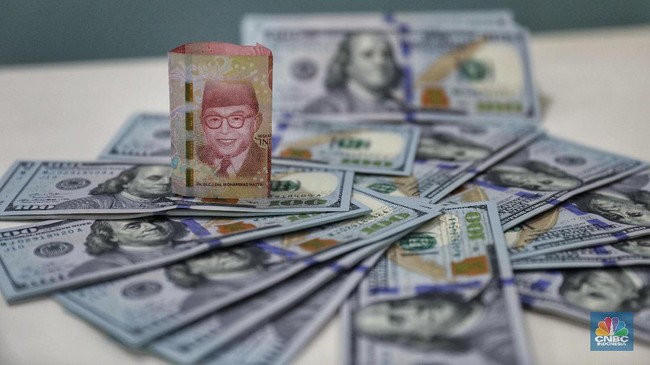
Jakarta, CNBC Indonesia - The rupiah exchange rate has once again come under pressure against the US dollar, breaching the psychological level of Rp17,000/USD during trading on Wednesday (1/4/2026).
According to Refinitiv data, at 11.40 WIB, the rupiah was at Rp17,020/USD, weakening by 0.18%. This level also marks the weakest position for the rupiah in history on an intraday basis.
This weakening is not a new phenomenon. Since the beginning of 2025 until early 2026, the Garuda currency has indeed been in a weakening trend against the US dollar. Even throughout 2026 up to now, the rupiah has depreciated by 2.10%, continuing the weakening in 2025 which recorded 3.6% for the full year against the US dollar.
Thus, the pressure occurring today is not merely a temporary weakening, but part of a trend that has been ongoing for quite some time.
Therefore, it is important to examine the main factors driving the continued pressure on the rupiah, both those triggering the weakening to breach Rp17,000/USD today and those sustaining the depreciation trend since the beginning of the year.
- External factor: US-Israel war against Iran
One of the main causes of the recent rupiah weakening is indeed inseparable from external factors, particularly the war in the Middle East between the US-Israel and Iran.
This conflict has triggered a surge in global energy prices, raising concerns about global inflation, which in turn has led investors to once again seek the US dollar as a safe-haven asset.
This pressure is also felt in Asia, including Indonesia, as the region is highly sensitive to rising oil prices and energy supply disruptions.
US President Donald Trump has actually just stated that the war with Iran could end in two to three weeks. That statement came on Tuesday (31/3/2026), which managed to press oil prices down and brought the US dollar index (DXY) back below the 100 level.
However, the market has not truly calmed. The reason is that oil prices remain at high levels, while the US dollar remains strong in trend because it is still sought as a safe haven since the war broke out. In other words, the daily correction in the dollar is not sufficient to change the overall global sentiment direction.
In such conditions, foreign investor interest in entering the Indonesian financial markets has also decreased.
Capital flows tend to exit risk assets and shift to the US dollar. This is what keeps the rupiah under pressure, even when the DXY temporarily weakens.
- Concerns over increased state budget burden due to held fuel prices
The second factor pressuring the rupiah is investor concerns about Indonesia’s fiscal condition after the government decided to hold fuel prices, both subsidised and non-subsidised.
For the public, this policy is certainly positive as it holds back cost pressures.
However, from an investor’s perspective, the decision also raises new questions. If global oil prices remain high, the government’s compensation and energy subsidy burden could potentially grow larger.
The government has indeed decided that Pertamina will not raise fuel prices starting 1 April 2026.
However, that policy comes amid the ongoing Middle East conflict that continues to lift global energy prices. This is where the market’s concern lies. When fuel prices are held, the state budget could potentially bear a larger price differential.
If oil prices remain high for a long time, the market will start calculating the risk of subsidy swelling for energy price hike compensation, which could ultimately lead to a widening of the state budget deficit.
Some analysts even estimate that the oil price surge could push Indonesia’s fiscal deficit to 3.6% of GDP if there are no policy adjustments, while the government itself is trying to keep the deficit below the legal limit of 3%.
This view also aligns with the statement from BCA Chief Economist David Sumual.
“So it’s still about negative external sentiment like rising oil prices and concerns about its impact on the state budget. There is quite strong selling pressure from foreigners in the SUN market,” David Sumual told CNBC Indonesia on Wednesday (1/4/2026).
In other words, a decision that appears good for consumers could be read by investors as adding fiscal risk, especially when budget space is being tested by energy price volatility.
- Downgrade of Indonesia’s outlook by rating agencies
Do not forget, the rupiah weakening trend has actually been running since 2025 and continues into early 2026.
One factor that worsens sentiment is the downgrade of Indonesia’s outlook by global rating agencies.
Moody’s on 5 February 2026 officially revised Indonesia’s outlook from stable to negative, while maintaining the Baa2 rating. One of these global rating agencies highlighted reduced policy predictability, risks to policy effectiveness, and concerns about governance.
After that decision, the Indonesian market came under pressure again, with the rupiah weakening and risk premiums increasing.
The pressure intensified when Fitch Ratings on 4 March 2026 also cut Indonesia’s outlook from stable to negative while maintaining the BBB rating.
Fitch assessed there is increased policy uncertainty and risks of weakening fiscal and monetary discipline, especially amid high growth targets, weak state revenues, and large welfare spending like the free nutritious meal programme worth around US$20 billion.
These concerns become more sensitive because the market is also monitoring Indonesia’s increasingly narrow fiscal space. Besides the potential deficit widening, investors also highlight the government’s increasingly heavy interest debt burden.
In this context, S&P Global’s comments on Indonesia’s interest debt payments approaching or exceeding the important threshold of 15% of state revenues further strengthen market concerns that Indonesia’s fiscal buffers are no longer as thick as before.
When fiscal risks are deemed to be growing, foreign investors tend to