
Rp18 Billion Nagekeo Presidential Instruction Road Project Handed Over in Damaged Condition
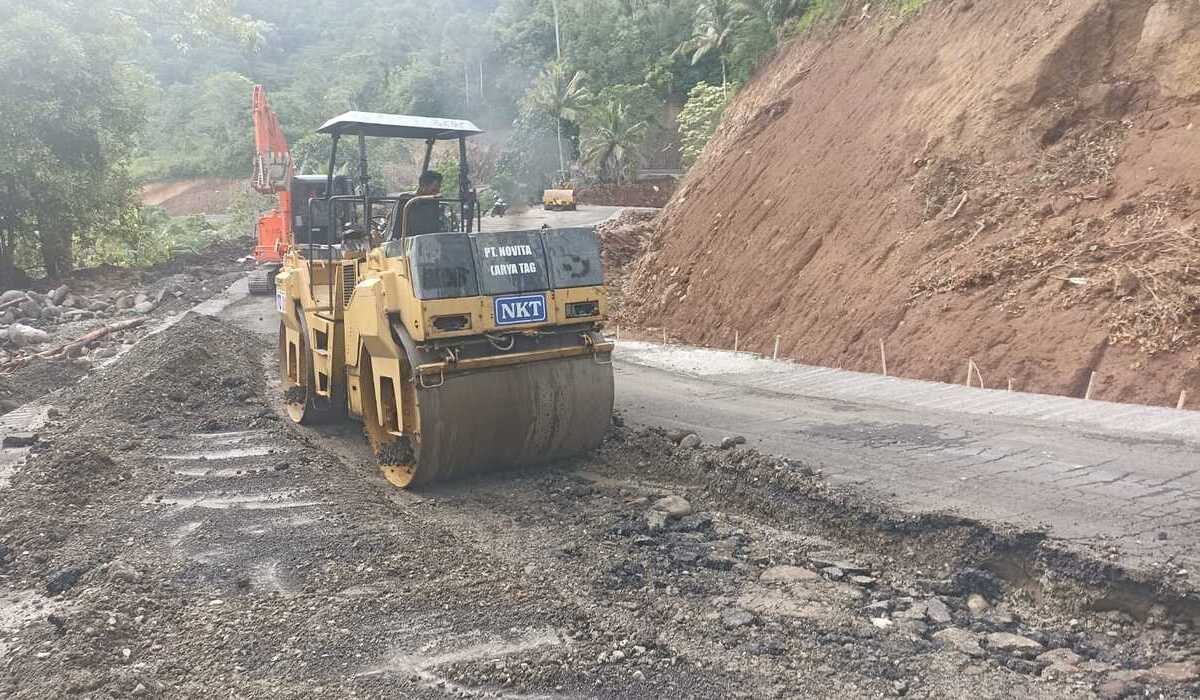
The Mauponggo-Ngera-Pu’uwada road section in Nagekeo Regency, East Nusa Tenggara (NTT), recently completed under the Presidential Instruction for Regional Roads (IJD) programme, has drawn sharp criticism from the public. The project, worth billions of rupiah, was reportedly provisionally handed over (PHO) in a physically damaged condition.
An investigation by Media Indonesia and the Nagekeo Journalists Alliance on the Mauponggo-Ngera-Pu’uwada road on 12 March 2026, following the PHO on 11 March 2026, revealed several points of damage. Although declared complete and handed over on 11 March 2026, the road showed serious damage at various points. Wide cracks emitting mud deposits were clearly visible, particularly in the area behind Ngera Village.
Some cracked sections of the road were attempted to be covered with additional hotmix asphalt layers, but the material did not adhere properly. This condition has raised suspicions that the handover was forced despite the quality not meeting contract standards.
The head of the PJNW IV Project Implementation Unit for NTT Province, Wilhelmus Sugu Djawa, clarified that the Mauponggo-Ngera-Pu’uwada 1 Road Preservation Package, valued at Rp9,114,590,000, was carried out in accordance with the contract. According to him, damage that occurred at the end of 2025 due to extreme weather had been repaired by CV Ratu Orzora before the PHO.
“The road is now usable by the general public smoothly. The NTT BPJN is committed to providing the best,” said Wilhelmus.
PPK Ricard Manukoa added that the project is under the supervision of the High Prosecutor’s Office and will soon be audited by BPKP. “Everything has been repaired, no need to worry about lab inspections later, and after Eid there will be a BPKP audit for all IJD,” said Ricard.
An expert source in hotmix asphalt road construction with experience in APBN projects highlighted the use of the thin asphalt sand layer (latasir) method in the repairs. According to him, this method only serves to cover rough asphalt surfaces, not to strengthen the road base structure.
“Latasir work like this is only for covering rough or hairline cracks in asphalt pores, not for strengthening the road base structure,” he stated. He also criticised the quality of the aggregate, suspected to contain a lot of soil mud, as seen in videos of the damage.
“They did not present the zero condition before work, only sending the condition that was 100 percent complete,” he added.
Furthermore, he explained that for road conditions as reported previously, the work should start from a strong base layer. The ideal stages include using Class A aggregate foundation compacted to at least 98 percent density, before proceeding with the wearing course layer of Hot Rolled Sheet – Wearing Course (HRS-WC).
In the project planning, it was stated that the asphalt layer was indeed designed as a single layer, namely HRS-WC. Therefore, the quality of work on the aggregate base layer becomes crucial in ensuring road durability.
“If the foundation is not done well, the asphalt layer on top will be prone to damage,” he explained.
Technically, he added that in ideal road construction, before the HRS-WC layer, a base asphalt layer such as HRS-Base should be used. However, based on technical guidelines from the central government, some projects directly use HRS-WC without that layer, so field implementation follows the established design.
Nevertheless, this method is still considered applicable if the base soil condition is sufficiently stable. An alternative is to use selected fill or embankment on the base layer before aggregate installation.
For projects funded by the State Revenue and Expenditure Budget (APBN), the more common practice is layered construction. Starting from selected embankment, followed by Class B aggregate, Class A aggregate, and then coated with asphalt as the final layer.
Moreover, working during the rainy season is not an excuse. If the soil structure is unstable, there are other alternatives prepared, such as strengthening the foundation structure with cement. Unless there is a major disaster like flooding and landslides that cannot be avoided or force majeure in technical terms. Then, before work is carried out, technical planning always includes soil bearing capacity tests to determine if the soil is unstable or not.
Viktor Tegu, a Nagekeo DPRD member from Ngera, emphasised that on 12 March 2026, the road was still under repair when journalists visited the site. “I think it’s not right to call the news a hoax; when the journalists came on the 12th, the reality on the ground was that repairs were still ongoing,” Viktor asserted.
Local resident Egidius Situ also confirmed the presence of damage before the new asphalt layering was done. With a total budget of Rp18 billion, the community hopes the road quality will last long and not just be aesthetically repaired on the surface alone.