
Rp 7.2 Trillion Allocated as KKP Builds Giant Shrimp Pond Project in Waingapu, NTT
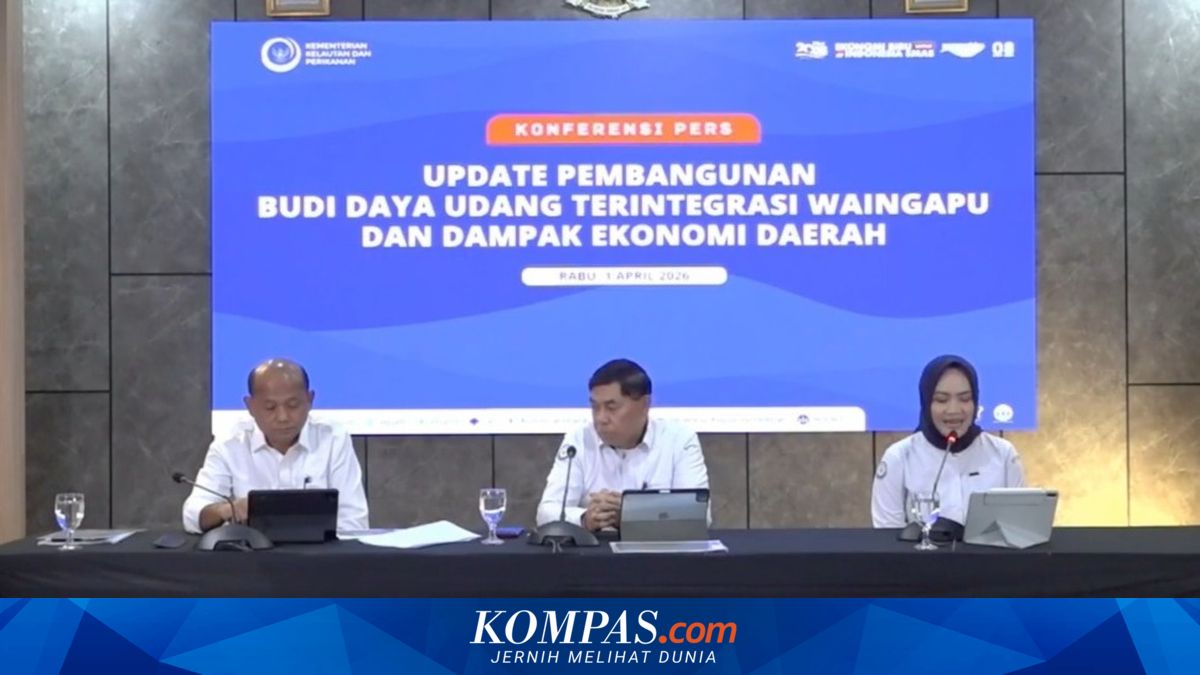
The government is beginning to allocate a major investment of Rp 7.2 trillion to build an integrated shrimp pond zone in Waingapu, East Nusa Tenggara (NTT), which is projected to become a new model for environmentally friendly aquaculture while driving regional economic growth.
The Ministry of Marine Affairs and Fisheries (KKP) states that the project is located in Palakahembi Village as well as the Watumbaka and Watumbangga sub-districts, Pandawai District, which is generally known as the Waingapu area.
The Director General of Aquaculture at KKP, Tb. Haeru Rahayu, said that the zone is designed as a pilot for integrated shrimp farming with the best operational standards at every production stage.
“We are building this zone as a model for integrated, environmentally friendly aquaculture, starting from the water intake process, processing in ponds, farming activities, to waste management through a wastewater treatment installation (IPAL),” Haeru stated in Jakarta on Wednesday (1/4/2026).
He emphasised that this approach is implemented to ensure that farming activities do not cause negative impacts on the surrounding ecosystem.
“The funding is quite extraordinary, reaching Rp 7.2 trillion, consisting of construction management and main construction needs of around Rp 7.1 trillion,” he said.
Haeru explained that the zone has land potential of up to 2,150 hectares, with plans for a built area of about 1,361 hectares.
The shrimp pond zone will be equipped with various supporting facilities, from intake channels, ponds, farming plots, wastewater treatment installations, to supporting industrial areas.
The central government will handle the zone’s development and human resource preparation, while the local government supports with permits, land provision, and local community involvement.
“We want local communities not just to be spectators, but to become an important part in supporting the sustainability of this shrimp pond zone,” he said.
In addition, KKP is opening opportunities for the private sector to get involved, both in upstream and downstream sectors, from seed and feed supply to product processing.
The zone’s development is targeted to take place over two years, with some areas expected to start operating soon.
“We invite the private sector or private companies to fill in the upstream and downstream sectors. For example, in upstream, there will be a need for hundreds of millions of shrimp seeds, and then feed,” he explained.
“In downstream, there will be processing and so on. So, both us at the centre, the regional government, and the private sector as investors must form a unified entity that cannot be separated just like that. They must engage with one another,” he stressed.