
Rosan Roeslani: Islamic Economy Strengthens National Economic Resilience
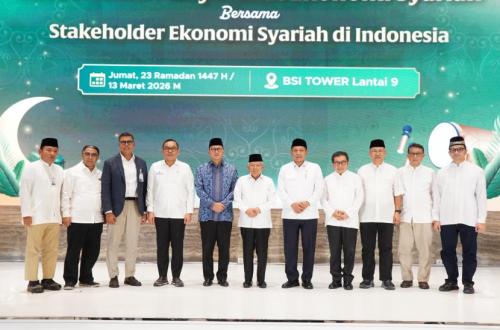
JAKARTA — The Central Board of the Islamic Economy Community (MES) utilised the Ramadan momentum, valued as a networking space and opportunity to strengthen synergy among stakeholders, through an iftar gathering held on Friday, 13 March 2026.
The event, hosted by Bank Syariah Indonesia, was attended by Indonesia’s 13th Vice President KH Ma’ruf Amin, the newly elected Chairman and Executive Chairman of the MES Central Board, as well as prominent figures and stakeholders in Islamic economics and finance.
Rosan P Roeslani, Chairman of the MES Central Board, stated that Ramadan is an important moment to strengthen solidarity whilst reaffirming commitment to promoting the development of Islamic economics in Indonesia. Roeslani also highlighted ongoing global dynamics, including geopolitical tensions in the Middle East, which are deemed to impact global economic stability, ranging from energy price uncertainty to financial market volatility.
“In a global situation as full of uncertainty as this, we need a strong and sustainable economic foundation. Islamic economics has great potential to strengthen national economic resilience because it brings values of justice, balance, and support for the real economic sector,” Roeslani said in a press statement on Saturday, 14 March 2026.
The development of Islamic economics, he continued, requires broad collaboration from all stakeholders, ranging from government, industry actors, financial institutions, academics, religious scholars, to civil society organisations.
“When all stakeholders can move together in the same spirit, we will be able to build a stronger, more inclusive, and sustainable Islamic economic ecosystem,” he said.
Roeslani, Head of the Danantara Investment Management Body, also revealed that the new management structure of MES is still in the final stages of preparation and is targeted to be completed shortly for official announcement.
“It is hoped that this management will make the organisation move more dynamically, collaboratively, and have an impact on the development of Islamic economics in Indonesia,” he concluded.
Meanwhile, Ferry Juliantono, Executive Chairman of MES, assessed that the future of Islamic economics should not only rest on the Islamic financial sector and halal industry. Islamic economics must penetrate more deeply into the real sector as a force for production, trade, and distribution within society.
In his capacity as Minister of Cooperatives, Juliantono also highlighted the significant potential of pesantren (Islamic boarding school) cooperatives as drivers of community economic development. Pesantren are deemed to possess a strong ecosystem, ranging from human resources, solid communities, to real economic needs.
“From pesantren we can build a model for developing the real sector of Islamic economics, ranging from production to sustainable business networks,” he said.