
Rosan Roeslani: Danantara to Manage Rp 15,000 Trillion in State Assets to Drive Economic Growth
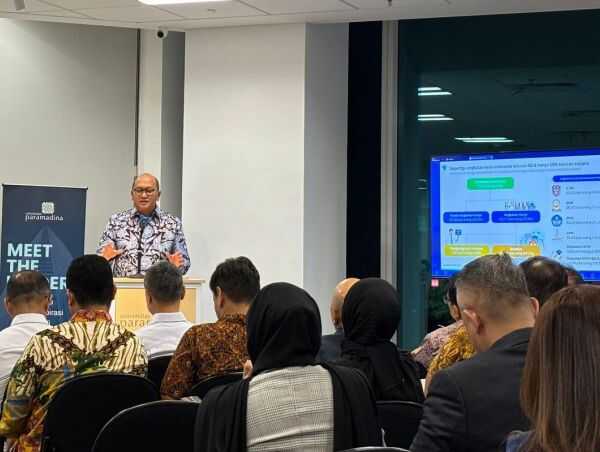
JAKARTA — Minister of Investment and Downstream Industries/Head of the Investment Coordinating Board (BKPM), Rosan Roeslani, has emphasised the importance of investment as the primary driver of Indonesia’s economic growth in the years ahead.
“Investment is a critical component of national economic growth, contributing approximately 29% after household consumption, which accounts for 53%,” said Rosan at the Meet The Leaders event organised by Paramadina University, where he delivered an oration entitled “Entrepreneurial Leadership in Action: Steering Indonesia’s Investment and Industrial Renaissance”.
He explained that over the past decade, total investment flowing into Indonesia reached Rp 9,100 trillion, and is expected to increase to Rp 13,000 trillion over the next five years to support a target economic growth rate of 8% by 2029.
Rosan, who now leads Danantara — a new entity consolidating all state-owned enterprise (SOE) assets — revealed that Danantara will manage assets worth Rp 15,000 trillion. Notably, Danantara’s funding will no longer depend on state capital injections through the national budget (APBN), but rather on dividends from state companies that will be reinvested into strategic projects.
“Dividends that previously went directly to the state can now be utilised for investment in industrial sectors that create quality jobs,” Rosan explained. He estimated that this year alone, Danantara will receive profits of USD 7 billion, equivalent to approximately Rp 120–150 trillion, which will be used to drive real sector growth.
In his address, Rosan also highlighted the serious challenge of Indonesia’s workforce quality. Of 140 million workers, 36% have only primary school education, and 24% of those did not even complete primary school. “This is a major national challenge,” he stressed. For this reason, Danantara has a dual mission: creating quality employment whilst achieving sustainable profits.
Rosan added that 2 million babies are born in Indonesia each year. “We must start now to ensure that the majority of them can eventually obtain decent employment,” he said.
He also confirmed that 80% of Danantara’s investment portfolio will be focused domestically, whilst 20% will be directed overseas. Over five years, this strategy is projected to generate revenue of USD 135 million.
Investment, according to Rosan, is not merely about deploying capital but also about creating added value and efficiency, particularly for SOEs that have thus far underperformed. “Danantara will serve as a bridge to strengthen foreign investor confidence. With the funds we hold, we can leverage investment to four or five times the initial amount,” he explained.
The event was opened by Paramadina University Rector Prof. Dr Didik J. Rachbini and moderated by Wijayanto Samirin, MPP. The occasion formed part of the university’s efforts to bring national leaders before students and lecturers as inspiration for action-based leadership.