
Rise of C-beauty: Chinese cosmetic brands build momentum in Southeast Asia and beyond
Rise of C-beauty: Chinese cosmetic brands build momentum in Southeast Asia and beyond
K-beauty or J-beauty products have been a staple among consumers for years – but now, a new wave of Chinese cosmetics and skincare is gaining attention overseas.
SINGAPORE: Xu Meicheng had already set her sights on becoming a professional makeup artist when she decided there was only one place to go: China.
Last year, the Singaporean travelled to Shanghai and enrolled in a five-month course to learn various makeup styles, including the latest in China’s beauty industry – known as C-beauty.
From earth-toned “latte” looks to “new Chinese-style” aesthetics and even “boiled water makeup” for an understated, natural finish, C-beauty trends have taken platforms like Xiaohongshu and TikTok by storm.
Once overshadowed by K-beauty and J-beauty – South Korean and Japanese cosmetics products which have been a staple among consumers for years – C-beauty is now gaining attention overseas, fuelled by social media buzz and rising exports.
“There’s so many more things that are yet to be explored, because constantly I’m seeing new trends, new products and new brands emerging from the Chinese market … I would say the growth is not at its peak yet,” said Xu.
The 26-year-old’s makeup lessons, held five days a week, cost around US$3,700. Graduates earn a certificate after examinations, and some even land opportunities with major brands like Disneyland.
“I’ve already been wanting to move forward with the goal of being a professional makeup artist. But I think the resources here are amazing, so that’s why I’m here in China instead of anywhere else,” she added.
Xu is part of a growing number of beauty enthusiasts and entrepreneurs looking to tap China’s vast and fast-evolving cosmetics industry.
DOMINANT AT HOME
At home, Chinese cosmetic brands dominate the country’s US$141 billion beauty market, making up nearly 60 per cent of total sales last year, according to Chinese media group Caixin.
Many are now looking overseas.
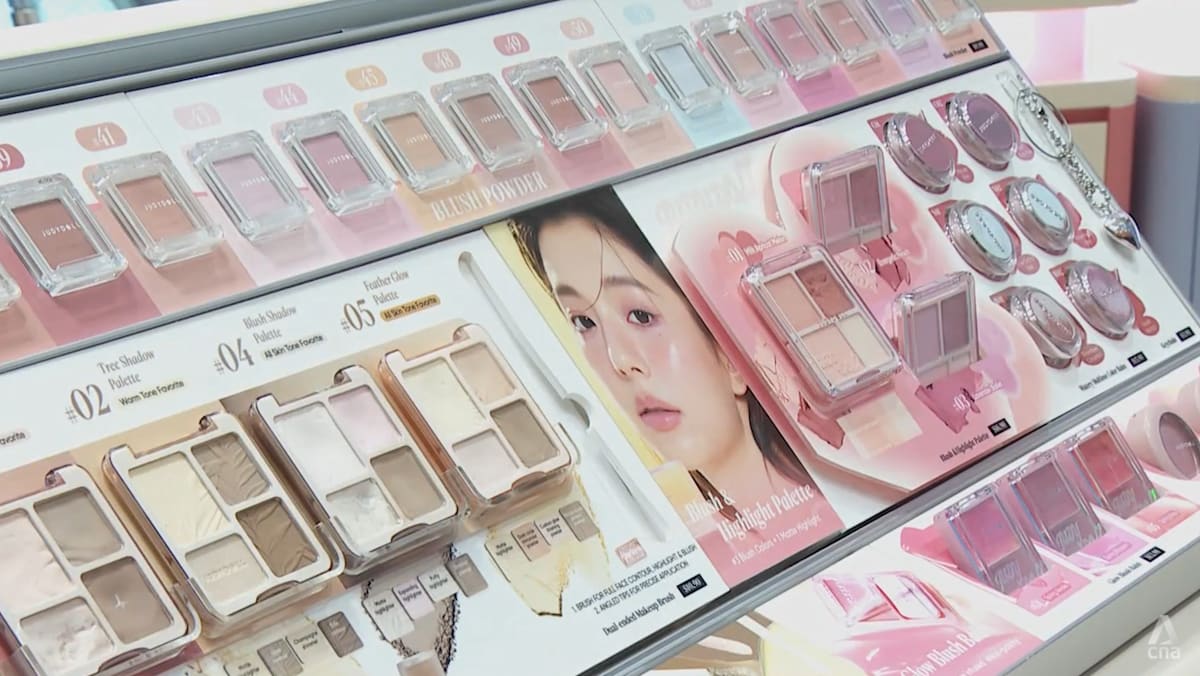
For example, cosmetics firm Joy Group opened its first standalone stores outside China in Singapore last year for makeup brands Judydoll and Joocyee.
“For the Singapore market, offline (sales are) still the strongest, so having a boutique store here in Singapore not only increases the brand awareness but also the credibility of the brand,” said Joy Group’s regional managing director Melvin Beh.
He pointed out that customers still shied away from “made in China” products just a few years ago.
Beh added the boutique’s launch marked a turning point, with more consumers warming to C-beauty and viewing it as both affordable and of high quality.
The company plans to expand into Malaysia and Thailand, and eventually into the Middle East, the United States and Europe.
C-beauty companies are also adapting products for overseas markets.
Joy Group said some items sold in Singapore are formulated for the country’s heat and humidity, with a diverse range of shades available. Some are not even sold in China.
Analysts say the next wave of C-beauty could include wellness-focused products blending skincare, health and lifestyle – as Chinese brands seek not just to ride viral trends, but to build lasting global appeal.
EXPORTS ON THE RISE
According to China’s Xinhua News Agency, in the first eight months of 2025, China’s cosmetics exports rose nearly 12 per cent year-on-year to more than US$5 billion. This marked a third straight year of double-digit growth.
While broader weakness in China’s domestic consumption has played a role, analysts say the overseas push is largely strategic as competition intensifies at home and demand picks up across emerging markets.
“Overseas demand is growing fast, but still smaller in absolute terms. So, exports are useful … but then the Chinese domestic market is still dominant,” said Nandini Roy Choudhury, principal consultant at Future Market Insights.
“C-beauty brand demand is not directionally specific to the Western world. It is still gaining traction in the Southeast Asian market (and) Japanese market,” she added.
David Zhang, an analyst at strategic advisory firm Trivium China, said this new wave of branded and more sophisticated Chinese exports – which has been termed “China Shock 2.0” – is a “fundamentally different model” of overseas expansion than in the past.
China has been able to leverage its low-cost labour to scale up production and become the world’s leader in global outsourcing, he added.
Joy Group said it has seen triple-digit growth globally since it began overseas sales in 2021, starting with e-commerce platforms before expanding into retailers such as Watsons in Singapore.
The chain plans to bring in more Chinese skin and hair care products next.
Watsons Singapore’s commercial director Goh Choon Gek said that K-beauty brands are still its mainstay and Western brands perform strongly among premium skincare lines, but C-beauty stands out due to its novelty.
“It’s very active on social media and we also feel that there’s actually a lack of physical presence, so we think there’s a lot of potential there, and we provide in store trials and testers and beauty advisors,” she added.
“We think the key barriers (are) trust and familiarity, especially when the brands are new in the market.”
TRENDS, TRUST AND TARIFFS
Advisory firm Dezan Shira & Associates estimates the global C-beauty market could grow from about US$18.7 billion last year to over US$49 billion by 2035.
But industry watchers say winning consumer trust will be key to long-term success – and tariff uncertainty could also play a part.
Last week, US President Donald Trump signed an order for a 10 per cent tariff on US imports to last 150 days, after the Supreme Court struck down his “Liberation Day” tariff policies. The Trump administration is working to increase it to 15 per cent, said a White House official.
Trivium China’s Zhang noted that the 10 per cent tariff is “good news” for China, but several caveats remain.
For exa