
Ridged bed and mulch strategy: the struggle behind shallot farmers' resilience
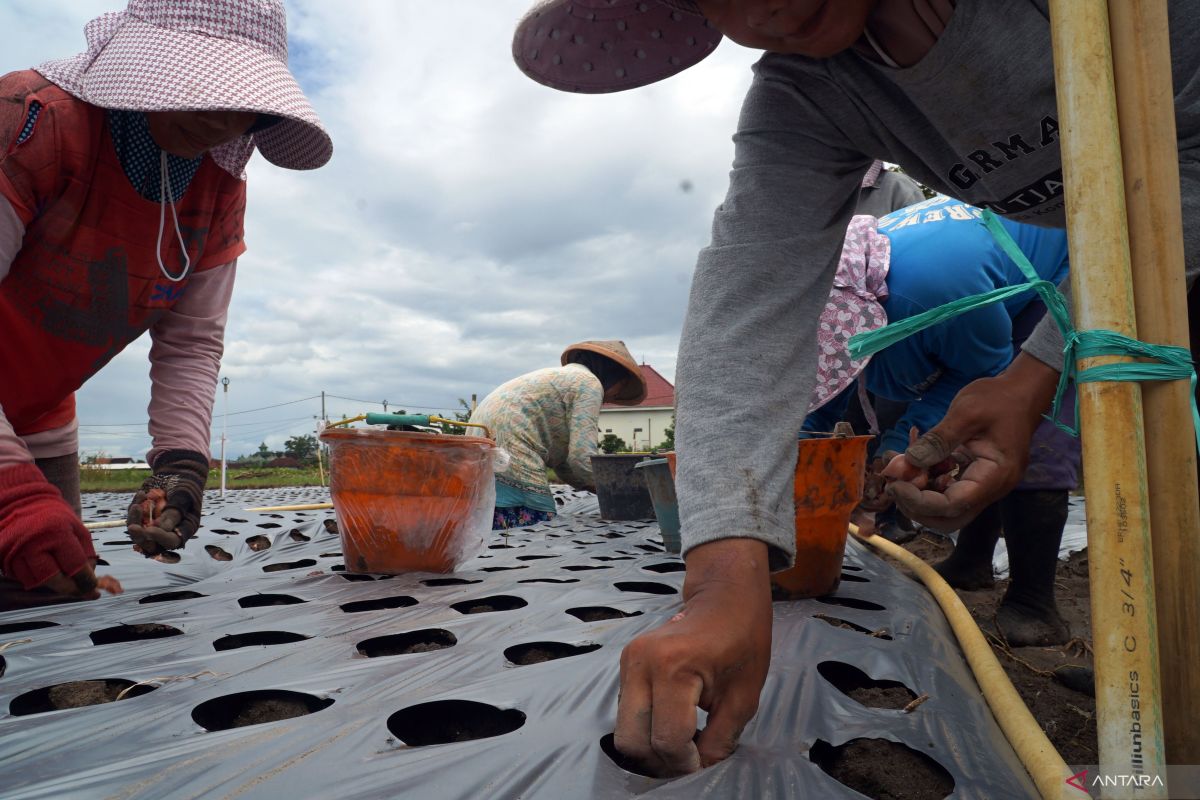
Tulungagung – Whilst most farmers in Tulungagung Regency, East Java, choose to postpone planting when heavy rain falls, some others take the risk instead: planting shallots in the middle of wet weather conditions.
On horticulture land prone to waterlogging, such a decision is often described as a bold gamble with uncertain results. Nevertheless, behind it lies technical calculation and market analysis that is far from simple.
This scene is visible in the rice fields of Podorejo and Junjung Villages, Sumbergempol District. A number of female labourers plant seedlings in holes on ridged beds covered with plastic mulch. Meanwhile, in another plot, mature shallot clusters are lifted onto the field ridges ready for harvest.
This landscape marks the fact that Tulungagung’s shallot production centre has not completely declined, whilst many shallot farmers have “collapsed” and switched to rice and food crops deemed to carry less risk.
Data from Tulungagung’s Agricultural Office shows that throughout 2025, shallot cultivation area reached 228.70 hectares, with harvest area of 219.70 hectares.
Total production was recorded at 2,151 tonnes, with average productivity of 103.20 quintals per hectare, or approximately 10.3 tonnes per hectare (productivity figure averaged across 11 districts with shallot horticulture farming).
Production distribution is concentrated in several districts. Sumbergempol is the largest centre, with a cultivation area of 80 hectares and production of 5,920 quintals.
Followed by Rejotangan with 51 hectares and production of 5,490 quintals, and Ngunut with 27 hectares and production of 2,700 quintals.
The highest productivity was recorded in Campurdarat, reaching 201.20 quintals per hectare, far above the regency average.
From January to February 2026, 16 hectares of land re-entered the planting season across six districts, including Sumbergempol, Kalidawir, Rejotangan, Bandung, Pakel and Gondang.
With prices ranging around Rp25,000 per kilogram, the economic value of rotating shallot crops can reach approximately Rp3.6 billion in just one two-month cycle.
Nationally, shallots are a strategic commodity. Data from the Central Statistics Agency shows national production is stable at around 1.9–2 million tonnes per year.
The National Food Agency frequently includes shallots as a commodity that triggers inflation when supply is disrupted. This means that harvest dynamics in regions such as Tulungagung contribute to broader price stability.
However, farming shallots during rainy seasons like now carries significant risk. High rainfall triggers waterlogging, root rot, and disease outbreaks such as moler (fusarium).
The experience of the previous season (2025) was a costly lesson for farmers still using flat land patterns without adequate drainage. Once roots are submerged and soil pores become saturated, oxygen supply is disrupted and bulbs rapidly rot.
Ridged beds and mulch
For shallot farmers in Tulungagung committed to the crop, the rainy season is no longer merely a phase of risk, but rather a phase demanding technical innovation.
The crop failure in the previous season (2025) experienced by some shallot farmers in Junjung Village due to not using ridged bed technology marked a turning point.
At that time, some land was still managed with flat patterns, without adequate drainage systems. Heavy rainfall caused water to stagnate for hours, even days.
Shallow shallot roots could not withstand saturated soil conditions, especially without deep drainage channels to help water drain away.
Andi Daniar, an agronomist from Blitar who also practises shallot farming directly, explained that rainy season ridged beds should ideally be constructed 30–40 centimetres high with width adjusted to planting distance. Meanwhile, drainage channels between them should be deep enough to contain rainwater runoff.
The principle is simple. Water must have a way out. If water sits around the roots for more than a few hours, infection risk increases.
Physiologically, shallots require good soil aeration. When soil pores are completely filled with water, oxygen diffusion is obstructed.
Roots experience hypoxia stress, nutrient absorption is disrupted, and tissue becomes vulnerable to soil-borne pathogens such as fusarium.
In extremely humid conditions, the fungus causing moler develops rapidly and attacks the tissue at the base of shallot plants, until the bulb rots.
Deep drainage channels function as a rapid drainage system. Once rain ceases, water from the ridged bed surface immediately flows into the channel, not retained in the root zone.
High ridged beds keep roots in a drier and more crumbly soil layer.
On top of the beds, some farmers install black-silver plastic mulch (BSPM). According to Andi, the function of mulch is more complex than merely suppressing weeds.
The plastic layer reduces direct contact between rainwater and soil, so soil splash that often carries disease spores to leaves can be minimised. Additionally, mulch helps maintain stable soil moisture and reduces nutrient leaching.
Rainwater in some areas has slightly acidic properties. Without protection, high rainfall can accelerate leaching of calcium, magnesium, and other nutrients, whilst also triggering soil pH fluctuation.
With mulch, such effects are more controlled. Activity of beneficial micro-organisms in the root zone is also relatively more stable because soil temperature does not fluctuate excessively.
For farmers with strong capital, the combination of deep drainage channels and mulch becomes the minimum standard for the rainy season. For those with limited resources, ditches and ridged beds alone are considered the main salvation, provided strict monitoring is carried out.