
Reverses Gains, JCI Slips 0.61% as Middle East Risks Keep Investors on Edge
Reverses Gains, JCI Slips 0.61% as Middle East Risks Keep Investors on Edge
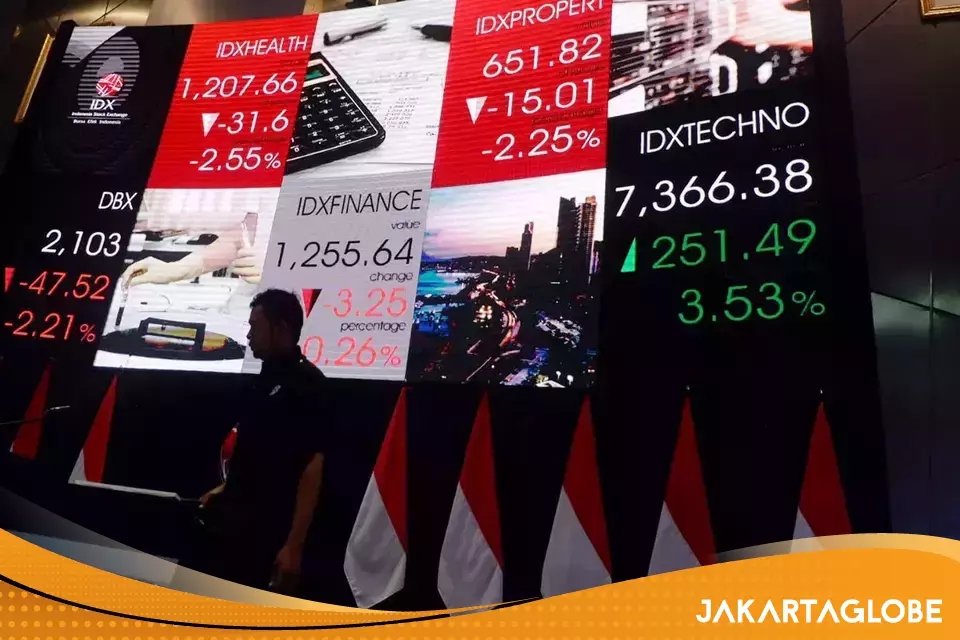
Jakarta. Jakarta Composite Index (JCI) reversed course on Tuesday, falling into negative territory as renewed geopolitical tensions and cautious global sentiment outweighed earlier gains.
The benchmark index dropped 43 points, or 0.61%, trading within a range of 7,031 to 7,155.
Market activity remained brisk, with volume reaching 27.26 billion shares and turnover totaling Rp 14.95 trillion ($878.46 million) across more than 1.7 million transactions. Decliners outnumbered gainers, with 406 stocks falling against 262 advancing, while 151 were unchanged.
Weha Transportation led the gainers with a 34.78% surge, followed by Pool Advista (+34.48%), Chemstar (+33.73%), and Yanaprima Hast (+25%).
On the losing side, Daya Intiguna slid 14.92%, Equity Development Investment fell 14.88%, Remala Abadi dropped 14.73%, and PP Presisi declined 14.65%.
Pilarmas Investindo Sekuritas said market pressure was partly driven by remarks from Federal Reserve Chair Jerome Powell, who noted that long-term inflation expectations remain under control, while emphasizing the central bank’s continued vigilance over geopolitical risks.
At the same time, markets reacted to evolving developments in the Middle East. Reports suggested US President Donald Trump has opened the possibility of halting the military campaign in Iran, although conditions along the strategic Strait of Hormuz remain unsettled.
“This sentiment briefly raised hopes of de-escalation. However, investors remain cautious following reports of attacks on oil tankers near Dubai and potential disruptions to distribution in the Red Sea,” Pilarmas wrote in a Tuesday research note.
The brokerage added that risks to global energy supply are rising, particularly as two key trade routes, the Strait of Hormuz and the Red Sea, remain under pressure.
From Asia, Pilarmas noted that China’s latest economic data offered some support, with both manufacturing and non-manufacturing activity returning to expansion territory. The manufacturing index rose to 50.4 in March 2026 from 49.0 previously, while the non-manufacturing index climbed to 50.1 from 49.5.
Domestically, investors are holding back ahead of the release of March inflation data and February trade figures. Rising global oil prices are seen as a key risk, potentially fueling inflation and increasing Indonesia’s energy import burden, which could weigh on the trade balance.
“In addition, the market is awaiting government measures to cushion the impact of global volatility. Authorities are reportedly preparing a mitigation package, ranging from limited work-from-home implementation and budget adjustments to the rollout of the B-50 program,” Pilarmas said.
Oil steadied on Tuesday, while most Asian markets moved lower amid mixed signals over potential de-escalation in the Iran conflict.
Japan’s Nikkei 225 fell 1.6% to 51,063.72. South Korea’s Kospi dropped 4.3% to 5,052, while Hong Kong’s Hang Seng slipped 0.3% to 24,678 and Shanghai’s Composite Index declined 0.8% to 3,891.
With the conflict entering its fifth week, uncertainty persists. Brent crude edged down less than 0.1% to $107.37 per barrel, while US benchmark crude rose 0.1% to $102.93. Oil prices have surged more than 40% since the start of the conflict, driven by supply concerns.
Disruptions in maritime traffic at the Strait of Hormuz, a route that typically carries about a fifth of global oil supply, remain a major pressure point. US Secretary of State Marco Rubio said Washington has “options available” in response to Iran’s threats to assert control over the strait.
On Wall Street, stocks closed mixed overnight. The S&P 500 fell 0.4% to 6,343, the Nasdaq Composite dropped 0.7% to 20,794.64, while the Dow Jones Industrial Average edged up 0.1% to 45,216.
Tags: Keywords: