
Revealed! Putin Has an Intelligence School That Can Influence Elections in Other Countries
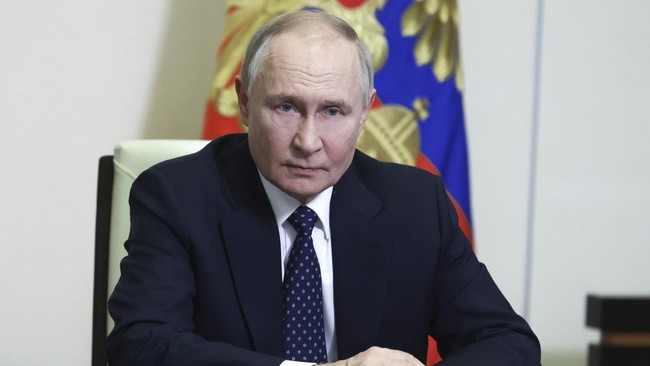
President Vladimir Putin visited Bauman Moscow State Technical University, located on the banks of the Yauza River in eastern Moscow, on Thursday (7 May 2026). During the visit, Putin toured the campus and met with undergraduate students, boasting about Moscow’s ambitious plans for space missions to the Moon and Mars.
Citing an investigation by The Guardian, during the meeting, Putin motivated the students by stating that they had everything needed to be competitive on the global stage. However, the Kremlin’s official report on the visit made no mention whatsoever of the existence of a secret faculty within the university known as Department 4 or “Special Training”.
This faculty serves as a hub for a select group of students secretly prepared for careers in the GRU, Russia’s military intelligence directorate. Agents from this directorate are known to have hacked parliaments in Western countries, poisoned dissidents abroad, and interfered in elections across Europe and the United States.
A former senior Russian defence official revealed that the recruitment process often begins during school years, where potential agents are monitored before entering Bauman and joining the secret service. According to the source, this scheme is part of a systematic intelligence cadre pipeline.
The direct pathway from one of Russia’s most prestigious institutions to the military intelligence apparatus was uncovered through more than 2,000 internal Bauman documents obtained by a consortium of journalists from six media outlets, including The Guardian, Der Spiegel, Le Monde, The Insider, Delfi, and VSquare. The documents, covering activities up to 2025, include course syllabi, exam records, staff contracts, and career placements of graduates in the most feared cyber units.
Secret Curriculum
Bauman, founded in 1830, has never hidden its close ties to the military as a producer of rocket and weapons engineers since the Soviet era. In an internal letter from 2013 addressed to then-Defence Minister Sergei Shoigu, the university rector wrote that the institution conducts more research and development than any other higher education body in Russia, with over 40% of research done for the defence ministry’s interests.
Department 4 itself is located within the university’s military training centre and is divided into three specialist streams, with the most prominent code being 093400, titled “Special Reconnaissance Service”. Documents show that the GRU holds full control over recruitment and grading processes, even sending its own officers to test students and approve their job placements.
The department is led by Lieutenant Colonel Kirill Stupakov, a signals intelligence officer who signed a three-year contract in 2022 with GRU Unit 45807. At Bauman, Stupakov teaches students to master electronic eavesdropping and covert surveillance, using disguise devices such as smoke detectors functioning as cameras to monitor cables capable of silently capturing screen shots.
Another recorded instructor is Major General Viktor Netyksho, an officer sanctioned by the West for leading the Fancy Bear hacking group, which the United States accused of interfering in the 2016 election. In the course “Defence Against Technical Reconnaissance”, students are taught modern hacking techniques from password attacks to creating computer viruses as part of their final assignments.
In addition to hacking tasks, the curriculum covers information warfare, where advanced students are assigned to create social media videos using manipulation and hidden propaganda. Teaching materials are filled with Kremlin doctrine, stating that the war in Ukraine was inevitable and accusing European countries of supporting genocide against Russians in Donbas.
From Lecture Halls to Unit Sandworm
Based on the documents, one student named Daniil Porshin, who graduated in spring 2024, was immediately placed in the Fancy Bear unit after achieving near-perfect grades over six years of study. Although not all students graduate due to strict GRU officer assessments, at least 15 from Porshin’s cohort were directed into GRU units.
One graduate was even placed in Unit 74455 in the city of Anapa, known to Western governments as the Sandworm hacking unit. Sandworm has been accused of carrying out the most damaging cyberattacks in the past decade, including attacking Ukraine’s power grid in 2015 and disrupting Emmanuel Macron’s presidential campaign in France in 2017.
Bauman University, Netyksho, Stupakov, and Porshin provided no response when asked for comment by the journalistic consortium regarding these allegations. Intelligence experts suggest that Russia continues to ramp up “hybrid” attacks against Ukraine’s allies in Europe through sabotage campaigns and cyber disruptions that remain below the threshold for open military response.
The former Russian defence official added that while these documents provide unprecedented insights, Bauman is just one of a handful of elite universities used to recruit exceptional talents into the intelligence structure. He mentioned that other universities, such as Mirea, also play a crucial role in training Russian hackers.
“Bauman is one of a handful of elite universities used to identify talented students for recruitment into the military and intelligence structures,” the source said in the published report.