
Revealed: How Iran Threatens US Dollar Dominance
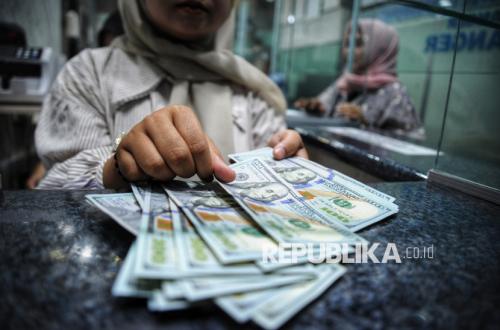
REPUBLIKA.CO.ID, TEHERAN – Iran’s retaliation against the actions of US President Donald Trump and Israeli Prime Minister Benjamin Netanyahu in attacking Iran is expected to shake the dominance of the US dollar. The closure of the Strait of Hormuz could not only disrupt global energy supplies but also collapse the US dollar’s dominance.
The US dollar has long been powerful as the world’s reserve currency, primarily because almost all countries buy their energy resources in dollars. If the disruption caused by the closure of the Strait of Hormuz effectively leads major countries to trade oil in other currencies, this could seriously weaken the dollar’s hegemony in central bank reserves and global trade.
This warning was issued by Deutsche Bank strategist Mallika Sachdeva in a special report published on Tuesday, subtitled “a perfect storm for the petrodollar.”
What is the petrodollar system? In 1974, US President Richard Nixon sent Secretary of State Henry Kissinger to Saudi Arabia to reach a secret agreement. Three years earlier, in August 1971, Nixon had delivered a “shock” that ended the Bretton Woods system and suspended the dollar’s convertibility to gold.
Persuaded by Kissinger, Riyadh eventually agreed to price and trade its oil in US dollars and to channel its oil profits back into US Treasury bonds. In return, Washington promised military aid, equipment, and security guarantees.
That agreement would secretly shape the global economy for the next half-century. The existence of this secret pact was only publicly confirmed in 2016, when Bloomberg News filed a Freedom of Information Act request with the National Archives.
Other OPEC members followed Riyadh’s lead in the subsequent years, ultimately making the dollar a highly dominant currency in the modern world. With that system, the US could also borrow almost limitlessly at low cost.
The US national debt exceeded 39 trillion US dollars on 18 March 2026, a historic milestone reached just weeks after the war in Iran. According to Fortune, the speed of accumulation was astonishing, and the timing was very poor: debt interest costs are projected to be the fastest-growing item in the federal budget for decades to come, and the United States has suffered credit rating downgrades from all three major rating agencies – S&P in 2011, Fitch in 2023, and Moody’s in May 2025.
The reason why this is important geopolitically – not just fiscally – can be traced back to that 1974 agreement. Saudi Arabia itself held US debt securities worth 149.5 billion US dollars in December 2025 – a figure that increased by 12 billion US dollars over the previous year, even as Riyadh refused to officially renew the original petrodollar agreement.
It is this recycling loop that allows Washington to borrow cheaply, run persistent deficits, and yet maintain its currency as the world’s reserve.
Sachdeva argues that the dollar’s dominance in cross-border trade can be said to be built on that petrodollar. And currently, that foundation is increasingly weak.
Sachdeva opines that the world is changing, and most oil produced in the Middle East is sold to Asia, not America, which is now a net exporter. Sanctioned Iranian and Russian oil (producing around 13 million barrels of crude oil per day, about 14 percent of global consumption) has been traded “off the dollar path.” She observes that Saudi Arabia has experimented with non-dollar payment forms such as the mBridge Project infrastructure, using central bank digital currencies.
Sachdeva suspects that regional Gulf conflict escalation may challenge assumptions about the security umbrella provided by the US, and could force some countries to reduce their holdings in foreign assets.
For example, Sachdeva notes that there have been reports in recent weeks where tanker ships were guaranteed safe transit through the Strait of Hormuz if the toll fees imposed by Iran were paid in Chinese yuan.
“This conflict could be remembered as the main catalyst for the erosion of petrodollar dominance and the beginning of the petroyuan.” An additional consideration cited by Sachdeva is the possibility that as the world reduces its dependence on fossil fuels, perhaps on domestically available fuels, renewables, and nuclear power, the need to hold dollars could also diminish.
“A world capable of achieving self-sufficiency in defence and energy could also be a world with fewer dollar reserves.”