
Returning from Japan and South Korea, President Prabowo Brings Home Rp 575 Trillion in Investments
President Prabowo Subianto has returned to Indonesia following his state visits to Japan and South Korea. After meetings with leaders and business figures from both nations, Indonesia has secured investment commitments totalling nearly $34 billion, equivalent to Rp 575 trillion. Amid global uncertainties, investments into Indonesia are claimed to be rising due to maintained political and economic stability.
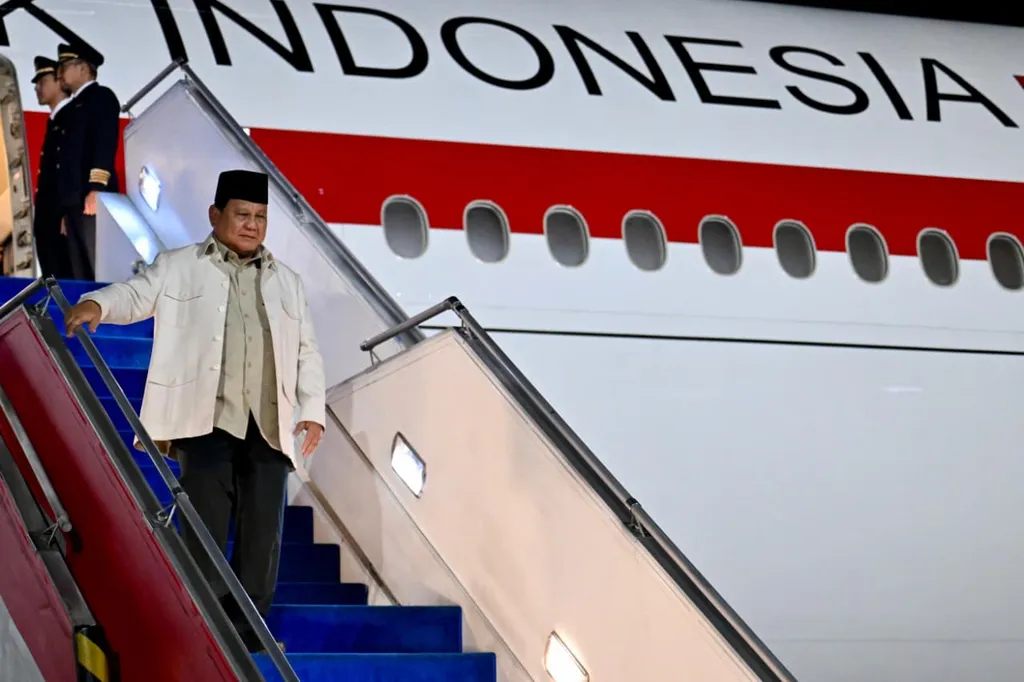
President Prabowo Subianto arrived at the TNI Air Force Halim Perdanakusuma Base on Wednesday (1/4/2026) at 23.55 WIB. The President, who had just completed his overseas trip to Japan and South Korea, was welcomed by Vice President Gibran Rakabuming, State Secretary Minister Prasetyo Hadi, TNI Commander General Agus Subiyanto, National Police Chief General (Pol) Listyo Sigit Prabowo, and Head of the State Intelligence Agency Muhammad Herindra.
During his stay in Japan from Sunday to Tuesday (29-31/3/2026), the President paid a courtesy call on Emperor Naruhito of Japan and met with Japanese Prime Minister Sanae Takaichi. Additionally, Prabowo attended a business forum that resulted in several cooperation agreements. These agreements are valued at $23.63 billion, equivalent to Rp 401.71 trillion.
In South Korea on Wednesday (1/4/2026), the President met with President Lee Jae Myung. The two agreed to elevate bilateral cooperation to the highest level, in the form of a special comprehensive strategic partnership. Indonesia and South Korea also signed 10 memoranda of understanding for inter-governmental cooperation. Furthermore, there were 17 business cooperation agreements between Indonesian and South Korean entities valued at $10.268 billion, equivalent to Rp 174 trillion.
In total, the investment commitments secured during President Prabowo’s visits to Japan and South Korea amount to $33.8 billion, equivalent to Rp 575 trillion.
Investment Minister/Head of the Investment Coordinating Board, who is also CEO of Danantara, Rosan Roeslani, stated that the President’s presence and involvement in dialogues with business actors is key to eliciting positive responses from the business world. This is because they can convey inputs and challenges faced in Indonesia, then receive direct responses from the President in business forums attended.
During the Japan visit, the business forum was attended by more than 300 entrepreneurs. There was also a limited meeting with 12 major companies. Meanwhile, in South Korea, there were intensive meetings with 11 major companies.
Rosan continued that interest in investments from Japan and South Korea is increasing amid global geopolitical uncertainties. On average, Korean investments grow by 14 per cent per year, while Japanese investments grow by 8-9 per cent per year.
According to him, this increase in investor confidence is inseparable from Indonesia’s maintained political and economic stability. This is acknowledged by investors as an important factor in long-term decision-making. “That is the main capital for every investment that constitutes a long-term commitment to Indonesia,” said Rosan after attending the Indonesia-Korea Partnership for Resilient Growth forum in Seoul on Wednesday local time.
He explained that the presence of Danantara as Indonesia’s sovereign wealth fund also plays a role in boosting investor confidence for joint investments (co-investment). Currently, the government is following up on plans for joint investments with several major companies, including Lotte Chemical and POSCO.
Several investors whose operations are already running in Indonesia have also committed to expanding investments to the next phase. For example, KCC Glass, POSCO, and several other companies that will enter the second phase.
Cabinet Secretary Teddy Indra Wijaya, in a written statement on Thursday, said that the achievement of investment commitments from Japan and South Korea demonstrates the high confidence of global investors in the direction of Indonesia’s economic policies. This is particularly related to efforts to promote industrial downstreaming, strengthen energy resilience, and develop national strategic sectors.
He promised that the government will guide these commitments to ensure they are realised and provide tangible impacts on national economic growth, job creation, and improved public welfare.