
Restriction on Trucks During Eid Holiday Exodus Deemed Necessary to Prevent "Horror Traffic"
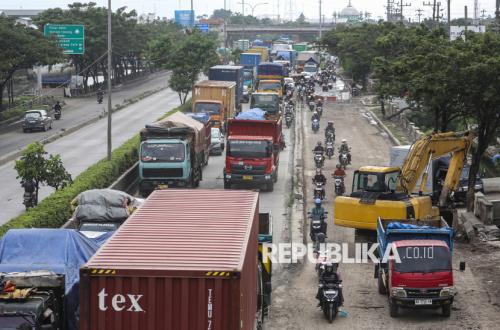
The Indonesian government has officially implemented a policy restricting the operational capacity of freight transport vehicles during the exodus and return journey periods for Eid al-Fitr 1447 Hijriah. The policy, which applies to large trucks on a number of tollways and national roads, comes into effect on Friday (13 March 2026) through Sunday (29 March 2026).
The policy is outlined in a Joint Ministerial Decree (SKB) issued by the Ministry of Transport, the Ministry of Public Works, and the Police Traffic Corps regarding traffic management and crossings during the 2026 Eid Transport Period/1447 Hijriah.
Tulus Abadi, Chairman of the Indonesian Consumer Empowerment Forum, stated that the policy is an unavoidable step. The surge in public movement occurring simultaneously is deemed to require stricter traffic management to ensure that the exodus journey remains safe and controlled.
He noted that public mobility during the exodus is a massive phenomenon rarely occurring in other countries. Therefore, the government must implement special policies to anticipate its impact on traffic.
According to him, based on data from the Indonesian Ministry of Transport, public movement during the exodus period is estimated to reach approximately 144 million people. Meanwhile, from the Greater Jakarta region alone, approximately 3.6 million vehicles are expected to move towards the eastern regions of Java Island via tollways.
Tulus explained that the surge in vehicle movement could potentially cause extreme congestion if not accompanied by adequate control measures.
“If this is not treated with exceptional policies, I am worried that ‘horror traffic’ will occur. The impact is not only congestion but could also endanger safety,” Tulus said.
He views the restriction on freight transport as part of a series of policies implemented by the government to secure the exodus journey. Besides truck restrictions, the government is also preparing various traffic engineering schemes such as contraflow systems and one-way traffic on major tollways heading towards Central and East Java.
According to Tulus, the presence of large vehicles such as trucks amid a surge in private vehicles can increase the risk of accidents and significantly slow down traffic flow.
“When people travel during the exodus, they psychologically want to reach home quickly. They bring their families, often in a fatigued condition. If there are large vehicles on the road that move slowly, that can increase the risk of accidents,” he said.
He added that the restriction is not actually a total ban on freight transport. The policy only applies to certain logistics vehicles, particularly trucks with three or more axles.
Meanwhile, vehicles carrying essential goods, fuel, and other important logistics are permitted to continue operating.
“So this is not a total prohibition but a control measure. Its purpose is to maintain safety and smooth traffic flow during the exodus period,” he said.
According to Tulus, the policy has also been applied almost every year, so logistics transport business operators should already be able to anticipate its impact through adjustment of distribution schedules.