
Restarting the Main Engine of the Economy Before It's Too Late
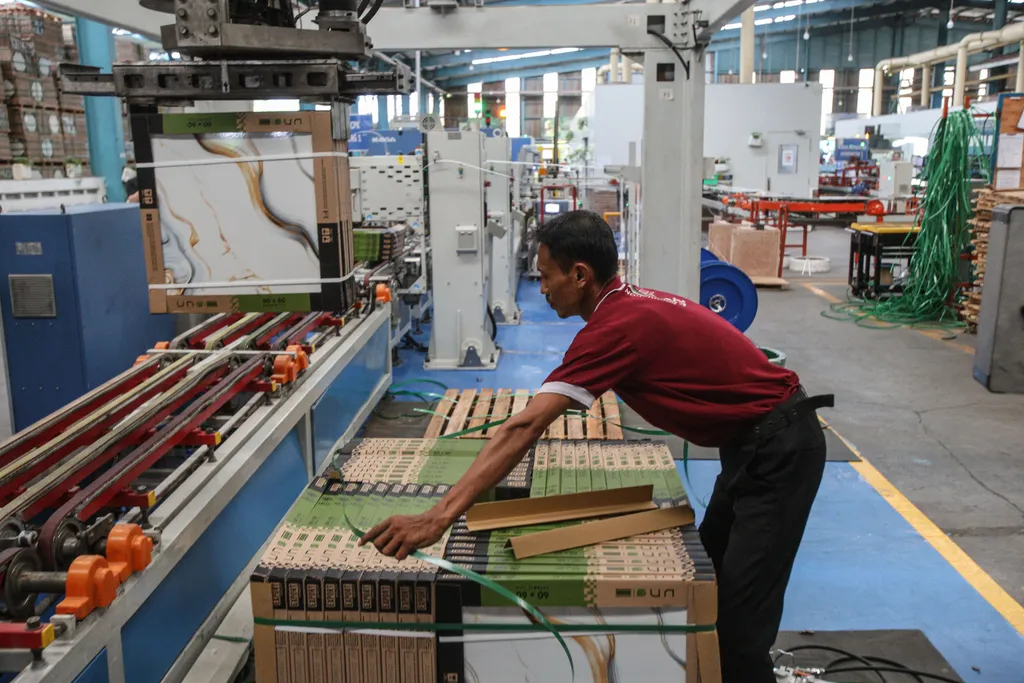
To become a developed country, the manufacturing sector typically needs to grow rapidly. Meanwhile, over the past 20 years, our manufacturing industry has been relatively stagnant.
By Agnes Theodora, Aguido adri
04 Jun 2026 07:00 WIB · English
In recent decades, the contribution of the manufacturing sector to the economy has declined and remained relatively stagnant. Amidst this condition, business uncertainty has intensified. Various inconsistent and non-industry-friendly policies have emerged. Can Indonesia accelerate industrialization more quickly before it is too late?
Once upon a time, Indonesia’s manufacturing industry was booming. According to the World Bank study, “The Effect of the Commodity Boom on Indonesia’s Macroeconomic Fundamentals and Industrial Development,” Indonesia experienced a period of strong industrialization during the New Order era.
In the 1990s, to reduce dependence on oil exports, there was a massive industrialization driven by a surge of investments flowing into the country and the rapid growth of Indonesia’s manufacturing exports. At that time, manufacturing grew rapidly, reaching double digits, surpassing economic growth in the range of 7-8 percent.
However, that success did not last long. The structure of economic and political governance during the Soeharto era was fragile due to rampant practices of corruption, collusion, and nepotism (KKN). When the Asian financial crisis struck in 1997–1998, the economic system collapsed. The manufacturing sector was also affected. At the same time, China began to rise as an economic power.
Post-reform, instead of rebuilding its manufacturing competitiveness, Indonesia was lulled by the surge in global commodity prices (commodity boom) that occurred between 2001 and 2012, particularly for crude palm oil (CPO) and coal. Indonesia, initially on the path to industrialization, reverted to a focus on raw commodities.
This period marked a setback for the industrialization process. High dependence on raw commodity exports created symptoms of Dutch disease, a condition where heavy reliance on natural resources actually hinders the development of high-value-added industrial sectors.
During this period, the share of manufacturing exports has shrunk, while coal and palm oil exports dominate Indonesia’s trade structure. On the other hand, significant revenues from commodities have not been optimally utilized to strengthen the long-term economic foundation based on industrialization.
As a result, post-reform, Indonesia continues to face a trend of declining contributions from manufacturing to the national economy. Data from the Central Statistics Agency indicates that in the period from 2000 to 2006, the contribution of the processing industry to the total gross domestic product (GDP) still reached 24 percent.
However, in 2007-2008, the contribution of manufacturing began to decline to 23 percent of the total GDP. This decline continued during the period of 2009-2015 when the contribution of manufacturing to GDP shrank again to 22 percent, and then further decreased in 2016-2021 to 21 percent of the total GDP.
In the last five years, from 2021 to 2025, the contribution of manufacturing to GDP has remained at 20 percent of the total GDP. Based on the definition, this trend begins to reflect the symptoms of early deindustrialization, namely the decline in the contribution of manufacturing to the economy of a country before it reaches high-income status.
Currently, according to researcher Teuku Riefky from the Institute for Economic and Social Research at the Faculty of Economics and Business, University of Indonesia (LPEM FEB UI), the manufacturing industry is in a relatively stagnant phase. Although it has not yet experienced a significant downturn like Mexico, Brazil, and several other countries, the trend is gradually beginning to slow down.
“To become a developed country, the manufacturing sector usually needs to grow rapidly. However, over the past 20 years, our manufacturing industry has been relatively stagnant, and has even begun to decline slightly,” said Riefky when contacted on Sunday (31/5/2026).
During President Joko Widodo’s second term, the government attempted to spur industrialization through a natural resource-based downstreaming policy. This strategy encouraged domestic processing of natural resource commodities before export, resulting in higher added value.
Jokowi started with nickel, which was then continued by President Prabowo Subianto to other sectors. Most recently, Prabowo inaugurated the construction of 13 national downstream projects in the second phase in Cilacap, Central Java, with a value of Rp 116 trillion. The projects are divided into three strategic sectors: energy (5 projects), minerals (5 projects), and agriculture (3 projects).
Nevertheless, thus far, the downstreaming efforts have not succeeded in accelerating rapid industrialization. According to the Executive Director of the Center of Reform on Economics (CORE) Indonesia, Mohammad Faisal, this is because the government’s industrial policy remains partial. Downstreaming is still concentrated on downstream industries based on natural resources, particularly mining.
Improvements are starting to emerge, but they are still partial due to over-concentration on natural resource-based industries, particularly nickel.
Meanwhile, several labor-intensive manufacturing sectors that have long been the backbone of Indonesia’s industrialization are facing pressure. The textile, electronics, and automotive industries, for example, have yet to show significant strengthening.
At the same time, competition is becoming increasingly fierce. In the domestic market, products from China are increasingly dominating with lower prices and varied quality. Meanwhile, in the export market, Indonesia must compete with neighboring countries that offer lower production costs and labor wages.
“Improvements are starting to occur, but they are still partial as they are too conc