
Researchers Discover Most Accurate Method for Detecting Volcanic Eruptions
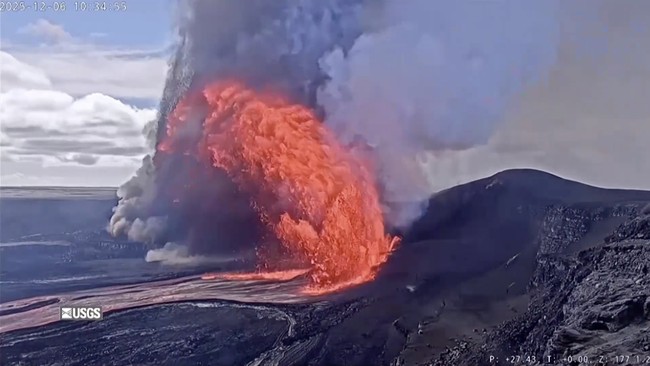
Jakarta — Researchers have discovered an accurate method for detecting volcanic eruptions. This latest system can capture eruption signals within hours before an explosion occurs.
To date, several signs of volcanic eruption have been identified, such as seismic activity, changes in land shape, and changes in the volume and composition of gases emanating from the volcanic mouth. Although these have been known for some time, these signals remain difficult to interpret, particularly regarding the timing of the eruption and its explosive force.
Existing signals have also left a problem of “false alarms.” Incorrect warning signs can cause several issues, such as expensive evacuation costs, disruption to life and the economy, and loss of public confidence in early warning systems.
Unlike previous approaches that relied on probabilistic analysis, François Beauducel from the Institut de Physique du Globe de Paris and Philippe Jousset from GFZ Helmholtz Centre for GeoResearch have employed a system that detects the physical signals of magma movement.
They used the “jerk” or “shock” method to identify small changes in ground movement that occur when magma enters the Earth’s crust. These signals appear at low frequency. Researchers believe their origin lies in the rock-breaking process that occurs before eruption.
These signals were actually recognised ten years ago from data collected from Piton de la Fournaise volcano in La Réunion. Even using the most sensitive seismometers, the emerging signals were extremely small, measuring just a few nanometres per second cubed.
The two researchers applied this concept through a system they installed from April 2014 at the observation station for Piton de la Fournaise volcano. The first signal was received on 20 June 2014. The system provided a warning 1 hour and 2 minutes before the eruption.
Over the following ten years, the “jerk” detection operation system operated continuously. The system provided automatic warnings in 92 per cent of 24 eruptions that occurred between 2014 and 2023. Warnings appeared from minutes to 8.5 hours before magma reached the volcanic mouth.
However, approximately 14 per cent of warnings did not result in an eruption, or “false positives.” Researchers emphasise that this is not an error in the system. The system detects magma intrusion that subsequently fails to break through upwards. This phenomenon is called an “aborted eruption.”
The research team now plans to expand testing of their method across more volcanoes. One of their primary targets is Mount Etna in Italy.