
Requirements, Registration Process and Benefits of Joining the 2026 National Vocational Training Programme
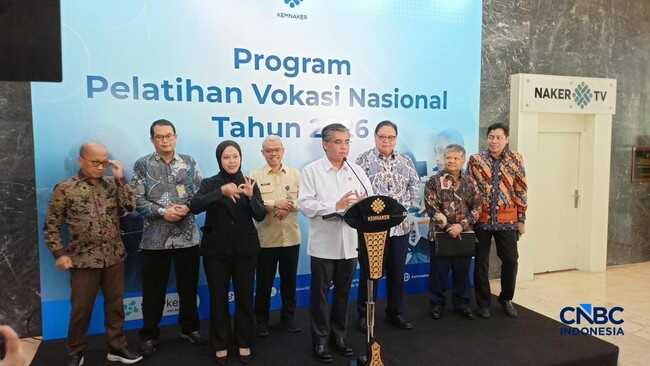
Jakarta — In pursuit of realising Golden Indonesia 2045, the government has officially launched the 2026 National Vocational Training Programme aimed at enhancing the skills of secondary and vocational school graduates.
The National Vocational Training Programme for 2026 is divided into three training batches, with approximately 20,000 participants per batch, totalling around 70,000 participants annually.
“The Government is launching the 2026 National Vocational Training Programme, which has been initiated by the Ministry of Manpower. All training activities are provided free of charge by the Government,” said Coordinating Minister for Economic Affairs Airlangga Hartarto on Monday (2 March 2026).
The programme is implemented at 33 technical implementation units of the Vocational Training and Productivity Centres (UPT BPVP) and Service Units (Satpel) of the Ministry of Manpower distributed across various provinces throughout Indonesia.
The National Vocational Training Programme is designed to provide skill development, upskilling, and reskilling to participants, emphasising the link and match principle. This principle ensures strong alignment between training curricula and the needs of the business and industrial sectors. This approach aims to produce graduates with competencies that are relevant, adaptive, and in accordance with labour market demands.
Secondary school graduates aged at least 17 years who have a SiapKerja account and have graduated within the past three years can participate by accessing the official portal at skillhub.kemnaker.go.id.
By participating in this programme, participants will receive benefits including transportation assistance of Rp20,000 per day (for the duration of training), Work Accident Insurance (JKK) and Death Insurance (JKM) contributions, Training Certificates and BNSP Competency Certificates, and for participants from outside the city, hostel accommodation can be provided for certain training programmes.
According to data from the Ministry of Primary and Secondary Education, the number of secondary and vocational school graduates for the 2024/2025 academic year was 3.28 million. According to the Central Statistics Agency, secondary school graduates account for 31.05 million workers or 20.99% of the total national workforce of approximately 148 million people, whilst vocational school graduates contribute 20.80 million workers or 14% of the total national workforce. Combined, secondary and vocational school graduates account for approximately 35% of the total workforce.
Training fields that participants can follow include Information and Communications Technology, Business and Management, Tourism, Fashion and Design, Garment and Apparel, Automotive, Housekeeping, Electrical Engineering, Smart Farming, Construction, Barista, Fish Farming, Hairdressing and Make-up, Cooking, Tailoring, Vehicle Maintenance, Tour Guide, Digital Marketing, Cybersecurity, Solar Panel Installation, Welding, Computer Numerical Control (CNC), Industrial Automation, Electric Vehicles, and presidential priority training programmes such as Red and White Cooperatives and Free Nutritious Meals. These various training programmes are conducted in offline, online, or hybrid formats with more than 820 training classes focusing on 31 vocational areas.
“I hope the implementation of this vocational training programme will also involve training providers not only from the Ministry of Manpower’s work units, but can also integrate training centres owned by various other Central and Regional Government agencies, as well as private institutions. This way, the national coordination and management of the training programme can run optimally, without duplication, sustainably, and efficiently,” said Coordinating Minister Airlangga.
Furthermore, Coordinating Minister Airlangga noted that this is a programme parallel to the internship programme that has already been implemented and its focus is secondary and vocational school graduates. “Of course, we appreciate the Ministry of Manpower and hope that secondary and vocational school students can participate in a programme that shortens the gap between education and the job market. This programme will also continue to be encouraged and refined in accordance with the President’s direction,” concluded Coordinating Minister Airlangga.