
Repositioning the Economy and Energy Geopolitics
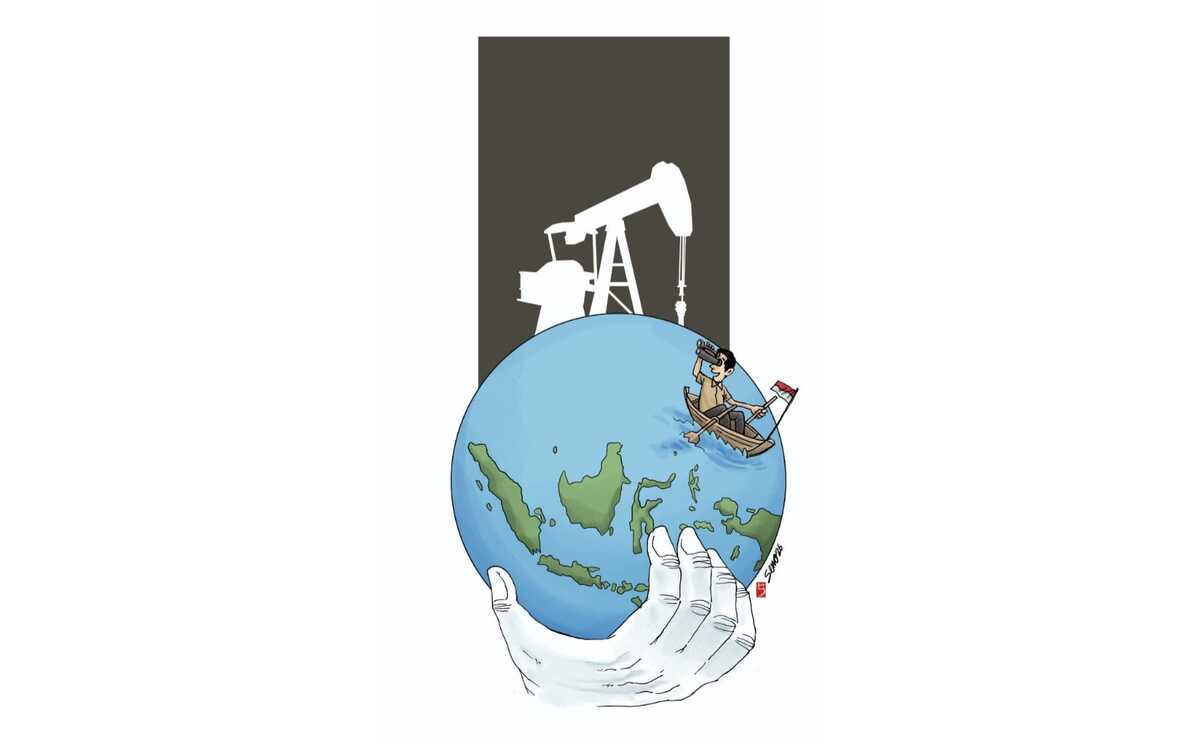
Indonesia suspends discussions on the Peace Council. Economic calculations are becoming increasingly intricate to formulate. Various projections often end up in disarray when confronted with uncertainty. Issues such as climate change, technological discoveries, and inter-regional political conflicts (wars) constitute megadisruptions that are difficult to anticipate. Global consensus ratified over the decades has been trampled under by narrow agendas of each country. Global economic agreements, as well as climate accords, have collapsed due to hard unilateralism demonstrated by the superpower, namely the United States. Multilateral institutions, such as the UN and the World Trade Organization (WTO), which once stood so superior in shaping the behaviour of countries worldwide, now falter and lose legitimacy. A new history is being written in the wake of World War II. The old order, not yet a century old, is soon to be replaced by a new rulebook filled with escalating threats and gloom. The shift in the global economy is creeping along, and one hard issue behind it is the scramble for energy resources. CRUMBLING OF THE CONSENSUS A decade ago, The Economist Intelligence Unit (2015) forecast that the 2019-2030 period would see the Asia-Pacific region contribute 42-43% of global GDP and, in the 2041-2050 window, their share would become dominant at around 55%. That projection has now gained validation, as the superiority of the US and Europe diminishes in step with the growth trajectories of China, India, Indonesia, and South Korea. Based on GDP with PPP (purchasing power parity) basis, by 2016 China’s GDP was already above the US. Indonesia is currently placed among the world’s top seven economies, having displaced Brazil (IMF, 2025). By 2030 Indonesia is projected to rank among the top five, ahead of Germany and Russia. By 2050 the world’s five largest economies, in order, are expected to be China, India, the United States, Indonesia, and Brazil. It should be noted that Latin American countries, especially Mexico, are also set to rise and reach the seventh position by 2050. The economic repositioning is unfolding in silence. For Indonesia, the forecast reads as an opportunity, stirring collective optimism. Yet, as noted above, the changes are immense. Beyond climate change, technological breakthroughs, and political conflict, the economy shows signs of liberalisation slowing due to mounting resistance, particularly from China and India (Saul, 2018). The world’s economic axis is now polarised into limited regional blocs. China has forged an economic bloc intended to eliminate US hegemony, as has Russia. China has historically preferred bilateral agreements over multilateral ones (Allen, 2023). India employs a high-growth strategy to bolster its bargaining power against the US and China. The dynamics of the global economy are intensifying in the face of growing multipolarity. Globalisation and liberalisation are cut through by polarisation. Europe is struggling to keep pace with the swift tempo of Asia-Pacific growth. Germany and the UK are attempting to endure with every resource at their disposal, though they still stagger against the onslaught from all directions. The available readings are not sufficient to fully digest the breadth of the economic changes. On the other hand, the fight against climate change is slowing due to domestic economic pressures in each country. The surface impression is that the US is cool towards mitigating climate change due to the exploitation of fossil resources. Yet, when viewed more deeply, many countries remain committed to managing their economies on a fossil energy basis. The global climate policy consensus has weakened on the ground. Meanwhile, technological change is becoming an inevitability that could curb the use of fossil energy. Technology broadens knowledge and innovation through technological support. The future certainty grows dim as inter-country political conflicts in the form of wars (which have been ongoing since 2022) intensify. The light dims into gloom. DYNAMICS OF REGIONAL GROWTH The above shifts in the world order also occur from the perspective of global economic growth (GDP) since the 1960s. At that time world economic growth averaged 5.4% (World Bank, 2025). Since then, the 1970s fell to 4.1%; the 1980s to 3.0%; the 1990s to 2.7%; the 2000s rose slightly to 2.9%; the 2010s rose again to 3.2%; and the 2020s are projected to grow at only 2.6% on average (the lowest in 60 years). The 1980s are regarded as the start of global liberalisation, but the global economy actually declined during that period. Data show that since the 1980s the growth of the world economy has been largely supported by East Asian economies, such as China, Korea, India, Indonesia, and several other countries. By contrast, the economy of advanced nations, particularly in Europe, declined due to demographic deficits, fiscal crises, and erosion of competitiveness. Growth in world GDP per capita over the last 25 years (2000-2024) has been driven, more specifically, by four major countries: China, Russia, Indonesia, and India (World Bank, 2025). In that period, cumulative growth in per capita GDP was 1,273% for China, 740% for Russia, 545% for Indonesia, and 509% for India. Following them are Turkey, Saudi Arabia, Australia, Korea, Brazil, and the United States. This data indicates that the acceleration of East Asia–Pacific economies will be hard for others to catch up, and by 2050 they will be major players on the global stage. Economic transformation has become the key word for the movements of these Asian countries, often encapsulated by the term industrialisation (more precisely: downstream processing). It is the same process that the United States and Europe underwent since the 1850s when the industrial revolution began. Economic growth and per capita incomes rose rapidly, so that they became