
Religious Affairs Minister Hopes Differing Ramadan Start Dates Will Not Cause Division
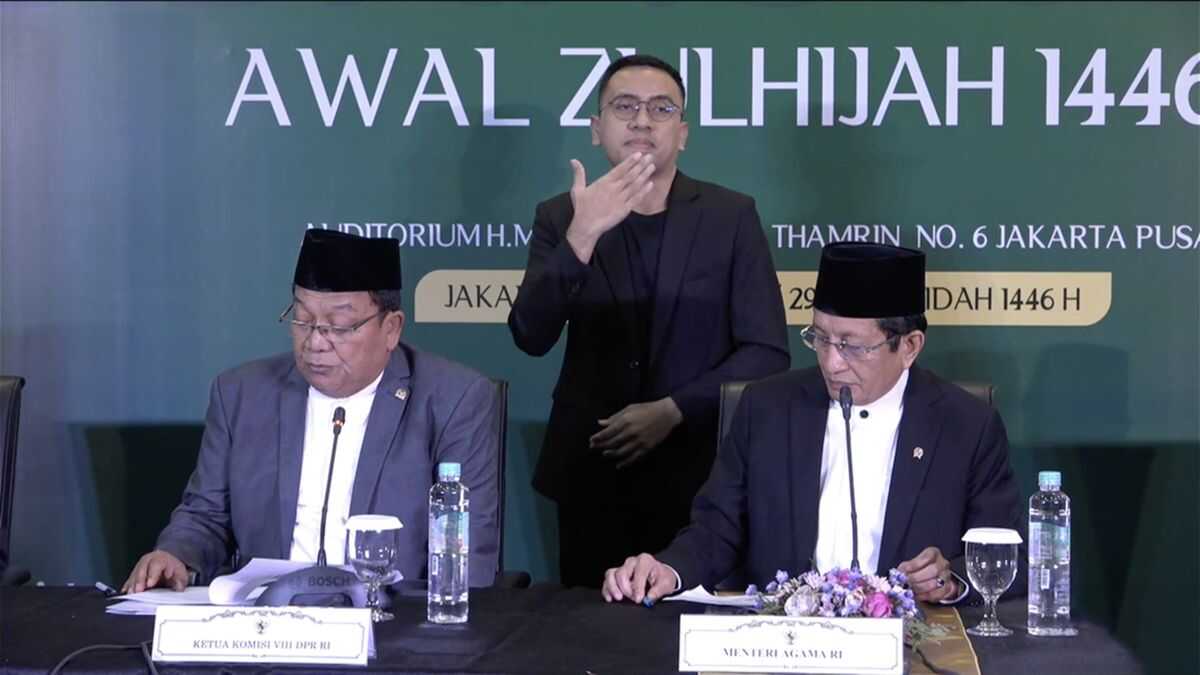
Religious Affairs Minister Nasaruddin Umar has expressed his hope that the difference in determining the start of Ramadan 1447 H will not damage the unity and solidarity among Muslims in Indonesia.
“Should there be Muslims who may observe a different date, we urge the entire community: let differences not lead to division or anything negative,” Nasaruddin said during the Isbat Session for the Determination of the Start of Ramadan 1447 H at Hotel Borobudur, Jakarta, on Tuesday (17 February).
He noted that differences in determining the start of Ramadan have frequently occurred in Indonesia, yet they have never caused a rift among Muslims.
“Indonesia has experience with differences whilst remaining intact in beautiful unity,” he said.
The government, through the Ministry of Religious Affairs, has determined that 1 Ramadan 1447 H falls on Thursday (19 February).
This was because the hilal (new crescent moon) was not sighted through rukyatul hilal observations at 96 points across Indonesia. Furthermore, according to hisab (astronomical calculation), the hilal’s position remained negative, meaning the moon was below the horizon.
“Based on the results of hisab and the absence of a visible hilal, it has been agreed that 1 Ramadan falls on 19 February 2026,” Nasaruddin said.
There is a one-day difference in the start of Ramadan 1447 H this year between the government and Muhammadiyah.
The Central Leadership of Muhammadiyah had determined that 1 Ramadan 1447 H would fall on Wednesday, 18 February 2026.
Muhammadiyah officially set 1 Ramadan 1447 H as 18 February, as stipulated in the Central Leadership of Muhammadiyah Proclamation Number 2/MLM/I.0/E/2025 and the Tarjih and Tajdid Council Explanation Number 01/MLM/I.1/B/2025.
This determination uses the Unified Global Hijri Calendar (Kalender Hijriah Global Tunggal/KHGT) as a new method that has now become Muhammadiyah’s official reference, replacing the previously used wujudul hilal method.
The implementation of KHGT requires the integration of three main elements known as the Principle, Condition, and Parameter (PSP) framework. One of the key parameters is that the hilal’s position after conjunction must reach a minimum altitude of 5 degrees and an elongation of 8 degrees anywhere on the earth’s surface, rather than being limited to a specific territory.