
Relevant Parties Affirm MBG Programme's Constitutionality in Constitutional Court Hearing
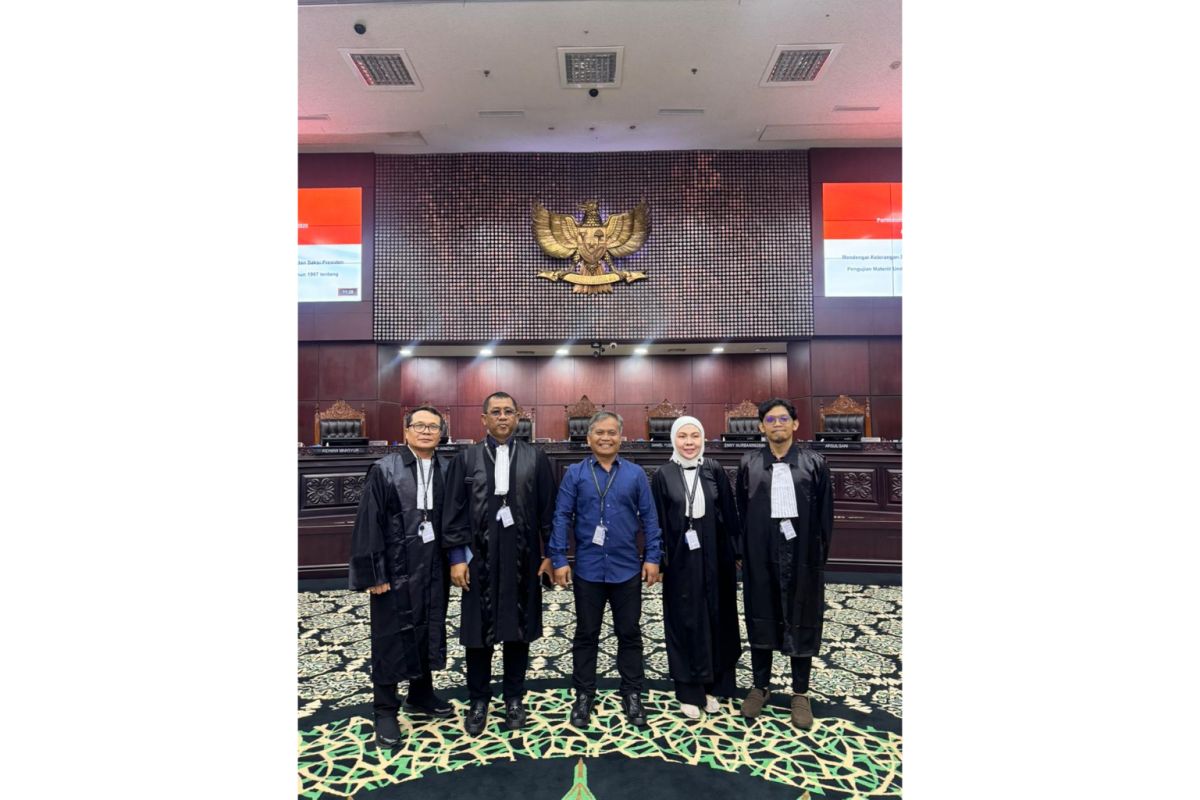
Jakarta (ANTARA) - Joko Sriwidodo, as the representative of the relevant parties in the material examination hearing for cases Number 40 and 55/PUU-XXIV/2026 at the Constitutional Court (MK), affirmed that the Free Nutritious Meals (MBG) programme does not contradict the 1945 Constitution (constitutional). Joko explained that Article 22 paragraph (3) of the 2026 State Budget Law (UU APBN) along with its elucidation, which is being materially examined at the MK, does not contradict the 1945 Constitution but instead expands the constitutional meaning of education financing. “The MBG programme is a long-term investment to improve the quality of Indonesia’s human resources,” Joko stated in his remarks received in Jakarta on Wednesday. Joko Sriwidodo, along with the legal advocacy team and consultants from JsR Law Firm, acted as legal counsel for the relevant parties in the material examination hearing at the MK, Jakarta, on Tuesday (28/4). The parties represented in this case consist of four Indonesian citizens: Sujimin (entrepreneur) as Relevant Party I; Nadya Alwin (housewife) as Relevant Party II; Ayu Yudiana (teacher) as Relevant Party III; and Rizka Rosmawati (private sector employee) as Relevant Party IV. In his statement before the Panel of Constitutional Court Judges, Joko affirmed that the MBG programme is part of a holistic national education system. According to him, education does not only encompass pedagogical aspects but also the fulfilment of basic needs for students, including nutrition. “The MBG programme must be understood as a supporting factor in achieving national education goals, namely to form healthy, knowledgeable, and competitive individuals,” Joko said. He explained that health conditions and adequate nutrition directly influence learning ability, concentration, and student participation in school. Therefore, according to him, providing nutritious meals is deemed relevant as part of efforts to improve education quality. The relevant parties also rejected the petitioners’ argument that the education budget should only be used for pedagogical functions. According to them, such an approach is too narrow and does not reflect the comprehensive concept of national education. In addition, Joko stated that the MBG programme has undergone a legitimate planning and budgeting process in accordance with the rule of law principle. The programme, according to him, has been formulated since 2024 and is part of the National Medium-Term Development Plan (RPJMN) 2025–2029. “This programme has gone through planning stages, discussions with the DPR, to approval in the 2026 State Budget. Thus, there is no violation of constitutional principles,” he said. He also affirmed that as the head of government in a presidential system, the President has the authority to implement priority programmes that have been approved in legislation. In response to the petitioners’ argument regarding poisoning cases in the MBG implementation, Joko assessed that such matters are casuistic and cannot be generalised as an overall programme failure. According to the statement provided, the MBG implementation is equipped with strict food safety standards, from material procurement, processing, to food distribution. “Poisoning incidents do not reflect the entire system, as this programme is run with clear oversight mechanisms and hygiene standards,” Joko said. Furthermore, allegations that MBG causes distortion in the education budget were also refuted. Joko stated that the programme actually strengthens the effectiveness of education spending by improving students’ learning readiness and reducing family economic burdens. Based on all these arguments, Joko, as the relevant party, requested that the Constitutional Court reject the petitioners’ application. This hearing was also attended by relevant parties from the petitioners, represented by Constitutional Law Expert Bivitri Susanti from the Constitutional and Administrative Law Society (CALS).