
Red Bird's Eye Chilli Prices Remain Steady at Rp80,000 Level, Agriculture Minister Claims Decline Beginning
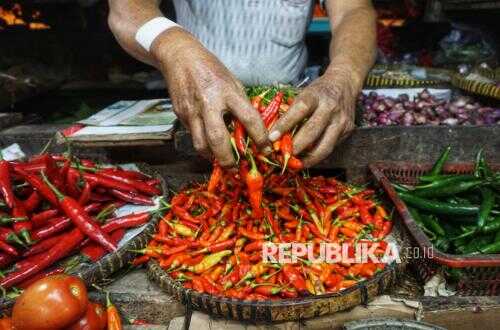
JAKARTA – The National Strategic Food Price Information Centre (PIHPS) managed by Bank Indonesia recorded prices up to Monday at 10:00 WIB with red shallot commodity priced at Rp46,900 per kilogram (kg), whilst red bird’s eye chilli stood at Rp83,850 per kg. Based on PIHPS data released in Jakarta, other food prices at the national retail trader level included garlic at Rp41,700 per kg.
Additionally, lower quality rice grade I was recorded at Rp14,600 per kg and lower quality rice grade II at Rp14,800 per kg. Medium quality rice grade I was Rp15,580 per kg and medium quality rice grade II Rp15,800 per kg. Premium quality rice grade I was documented at Rp17,000 per kg and premium quality rice grade II at Rp16,600 per kg.
The PIHPS further recorded large red chilli prices at Rp43,400 per kg, curly red chilli at Rp48,150 per kg, and green bird’s eye chilli at Rp53,400 per kg.
Subsequently, broiler chicken meat was Rp41,700 per kg, beef quality grade I Rp141,100 per kg, and beef quality grade II Rp133,900 per kg. Other commodity prices included premium refined sugar at Rp19,650 per kg and local refined sugar at Rp18,700 per kg.
Bulk cooking oil was priced at Rp19,650 per litre, whilst branded packaged cooking oil grade I was Rp23,100 per litre and branded packaged cooking oil grade II Rp22,200 per litre. The PIHPS also recorded broiler chicken egg prices at Rp33,400 per kg.
The Head of the National Food Agency (Kabapanas) and Agriculture Minister Andi Amran Sulaiman stated that chilli and chicken meat prices began declining as supply improved and the government stabilised markets across various regions.
“Alhamdulillah, red bird’s eye chilli and chicken meat prices are showing a downward trend. This is the fruit of collaborative effort, both from the supply side and distribution oversight,” said Amran in a statement in Jakarta on Monday (2 March 2026).
He conveyed that the price trend for two strategic food commodities, red bird’s eye chilli and broiler chicken meat, showed significant national decline.
Based on data from the Food Price Panel managed by Bapanas for the period 23 February to 1 March 2026, red bird’s eye chilli prices showed a fairly significant downward trend.
On 23 February 2026, prices were recorded at Rp77,645 per kg, then gradually decreased to Rp70,953 per kg on 1 March 2026. Cumulatively, there was a decline of approximately 8.62 per cent within a week.
“This trend demonstrates consistent price correction that tends to stabilise approaching early March,” he stated.
Meanwhile, broiler chicken meat prices remained relatively stable with a declining tendency. On 23 February 2026 the price stood at Rp41,293 per kg and gradually fell to Rp40,767 per kg on 1 March 2026, or a correction of approximately 1.27 per cent.
This pattern indicated broiler chicken meat prices were in stable condition with controlled fluctuation.
Amran emphasised that the downward trend resulted from strengthened cross-ministerial coordination through intensified Food Violation Task Force (Satgas Saber Pelanggilan) surveillance in the field.
“We ensure price and supply stability are continuously maintained. Market inspections will continue and no business actor must manipulate food prices,” Amran asserted firmly.
The declining tendency in the two commodities’ prices was evident from inspections conducted across various regions on 28 February 2026. At Mamuju Central Market, West Sulawesi, red bird’s eye chilli prices fell significantly from Rp50,000 per kg to Rp40,000 per kg.
At Wonosobo Market Hub, Central Java, prices also corrected sharply from Rp120,000 per kg the previous day to Rp80,000 per kg and further declined to approximately Rp75,000 per kg. At Cikpuan Market, Riau, prices were even significantly below the reference selling price (HAP), at Rp40,000 per kg.
Meanwhile, in Gorontalo prices were monitored in accordance with HAP at Rp57,000 per kg.
Although in some regions such as East Java and Banten prices remained above HAP, at approximately Rp80,000 per kg and Rp100,000 per kg respectively, a downward trend was beginning to form as distribution improved.
Additionally, strengthened supply chain surveillance was conducted through chilli saturation actions carried out with collaboration from champion chilli farmers under the Agriculture Ministry’s guidance together with Bapanas through the Food Distribution Facilitation (FDP) scheme.
Overall, chilli price pressure began to ease compared to the previous period which had experienced significant spikes.