
Record Rice Stock Levels
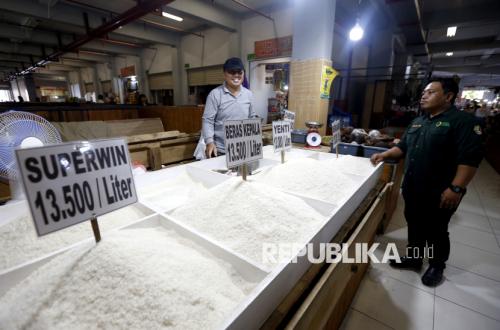
The administration of President Prabowo Subianto and the Red-White Cabinet differs markedly from previous governments. Although it has only been in power for about 17 months, it has already recorded numerous achievements worthy of note in the nation’s history. One such accomplishment is the exceptionally high national rice stock levels, the highest since Indonesia’s independence.
As of March 2026, the government, through the Coordinating Minister for Food Affairs, Bung Zulhas (Zulkifli Hasan), announced that national rice stocks had reached 3.9 million tonnes. This is undoubtedly a commendable achievement.
This high stock level stems from a significant surge in rice production, enabling the country to achieve self-sufficiency as of 31 December 2025. However, despite the abundant stocks, rice prices in the market remain very high.
The question arises: why is this happening? What is really behind these high national rice reserves? Shouldn’t abundant stocks lead to lower rice prices? These are the answers we need.
Indeed, the current situation shows a surplus in national rice stocks, yet prices remain high due to several factors. First, there is inefficient distribution and instances where retail stocks have run out.
Second, suboptimal rice governance, including issues with paddy procurement, stock storage, and the distribution of government rice reserves. It is also worth noting various structural factors and market behaviour dynamics that influence rice prices.
For example, the milling capacity of rice mills exceeds national paddy production, leading to many small mills operating suboptimally.
Faced with these challenges, the government has taken steps to stabilise prices, such as large-scale market operations and distribution evaluations. However, further efforts are needed to improve distribution efficiency and reduce management costs.
In this context, the core issue is the imbalance between rice production and consumption, which can lead to falling selling prices for farmers and rising prices for consumers. This also impacts national food security.
On the other hand, it is important to understand the factors affecting rice stocks, including unstable rice production due to weather, pests, and diseases. Additionally, rising rice consumption with population growth.
Then, inefficient rice distribution, causing disparities between surplus and deficit regions. Uncontrolled rice imports can also affect local rice prices. And inadequate storage leads to post-harvest losses.
Solutions to manage high rice stocks include increasing consumption. Promote food diversification to reduce rice consumption. Then, rice exports. Seek export markets to reduce stocks.
In addition, better storage. Improve storage infrastructure to minimise post-harvest losses. And support for farmers. Provide incentives and technological assistance to farmers to enhance production quality and efficiency.
However, perhaps the most crucial aspect is “transparent and effective rice stock management” by the government. Effective and efficient rice stock management can be achieved through several methods.
First, an accurate information system. Collect real-time data on production, consumption, and rice stocks. Second, thorough planning. Set targets for national production, consumption, and rice stocks. Third, good coordination. Involve all stakeholders, including farmers, traders, and the government.
Fourth, adequate infrastructure. Build storage warehouses and efficient distribution systems. Fifth, clear regulations. Establish clear rules on imports, exports, and rice prices. It should be noted that in rice stock management, the key is “transparency and accountability”.
In practice, transparency and accountability can be implemented through data publication. Present data on rice stocks, production, and consumption openly and regularly.
Next, routine reports. Produce routine reports on rice stock management and share them with the public. Then, independent audits. Conduct independent audits to ensure data accuracy and the effectiveness of rice stock management.
Furthermore, public participation. Involve the community in the planning and oversight of rice stock management. Sanctions should even be imposed strictly on those who violate rules and procedures.
Through these methods, society can monitor and oversee rice stock management, making it more transparent and accountable.