
Reasons Why Convection Entrepreneurs Are Shouting - Just Asking for Import Controls
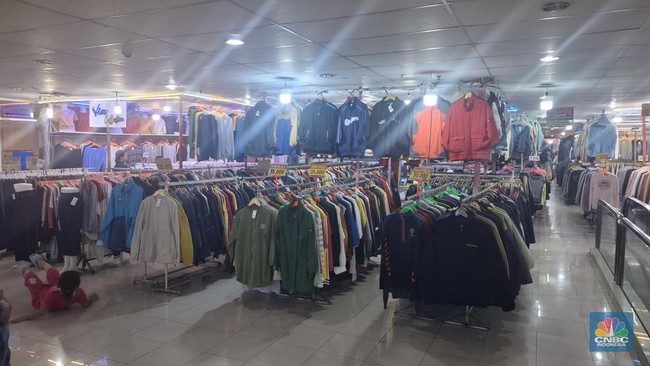
Jakarta, CNBC Indonesia - Players in the small and medium-sized industry (IKM) convection sector are pressing the government to bolster domestic market protections amid the torrent of cheap imported products deemed to be undermining the competitiveness of local businesses.
This demand arises amid the strained conditions in the textile industry. Data from the Industry Confidence Index (IKI) for April 2026 shows the textile sector experiencing contraction, although the garment subsector still records relatively good performance.
However, in the field, IKM players are feeling different pressures. They rely on the domestic market as the backbone of their sales, so disruptions in the local market directly impact business sustainability.
“Because what IKM produces, especially, is almost 95% for the domestic market,” said Pak Nandi.
This dependence on the local market makes business players highly sensitive to changes in competitive conditions. The entry of imported products at low prices is seen as the main threat.
IKM players believe that as long as the domestic market can be protected, pressures from costs or global fluctuations will not have a significant impact on their businesses.
This is because the nature of IKM convection businesses focuses more on absorbing the local market rather than exports. Thus, the stability of domestic demand becomes the primary factor.
“Actually, it’s not too worrying as long as the market is there, the market is protected,” he said.
In addition, business players also highlight imbalances in competition on digital platforms. They admit to struggling to compete with large businesses that have substantial capital for promotion.
This situation makes local products lose out in competition, not only in terms of price but also visibility on online sales platforms.
“Well, IKM still can’t develop on the platform, because without pouring money into heavy advertising, we won’t rise,” said Pak Nandi.
Therefore, business players hope the government does not only focus on macro policies but also introduces concrete regulations to protect the domestic market, including in the e-commerce realm.
This step is deemed important so that IKM players can survive and grow without having to depend on direct assistance or subsidies.
“We just need to be protected in the market, and we’re sure we’ll grow back,” he said.
Meanwhile, manufacturing industry activity is beginning to show signs of slowdown from the demand side. From the IKI release, there is a decline in the new order index to 51.43 and production to 51.34.
Amid these conditions, the domestic market remains the main support.
The domestic demand index is recorded to have increased to 50.90, while the performance of export-oriented industries is slowing with the index dropping to 52.28. This means the local market’s absorption capacity is still strong enough to sustain industrial activity.
Several subsectors are recorded to have experienced contraction during this period. The beverage, textile, wood and wood products, chemical, non-metallic mineral products, metal products, and other transport equipment industries show weakening performance. Specifically for the textile industry, pressure is occurring due to supply constraints of raw materials originating from the petrochemical sector.
The Ministry of Industry (Kemenperin) sees different dynamics at the subsector level. The ready-made garment industry, especially in bonded zones, is considered to benefit from easier access to raw materials.
However, on the other hand, the government highlights the need to regulate the flow of goods so as not to create pressure on domestic industry players.
“We hope the flow of products entering and leaving the domestic market can be well regulated, because this is what is causing the textile industry to face challenges,” said Kemenperin Spokesperson Febri Hendri Antoni Arief in his statement on Thursday (30/4/2026).