
Realising Indonesia's Aquatic Food Sovereignty
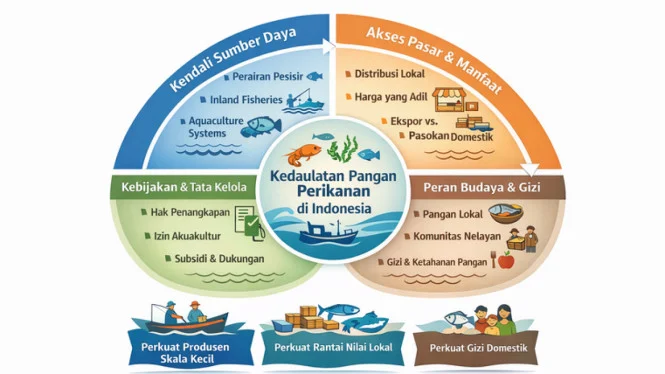
(This opinion article was written by Boimin, Ph.D., a Food Policy Observer, Research Fellow at PKSPL-IPB, Marine-Food Biotechnology Division, who completed his doctoral studies in Food Science at the University of Massachusetts Amherst, United States.)
Food sovereignty is enshrined in President Prabowo’s Asta Cita agenda. Aquatic food has the potential to become a principal pillar in realising Indonesia’s food sovereignty. Indonesia is one of the world’s largest producers of aquatic food, both from capture fisheries and aquaculture — including shrimp, fish, and seaweed.
Aquatic food plays a central role in improving the nutrition and livelihoods of local communities, as well as boosting state revenue from exports. However, public access to affordable and nutritious aquatic food remains uneven across different regions. Small-scale fishers and fish farmers also receive only marginal returns from the existing aquatic food system.
Aquatic food sovereignty must be realised. Stakeholders should work together and possess the capacity to control the production, distribution, and public access to aquatic food (Wittman, 2023) — that is, through sound aquatic food policy.
Aquatic food policy can deliver a robust aquatic food system, thereby improving local nutrition. Small-scale fishers and fish farmers can be better prioritised. Value chains can also be strengthened, as supply chains and logistics improve in tandem. Indonesia’s aquatic food export markets can likewise be safeguarded and expanded.
In other words, aquatic food sovereignty is closely linked to the aquatic food system.
FOOD SOVEREIGNTY AND THE AQUATIC FOOD SYSTEM
Food sovereignty goes beyond mere food security. Food security concerns how communities can survive. Food sovereignty, by contrast, concerns how communities can not only survive but also grow and thrive (Maudrie et al., 2025).
Aquatic food sovereignty can be achieved if supported by a robust aquatic food system. The characteristics of Indonesia’s aquatic food system include the following: small-scale capture fisheries are dominant; aquaculture is expanding rapidly; seaweed production is undergoing extensification; and fish markets are diverse, serving both local and regional demand.