
‘Real increase in violence’: What’s behind rising domestic abuse rates reported in Southeast Asia?
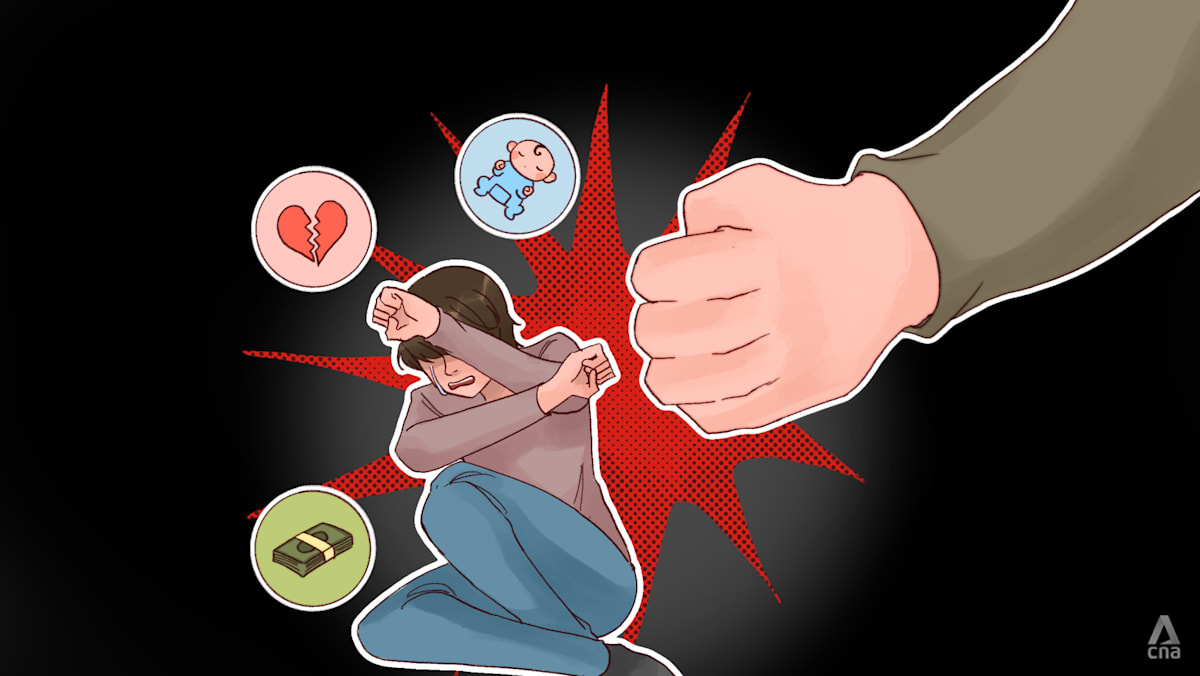
‘Real increase in violence’: What’s behind rising domestic abuse rates reported in Southeast Asia?
Experts say there is a need for governments to allocate resources to support the long-term recovery, rehabilitation and empowerment of domestic violence survivors.
KUALA LUMPUR: A few months ago, Mira (not her real name) reached breaking point.
The 49-year-old mother of five from Shah Alam, Selangor, stood sobbing hysterically in her bedroom, holding a knife to her skin.
Just moments earlier, her husband had loomed over her, brandishing a machete, demanding the password to her phone.
“It was just before the start of fasting for the day and I was scrolling through social media when he suddenly flew into a rage, and accused me of cheating on him,” she told CNA.
The accusation was followed by physical assault. Hysterical and exhausted by the mental toll of continuous violent abuse over the course of her 20-year marriage, Mira grabbed the knife in a desperate act of self-harm.
Her husband, who is a fisherman, eventually wrestled the blade away, handed her some money, and told her to go shopping for the festive season.
Instead, Mira went to the police. She sat outside the station for a full hour before she finally walked inside and lodged a police report.
She was subsequently admitted to the hospital for three days of treatment. She never returned home and today, she lives in a women’s shelter with other victims of domestic violence.
“I told myself that enough was enough,” she said. “My time with him had to come to an end.”
Mira, who used to operate a cafe, feels she has been granted another chance at life. She compares her case against the recent high-profile news in the country of a civil servant who was so severely beaten by her husband that she suffered a miscarriage.
The woman also reportedly suffered from a broken arm and broken ribs from her husband - whose violent history had left his previous wife in a coma for five years - allegedly punching her in the stomach and using clothes hangers, a garden hose, a curtain rod and a broomstick to beat her.
“I really can’t imagine what she is going through,” said Mira.
These cases paint a grim picture of wider regional statistics. While data collection and tabulation methods vary significantly across Southeast Asian nations, the underlying trend remains: Reported domestic violence cases are climbing sharply.
In Malaysia, the number of recorded domestic violence cases has climbed in the past three years, rising from 5,507 in 2023 to 7,116 in 2024, and 7,391 by 2025, according to media reports citing Women, Family and Community Development Minister Nancy Shukri.
The National Commission on Violence Against Women in Indonesia released its 2025 annual report in March, revealing that gender-based violence cases in the country rose by over 14 per cent last year from 2024, to 376,529 cases.
Almost 90 per cent occurred in the personal sphere, said the commission, reinforcing that the home and intimate relationships remain the most dangerous spaces for women.
And the numbers may not be fully representative of the situation, said experts.
“Reported cases do not tell us the full picture, because many survivors never report to the authorities at all,” Nazreen Nizam, executive director of the Women’s Aid Organisation (WAO), a Malaysian non-governmental organisation (NGO) that deals with issues of domestic violence, told CNA.
“When we see numbers rise, it may reflect a real increase in violence, but it can also mean that more survivors are recognising abuse, feeling safer to seek help, or finding more channels to report,” she added.
WHAT IS DOMESTIC VIOLENCE AND WHY DOES IT OCCUR?
Domestic violence, as defined by the United Nations (UN), is a pattern of behaviour used by one partner to gain control over another in an intimate relationship.
Experts categorise domestic violence into several overlapping dimensions: physical, psychological, social, and financial, all of which serve to isolate and control the victim.
Around one in four reported domestic violence cases in Malaysia last year were against males, according to the country’s women, family and community development deputy minister. Reports citing Lim Hui Ying said that out of 7,391 domestic violence cases reported nationwide, 1,961 involved male victims.
“Abuse happens because domestic violence is about power and control,” said Nazreen of WAO. “So … men can also be subjected to physical, emotional, psychological or financial abuse … but one of the biggest issues is that male survivors often face strong stigma when it comes to speaking up.”
She added that social expectations about masculinity could make it harder for men to admit they are being abused or to seek help, making it possibly even more challenging for them than for women to come forward and report it.
“Many may fear shame, ridicule, disbelief, or not being taken seriously,” she said.
Still, the statistics are skewed towards female victims being the vast majority.
Malaysian civil society organisation Sisters in Islam (SIS) provides legal aid through its free helpline, “Telenisa”. It told CNA that many women reach out only after years, at the point where abuse has escalated to life-threatening physical injury or total psychological breakdown.
“The data from both national reporting and Telenisa cases makes clear that domestic violence is not isolated. It is systemic, often hidden, and deeply tied to issues of power, access, and inequality,” a SIS spokesperson said.
They added that domestic violence was also a leading factor in marital breakdown, ranking among the top three causes of divorce.
Siti Aminah Tardi, executive director of the Indonesian Legal Resource Center (ILRC), told CNA that domestic violence was still a pervasive issue in the archipelago, noting that according to the 2024 UN Population Fund Indonesian Women’s Life Experience Survey, one in five Indonesian women had experienced domestic violence within the past year.
She posited tha