
Readiness of Warehouses to Store 6 Million Tons of Rice Stock
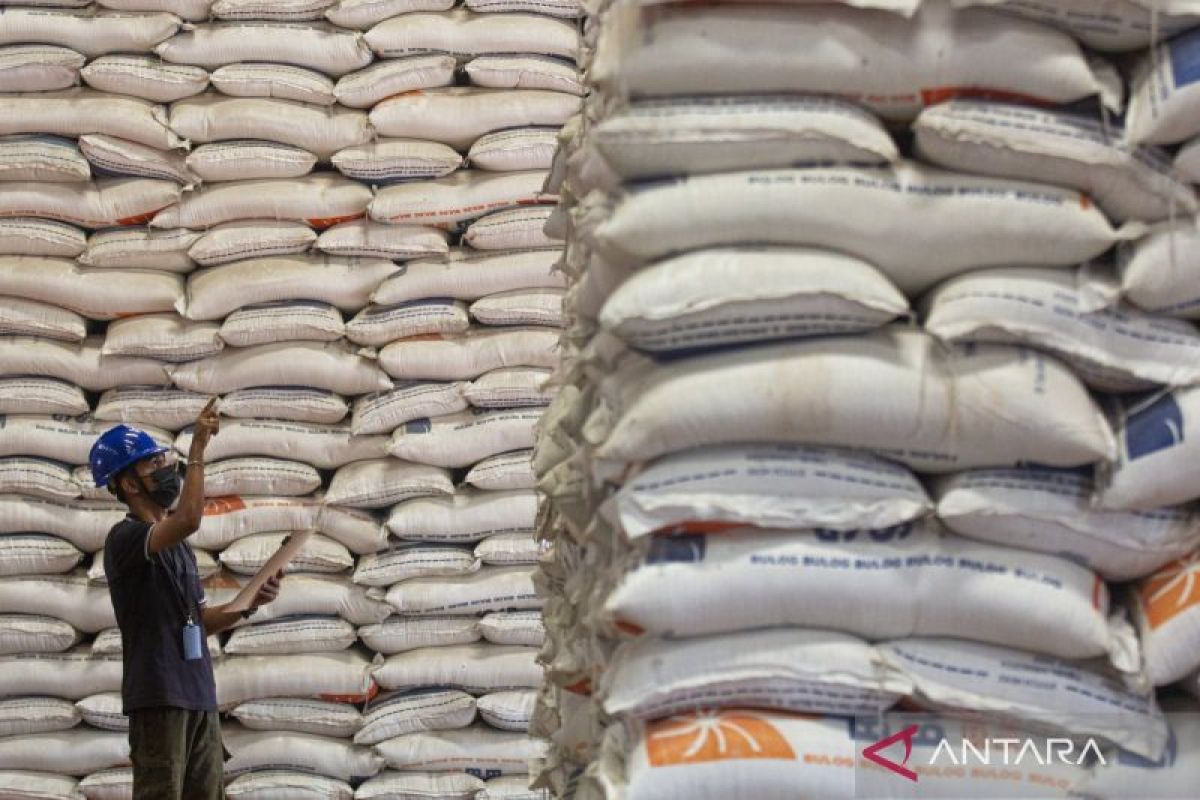
Jakarta (ANTARA) - The national rice stock at the beginning of February 2026, as reported by the Ministry of Agriculture (Kementan), stands at around 3.4 million tons and is estimated to rise to 3.9 million tons by the end of March 2026, with the potential to reach 4 million tons.
This increase indicates improvements in production, as well as initial success in strengthening the national food reserves, which has been a primary concern for the government.
Agriculture Minister Amran Sulaiman stated that Bulog’s rice stock is projected to reach 6 million tons in the next three months, while Bulog’s current warehouse capacity is only around 3 million tons.
This projection certainly signals optimism, as well as a non-trivial challenge for national food logistics management.
If Bulog’s absorption target for this year is 4 million tons, added to the current stock of around 3.3 million tons, the total rice stock could reach approximately 7.3 million tons.
This figure illustrates the potential for very strong rice availability if all targets are realised as planned.
However, if the remaining effective absorption target is only 2.7 million tons from the 4 million ton target, after subtracting the 1.3 million tons already absorbed, the addition would bring the total stock to around 6 million tons.
Thus, the figure of 6 million tons becomes a more realistic projection to achieve in the short term.
The Agriculture Minister’s estimate of a 6 million ton rice stock in the next three months is likely based on several interrelated key factors.
First, the increase in paddy production. Indonesia is expected to enter the peak harvest season from March to April, thus significantly boosting rice production in major production centres.
Second, the optimisation of Bulog’s absorption. With an absorption target of 4 million tons, this effort will have a significant impact on stock increases if carried out consistently and supported by attractive pricing policies for farmers.
Third, the initial stock that is already relatively high. With an initial position of around 3.3 million tons, additions from paddy production and Bulog absorption will drive a rapid surge in stock in a relatively short time.
Fourth, supportive weather conditions. Relatively stable and supportive weather will contribute to increased paddy productivity, thereby strengthening the national rice supply in the coming months.
Bulog Capacity
The critical question is whether storing 6 million tons of rice will not create new problems? The answer is yes, it has the potential to.
The issue is no longer just about the presence or absence of rice, but whether the state can manage that abundance without creating new problems.
Bulog’s limited warehouse capacity becomes the main challenge that must be anticipated immediately with concrete and measured steps.
With a capacity of only around 3 million tons, a stock surge of up to twice that amount certainly risks causing logistical and storage management problems.
These risks are not only related to physical space but also concern rice quality, distribution efficiency, and potential losses due to quality degradation if not managed properly.
In such conditions, Bulog needs to prepare various adaptive strategies, one of which is renting additional warehouses from other parties that have adequate facilities and are located in strategic regions.