
Ramadan on Campus: University Urged to Strengthen Role in Safeguarding Democracy
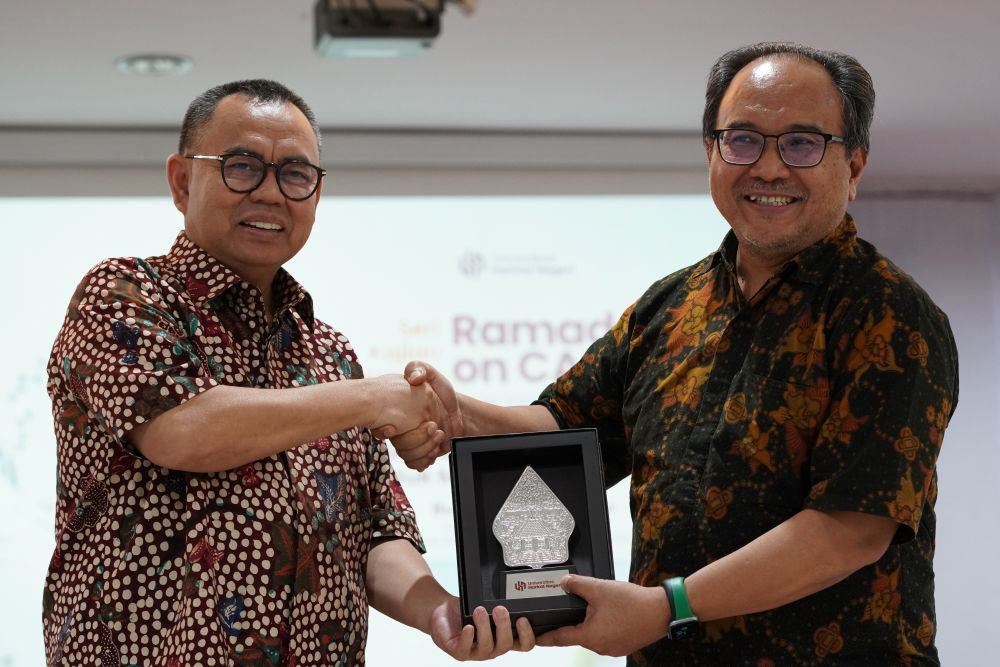
Universitas Harkat Negeri (UHN) in Tegal, Central Java, held its third Ramadan study series entitled “Ramadan on Campus: Strengthening Campus Roles in Civil Society Consolidation to Safeguard Democracy.” The event featured senior journalist Budiman Tanuredjo as the main speaker and took place in the Mataram campus auditorium.
Budiman emphasised the critical importance of universities’ role in shaping ethical public leadership as Indonesia approaches its centennial of independence in 2045. He stressed that the current generation of university students will determine the quality of Indonesia’s democracy in the future.
“The founding generation of the republic was born from crisis. The Indonesia generation of 2045 will be born from today’s campuses. The question is whether they will become ordinary politicians or statesmen,” Budiman stated.
According to Budiman, statesmen are not born from comfort but from intellectual restlessness and moral courage to champion democratic values. Consequently, universities must serve as spaces that foster a tradition of critical thinking and healthy dialogue. He also emphasised that democracy requires strengthening various important institutions, ranging from the rule of law and meritocracy in leadership to healthy political party cadre development and robust checks and balances mechanisms.
“Universities must dare to criticise power without becoming partisan, serve as the conscience when law is weakened, and defend principles rather than figures,” Budiman insisted.
UHN Rector Sudirman Said expressed the campus’s commitment to continuously improving educational quality whilst strengthening student character development. He sought to demonstrate that universities in second-tier cities are equally capable of delivering high-quality education.
“At Harkat Negeri, we are determined to use the word ‘even though’ more often. Despite being in a second-tier city, we believe the educational quality here will reach the highest level,” said Sudirman Said.
Sudirman noted that Harkat Negeri was being directed towards becoming an applied university, emphasising skills strengthening and soft skill development for students. “We want to emphasise soft skill development. When someone has strong mental and interpersonal abilities, they will be able to thrive anywhere,” he explained.
According to Sudirman Said, UHN is also expanding its global academic network, including plans to cooperate on health education development with Harvard Medical School and academic collaboration with Kyoto University through Professor Okamoto from Southeast Asian Studies.
Sudirman Said noted that the discussion on universities’ role in democracy recalled Mohammad Hatta’s thoughts on the moral responsibility of intellectuals. In his book “Tanggung Djawab Moril Kaum Inteligensia” (The Moral Responsibility of Intellectuals), Hatta emphasised that intellectuals must not remain passive towards national issues. An academic, according to Hatta, bears both intellectual and moral responsibility since knowledge ultimately aims to seek and defend truth.
Sudirman Said stated that Hatta also emphasised that intellectuals are part of society with equal rights and obligations in national life and therefore cannot entirely delegate public affairs to those in power.
“Through the Ramadan on Campus forum, we hope that universities can continue to serve as spaces for critical dialogue and as places where future leaders are born—leaders who are not only intellectually superior but also possess moral integrity to safeguard Indonesian democracy,” concluded Sudirman Said, the former Energy and Mineral Resources Minister.