
Ramadan Crescent Moon Not Visible in Surabaya, Still Below Horizon
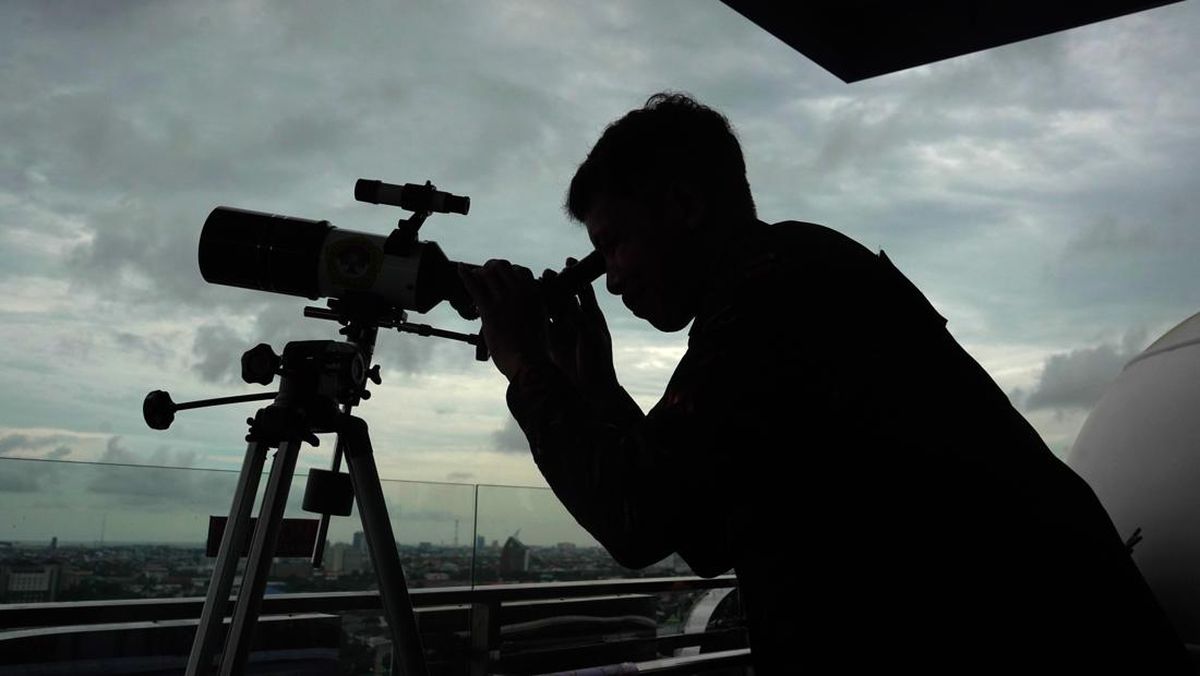
The crescent moon (hilal) that determines the start of the Islamic month was not visible in Surabaya, based on observations (rukyatul hilal) conducted by the Faculty of Sharia and Islamic Law at Sunan Ampel Islamic State University (UINSA) Surabaya on Tuesday (17 February).
The rukyatul hilal involved lecturers and students from the Falak Science (Islamic Astronomy) programme. They also conducted an in-depth study of hisab (astronomical calculation) data to educate the public regarding the position of the lunar month.
Siti Tatmainul Qulub, head of UINSA’s Falak Science programme, stated that based on their observations, the Ramadan hilal was not visible as it remained below the horizon.
“Today the hilal is still below the horizon. Based on calculations, the moon set before the sun, and conjunction has not yet occurred,” said Siti during the observation session.
Under the MABIMS criteria (Ministers of Religious Affairs of Brunei Darussalam, Indonesia, Malaysia and Singapore), which serves as Indonesia’s official reference, a hilal is deemed to meet the threshold if it has a minimum altitude of 3 degrees and an elongation of 6.4 degrees.
However, Siti noted that observations at the Surabaya point showed figures far below the MABIMS standard, meaning the prospect of sighting the hilal was nil.
“For Surabaya specifically, the hilal altitude is still at -1 degree 16 minutes and the elongation is approximately 1 degree 13 minutes. So it is still well below the criteria for determining the start of the month in Indonesia, namely the MABIMS criteria,” she said.
Siti added that the UINSA team had prepared at least eight instruments to support the observation process, ranging from robotic telescopes and manual telescopes to theodolites and binoculars.
Although mathematical calculations confirmed the hilal would certainly not be visible, the rukyat procedure still had to be carried out as a form of factual field verification and to fulfil religious requirements on the 29th day of the current month of Sha’ban.
“It is not merely difficult to see — it is actually impossible to see because the hilal is already below the horizon. The moon has already set by the time the sun goes down. So it cannot possibly be seen. But we still carry out the rukyatul hilal,” she said.
Siti explained that if the hilal remains unsighted by the end of observations, the month of Sha’ban will be completed to 30 days (istikmal). This means, she said, the start of Ramadan will most likely fall on Thursday (19 February).
“Tomorrow is still the 30th, and the day after will be the 1st. But we must of course wait for the Isbat session. Because that session is not based solely on calculations — it is also based on rukyat reports from across Indonesia, from Sabang to Merauke,” she said.
Beyond astronomical factors, weather conditions in the Surabaya area, which is currently in the rainy season, also posed an additional challenge. Overcast skies further increased the difficulty of the observation process.
The report from UINSA’s observation point will be submitted through coordination with the East Java branch of Nahdlatul Ulama (PWNU) to be forwarded as material for consideration at the Isbat Session held by the Ministry of Religious Affairs.