
Ramadan amid Sumatra's Ecological Catastrophe
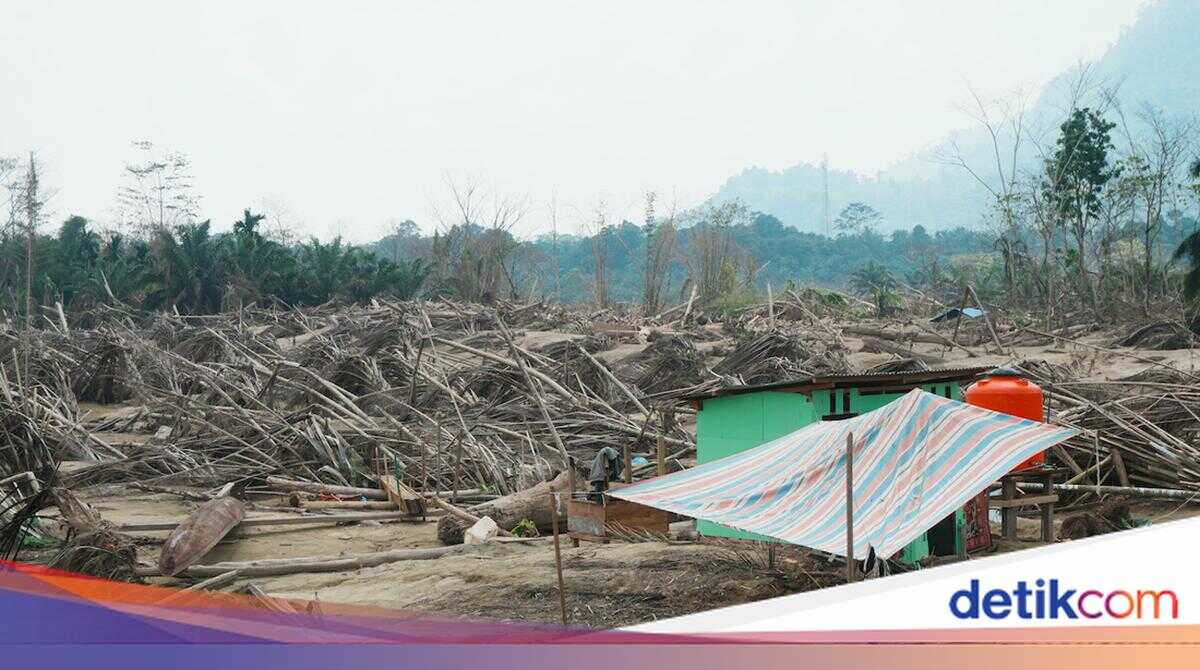
Months after the major floods hit Batu Sumbang village, Simpang Jernih sub-district, East Aceh regency, some residents still live in evacuation tents. Others have been forced to live in their homes, despite the unsuitable conditions. Most houses are surrounded by mud deposits that are higher than the yards, causing water to frequently enter during rain.
“The house is basically on the ground now (lower because of the sediment around it), it was cleaned yesterday. Because this person (the homeowner) couldn’t stand staying in the tent (due to the heat), so they live in the house. When it rains, it’s like that. It’s like scooping water from inside the house,” said Rabuna, a resident of Batu Sumbang, to detikX.
Rabuna said that this year’s Ramadan is a difficult time for residents who are still living in evacuation shelters. Some residents have been forced to build their own temporary shelters. Of the approximately 130 families in Batu Sumbang, the majority of homes were affected and are uninhabitable.
The temporary housing promised by the government is also not yet ready. Residents have been hoping to move out of the tents for a long time. Initially, the government promised to build a large number of temporary housing units. However, only a few have been started and are not yet ready for occupancy.
“Yesterday, the government said 95 units, 95 doors for our village. But it turned out that there was a reduction, but there was no clear explanation. So, the residents were already hoping (to move to the temporary housing). Some residents are still living in evacuation tents,” he said.
The floods also damaged educational facilities. To date, the elementary school in the village has not fully recovered. As a result, students have been forced to learn in limited conditions. In addition, health facilities have also been affected. The community health centre building was severely damaged and cannot be used. Currently, a temporary community health centre is provided for health needs. Sanitation is also limited. To date, residents only have a few public toilets that were built by volunteers.
Residents also complained about the slow assessment of the damage by the government. The team only arrived when some residents had already cleaned their own homes. As a result, some residents have not received assistance for home repairs.
“Basically, the assessment of the houses (affected by the disaster) by the BNPB (National Disaster Management Agency) only started after almost two months. The houses are already occupied by the owners, they have been cleaned. That’s why many residents’ houses were not included in the data (regarding the extent of the damage). Because the houses have been cleaned and repaired by the residents, then the people came to assess them. Where were they before?” he said.
To date, residents are still waiting for the promised assistance in the form of food supplies, funds for home repairs, and the construction of temporary housing. He hopes that the government will immediately fulfill the promise.
“We ask our brothers and sisters, the volunteers, if there are any who would like to donate to our area. Because in this holy month of Ramadan, the food supplies in our village are running low,” he said.
A group of students are playing in the backyard of the Harapan Ne-Ate early childhood education centre, which was damaged by the flash flood in Gampong (Village) Pante Kera, East Aceh, Wednesday (11/2/2026).
Photo: Harits Naufal Arrazie/detikX Contributor
Elsewhere. Almost three months after the floods hit Aceh Tamiang regency, the situation in several areas is still not considered to have recovered. In Landuh village, Rantau sub-district, mud is still piling up in residents’ houses, access to clean water is not yet available, and some residents are still staying in emergency tents.
“Currently, the condition in Aceh Tamiang is still far from recovery. Especially in my area, in Landuh village, many residents are still living in emergency tents,” said Intan Kumalasari, a resident of Landuh village and also a teacher at SMKN 2 Karang Baru, to detikX.
According to Intan, many residents’ houses are still covered in mud. However, there has been no assistance from the government to remove the sediment. Residents also said they had difficulty cleaning independently due to limited equipment.
“There is no effort to clean the houses from the government at all. If there is any, it is done privately by people who have money. But, if it is done by the government, door to door, to the houses, there is none,” she said.
In addition, some locations are still difficult to access due to the high mud deposits. The sediment also makes the roads very slippery and difficult to pass. Conversely, when the sun is shining, the mud deposits turn into thick dust that is easily blown by the wind. This condition is said to make residents experience shortness of breath and respiratory infections.
“Personally, when I go outside, I wear a helmet, a mask, and my chest feels tight because the dust is super thick, super abundant,” she said.
In addition to housing, according to Intan, the most pressing problem for the residents of her village at this time is clean water. To date, the PDAM (Public Water Company) service has not been restored. During the disaster, many water pipes were damaged and have not been repaired. So far, residents have only relied on assistance from private companies and donors, which is limited.
“Many of the pipes are broken and the repairs have not been completed. When I asked, ‘When will the PDAM water supply be restored?’ They couldn’t answer. It is likely to be completed after Eid,” said Intan.
According to Intan, this year’s Ramadan also feels different for the residents of Landuh village. The smooth running of worship is somewhat disrupted because many mosques are damaged. In addition, the atmosphere of the village has also changed drastically.
“Many residents have not returned to their homes. Many are still in evacuation shelters, in rented houses, in relatives’ houses. So this village looks more deserted than before the flood,” said Intan.
Loss of Livelihood
In another place. Habib Muhammad Isa, 70 years old, lives in his house in Blang Panjoe village, Kutablang sub-district, Bireuen regency, Aceh. The house is now habitable again. Previously, the house was uninhabitable. The mud that entered has been removed. However, for Habib, cleaning the house is not enough.