
Race for Hajj Tickets
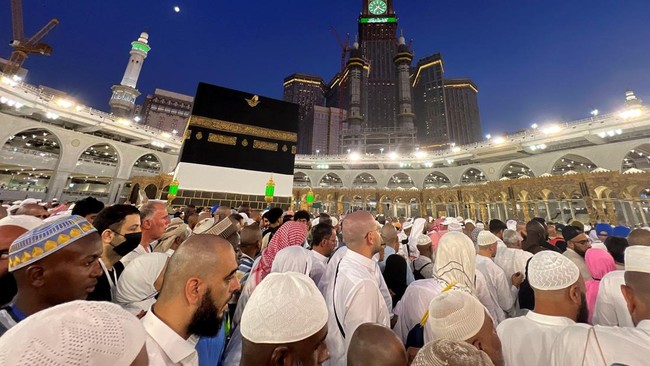
The discourse on implementing a “ticket war” system in Hajj organisation, floated by the Ministry of Hajj and Umrah, has become one of the most spotlighted issues in improving Hajj governance in Indonesia. This idea is intended as a solution to the lengthy queue for Hajj departures.
However, as a concept, it deserves deep attention and consideration, given that there has been no new breakthrough to date that can shorten the long waiting list. Although the idea has been temporarily halted by the Minister of Hajj and Umrah to avoid further controversy, the Ministry of Hajj should begin preparing comprehensive data-based studies and analyses.
As the world’s largest Muslim-majority country, the Hajj quota allocated by the Saudi Arabian government is limited, while the number of registrants continues to rise. The international Hajj quota formula set by Saudi Arabia is generally one pilgrim per 1,000 Muslim residents in a country.
Meanwhile, the provincial quota determination uses a formula based on proportional waiting lists for pilgrims, as mandated by Law No. 14 of 2025. The total national quota is set at 221,000 pilgrims, consisting of 203,320 regular pilgrims (92 percent) and 17,680 special Hajj pilgrims (eight percent).
Using this new quota formula, the waiting period for prospective Hajj pilgrims in Indonesia for 2026 is standardised at around 26.4 years, with estimated departures for 2026 registrants in 2052-2053. The total regular queue reaches nearly 5.7 million people.
This situation causes public anxiety and prompts the government to seek policy breakthroughs. The existence of the Ministry of Hajj and Umrah is expected to be part of major reforms in Hajj governance. With more focused authority, this ministry is hoped to bring innovations in Hajj management, including in the registration system.
It is in this context that the “ticket war” discourse emerges. This system proposes a real-time digital registration mechanism, where prospective pilgrims hunt for quotas directly. The principle is simple: first come, first served.
The government argues that this system will increase efficiency and transparency. No more decades-long waiting lists; the process becomes more dynamic and technology-based. Additionally, digitalisation is seen as capable of minimising brokerage practices and queue manipulations.
As a discourse, the “ticket war” idea is certainly reasonable. The issue is that it was voiced by public officials at the level of Minister or Deputy Minister, still in the form of discourse, not based on accurate studies and data.
The complexity of Hajj issues is not merely about shortening waiting times, but involves aspects of justice, regulation, and Hajj financial management. Therefore, the government needs to conduct in-depth studies, based on data and input from various parties, so that the resulting policies are truly on target and do not create new problems.
Challenges in Implementing “Ticket War”
The “ticket war” system has the potential to create new injustices for pilgrims, especially elderly ones. Not all prospective pilgrims have equal access to technology.
Uneven internet connectivity, limited digital devices, and low technological literacy in parts of society pose serious barriers. In a speed-based system, they must compete with those more tech-savvy. Justice in public services is not just about equal opportunities, but also about the ability to access those opportunities.
It cannot be denied that the current Hajj queuing system in Indonesia has weaknesses, particularly the long waiting time. However, that system offers one very important thing: certainty. Every registrant knows approximately when they will depart, even if they have to wait a long time.
In contrast, the “ticket war” system eliminates that certainty. Departures are no longer determined by registration order, but by speed and readiness at a specific moment. From a distributive justice perspective, this change is very significant.
The “ticket war” system also faces non-trivial technical challenges. Experiences in various sectors show that quick-claim systems are vulnerable to server disruptions, overloads, and system errors.
Moreover, there is potential for technology misuse. In online ticket systems, the practice of using bots to win competitions is not new. If something similar happens in the Hajj context, quotas could be dominated by certain parties with superior technological capabilities. This could give birth to a new black market, where Hajj slots are traded unofficially.
This controversy also touches on religious ethical aspects that must guide everyone. Hajj is a pillar of Islam with high spiritual value. The process towards this worship should reflect values of justice, patience, and sincerity.
Turning that process into a speed-based competition is a form of commercialisation that does not align with the spirit of worship. This criticism indicates that public policies in the religious field cannot be viewed solely from an administrative efficiency standpoint.
Policy Alternatives
One viable approach to maintain is the queuing system, but with significant improvements in transparency and efficiency. Digitalisation can still be implemented to build transparency.
The queuing system can be made more transparent through an online platform that allows the public to monitor their position in real-time. Additionally, quota allocation can be made more flexible to accommodate priority groups, such as the elderly.
A hybrid approach also presents an interesting option. A small portion of the quota can be allocated to a quick-claim mechanism.