
Pursuing Zero ODOL Target by 2027, East Java Tightens Vehicle Oversight
Amid preparations for Lebaran 2026 travel period, East Java Provincial Government accelerated the handling of Over Dimension Overload (ODOL) vehicles while supporting the realisation of Zero ODOL in East Java by 2027.
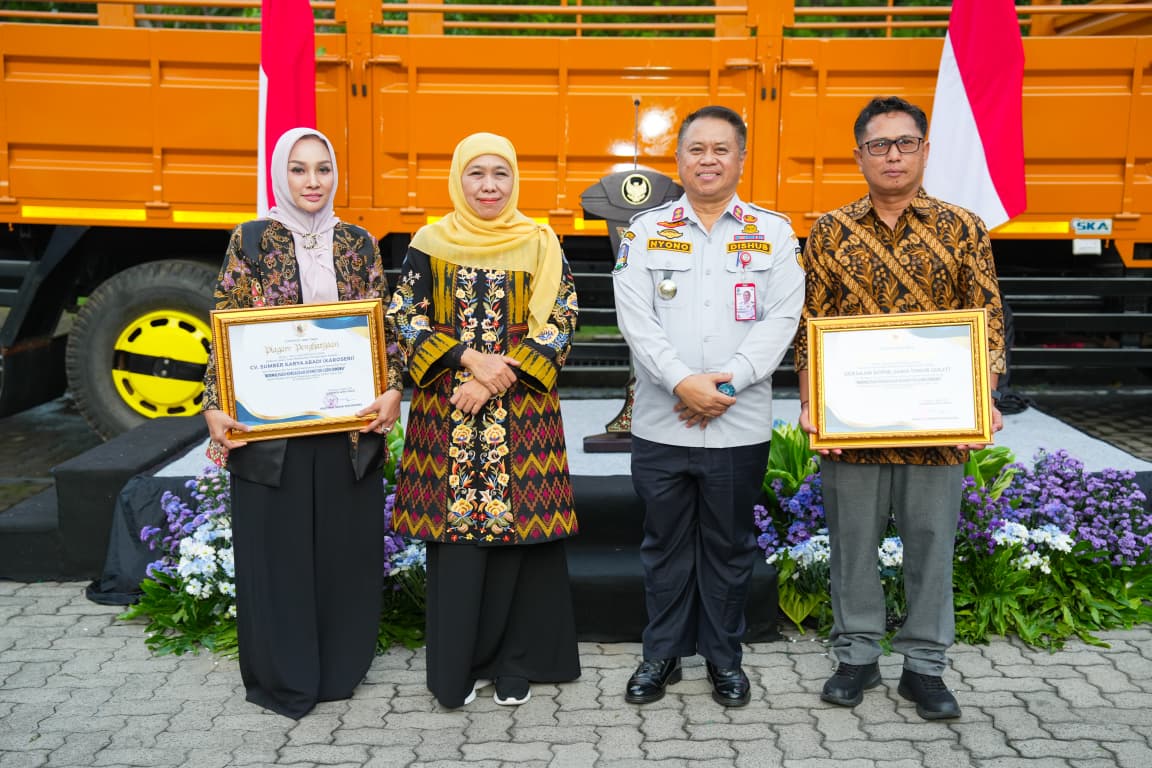
This acceleration began with the handover of trucks whose dimensions have been normalised to representatives of drivers at the East Java Province Department of Transportation (Dishub) compound by East Java Governor Khofifah Indar Parawansa.
In Surabaya on Saturday (7/3), Governor Khofifah Indar Parawansa said that normalising vehicle dimensions is an important step toward creating a road transport system that is more orderly, safe, and sustainable.
This is also part of the government’s commitment to improve traffic safety while maintaining road infrastructure quality. ‘What we are doing today is part of our joint effort in normalising ODOL vehicles. Insha’Allah, if we move together, East Java Zero ODOL by 2027,’ she said.
She explained that vehicle measurements were conducted by the Class II Directorate of Land Transport Management (BPTD) East Java, covering 209 units owned by members of the East Java Drivers Movement (GSJT). Of 238 units, the technical specifications for vehicle dimensions have been issued and normalisation must be carried out on 160 vehicles measured by BPTD Jatim.
The entire normalisation process is facilitated by the East Java Provincial Government gradually, including financing support for dimension cuts for individual vehicle owners who are also drivers and who are not yet able to undertake normalisation.
‘The normalisation process is fully facilitated by the East Java Provincial Government through financing support for dimension reductions,’ she said.
According to Khofifah, this step is expected to encourage broader participation from transport business operators and the driving community to adjust vehicle dimensions to regulatory standards.
SAFETY ASPECTS
Governor Khofifah emphasised that controlling ODOL vehicles is not solely a matter of compliance with regulations, but is closely linked to safety for all road users. Vehicles with excessive dimensions and loads have been shown to increase accident risk and accelerate damage to road infrastructure.
Road damage caused by ODOL vehicles not only increases the need for infrastructure repair budgets but also affects the smoothness of national logistics distribution and the effectiveness of various government programmes, including the Safety Action Plan (RAK).
‘In strengthening national logistics, ODOL can become a bottleneck. Road damage due to excessive loads will affect distribution effectiveness and safety,’ she said.
Governor Khofifah urged all parties to continue the normalisation process for vehicles still in the ODOL category so that Zero ODOL by 2027 can be achieved in East Java.
‘Thank you once again. Let us continue; vehicles still in the ODOL category, let us normalise together with the strength we have. Insha’Allah, we can achieve Zero ODOL by 2027 in East Java,’ she said.