
Pursuing 100 GW of Solar Power: IESR Presents 11 Strategic Recommendations
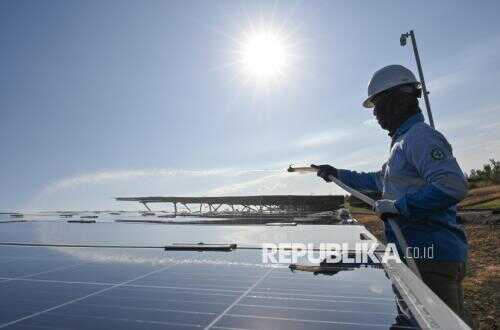
JAKARTA — The Institute for Essential Services Reform (IESR) is urging the government to launch a national mobilisation effort to realise the target of building 100 gigawatts (GW) of solar power plants (PLTS) within the next five to ten years. IESR CEO Fabby Tumiwa said a programme of this scale, targeting up to 80,000 villages, cannot be executed through a business-as-usual approach and instead requires governance akin to national crisis management.
“This cannot be done in the usual way. The scale is enormous and the timeframe is short. We need management similar to facing a war or a pandemic,” Fabby said during the presentation of the 100 GW solar implementation roadmap on Monday (23/2/2026).
IESR has put forward 11 strategic recommendations as the foundation for implementing the programme. The first recommendation is the establishment of a national command structure, or national solar coordination body, in the form of a cross-ministerial task force. This structure is needed to ensure coordination, regulatory synchronisation, and centralised and rapid project execution.
The second recommendation emphasises the importance of coordination structures at the regional level. With more than 17,000 islands and 34 provinces, project implementation is considered impossible to carry out effectively without the active involvement of local governments. Local structures are also important to ensure solar projects can create direct economic benefits for village communities, including business opportunities and employment.
Third, regulatory reform to make projects commercially viable (bankable). IESR proposes the development of standardised contracts, the application of a regulatory sandbox to test new business models, and certainty regarding offtake schemes and payment guarantees such as take-or-pay arrangements. Tariff setting must also consider geographical factors, as project costs in remote areas differ from those of utility-scale solar plants in infrastructure-dense regions.
Fourth, the creation of a dedicated financing architecture. IESR proposes mechanisms such as a village energy facility with blended financing schemes, including equity support and risk guarantees. Cluster-based green bond instruments and performance-based incentives are considered essential to attract investor interest.
Fifth, standardisation of design and technical systems. To achieve the 100 GW target, IESR proposes a container-based modular model with specific capacities, such as 200 kilowatts or 500 kilowatts, designed as plug-and-play systems. National design standards are needed to enable simultaneous and efficient implementation.