
Pure electric vehicles predicted to dominate 80 percent of China's market by 2040
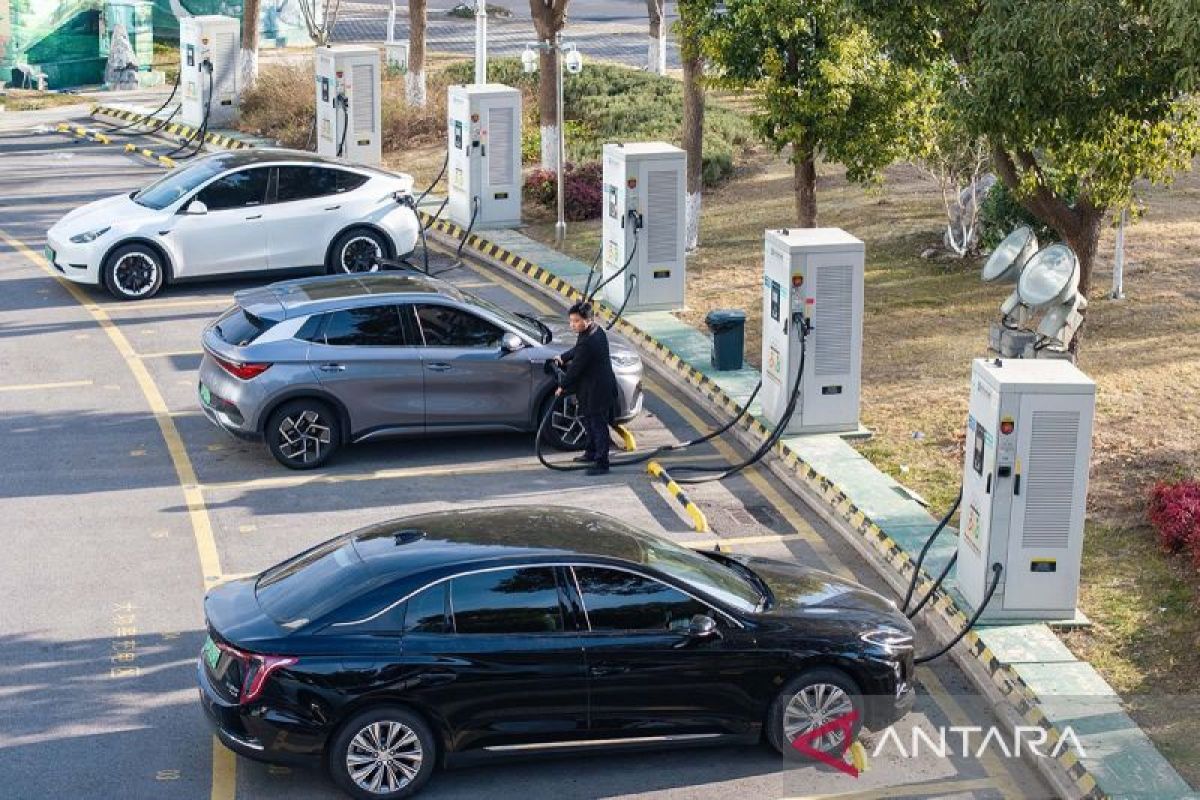
Jakarta (ANTARA) - Plug-in hybrid vehicles (PHEVs) and electric vehicles with range extenders in China are already beginning to decline and are predicted to be fully dominated by pure electric vehicles in the Chinese market by 2040.
This statement was made by Professor Ouyang Minggao from Tsinghua University at the Smart Electric Vehicle Development Forum held on 11–12 April in Beijing.
Quoted by Carnewschina on Saturday (11/4) local time, Ouyang emphasised that pure electric propulsion is the most efficient way to utilise green electricity. Its efficiency is said to be twice as high as hydrogen vehicles and four times higher than combustion engine vehicles using synthetic fuel.
According to him, this advantage fundamentally determines that PHEVs and extended-range models will increasingly be abandoned.
Ouyang predicts that by 2030, the market share of new energy passenger vehicles (NEVs) will exceed 70 per cent, with a ratio of pure electric vehicles (BEVs) to PHEVs of 7:3.
Ouyang stated that at that point, BEVs will end the debate on which technology is best and become the primary choice, while also elevating China’s automotive industry from merely large to strong.
For trucks and commercial vehicles, one of China’s leading automotive industry experts projects that the market share of new energy vehicles will gradually exceed 50 per cent by 2030 and over 70 per cent by 2040.
The total number of new energy vehicles is estimated to reach 100–150 million units by 2030, 200–300 million units by 2035, and 300–380 million units by 2040.
In response to industry enthusiasm for solid-state batteries, Ouyang cautioned against rushing. He explained that this type of battery still faces various scientific challenges, such as side reactions at interfaces that affect chemical, air, mechanical, and thermal stability.
He estimates that solid-state batteries with an energy density of 300 Wh/kg may only emerge towards the end of 2030. However, he emphasised that companies should be cautious in launching products and not use this technology merely as a marketing tool.
China itself has made significant progress in this field, with 44 per cent of total new patent applications coming from the country.
Nevertheless, Ouyang highlighted that China does not yet have a truly authoritative safety rating system, unlike some other countries that already have such standards.