
Purbaya’s Rp1,082.8 Trillion Expenditure Through April 2026: What Is It For?
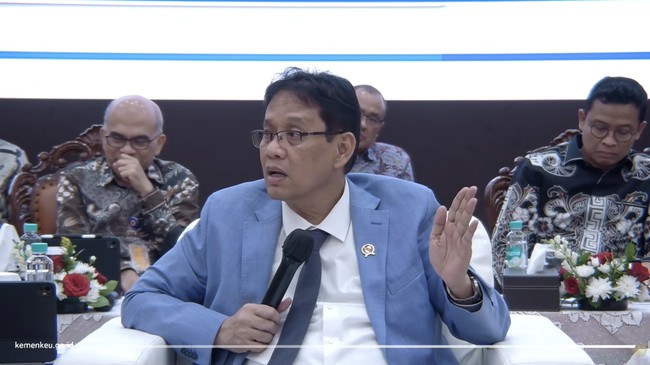
Jakarta, CNBC Indonesia – The realisation of state expenditure stood at Rp1,082.8 trillion up to the end of April 2026. That expenditure rose by 34.3% compared with the same period last year, or about 28.2% of the total budget ceiling for the year. The increase was mainly driven by central government spending reaching Rp826 trillion, up 51.1% from the same period last year.
Government Spending by Ministries/Institutions
The rise in government spending was led by Ministry/Agency outlays reaching Rp400.5 trillion, up 57.9%, influenced by the MBG programme, social assistance transfers (PBI JKN, Kartu Sembako, PKH, and KIP Kuliah), and THR payments.
Detailing the breakdown of ministry/agency expenditure, it comprises government employee expenditure, which from January to 30 April 2026 rose compared with the same period last year. “Realisation of KL spending grew more strongly. Government employee expenditure up 24.4%,” Purbaya said at the APBN press conference at his Jakarta office on Wednesday (20 May 2026).
According to the APBN KITA data edition April 2026, the amount of realisation of government employee expenditure stood at Rp126.9 trillion as of 30 April 2026, rising 24.4% from Rp102 trillion a year earlier. The surge in government employee spending was mainly driven by the appointment of new civil servants, totalling 355,000 people.
Next, the disbursement of Hari Raya allowances (THR) for the State Civil Apparatus (ASN), the TNI, Polri, pensioners and recipients of pensions, followed by accelerated payments of allowances for non-PN educators. The rise in employee expenditure also boosted realisation of ministry/agency expenditure. Overall, the realisation of expenditure by ministries/agencies reached Rp400.5 trillion in January–April 2026, up 26.5% from the same period a year earlier.
Beyond employee costs, other outlays also rose. Capital expenditure increased by 43.6% to Rp52.6 trillion. The rise in capital outlays was mainly to support connectivity and food security (construction of networks and irrigation) through the Ministry of Public Works (PU) at Rp12.8 trillion, the Police (Polri) at Rp19.5 trillion, the Attorney General’s Office at Rp4.0 trillion, and the Ministry of Defence at Rp10.8 trillion.
Social assistance outlays rose 30.2% to Rp56.7 trillion, with social assistance disbursement prioritising improvements in beneficiary data. Outlays for social programmes included: PKH Rp12.9 trillion for 9.7 million beneficiaries; Kartu Sembako Rp16.7 trillion for 17.5 million beneficiaries; PBI JKN Rp15.4 trillion for 96.7 million people; PIP Rp1.4 trillion for 2.9 million students; and KIP Kuliah Rp8.1 trillion for 863,300 students.
Next, goods outlays reached Rp162.4 trillion, up 130%, driven mainly by MBG spending of Rp73.8 trillion.
Non-Ministry/Institution Government Spending
In addition, Non-K/L spending reached Rp425.5 trillion, up 45.2%, influenced by pension benefits payments, subsidies, and compensation for fuel and electricity.
From non-K/L spending, subsidies and compensation disbursed amounted to Rp153.1 trillion by 30 April 2026, equivalent to 34.4% of the APBN. Finance Ministry data show subsidies of Rp74.9 trillion and compensation of Rp78.2 trillion. The level of subsidy and compensation is influenced by fluctuations in Indonesia’s crude oil price (ICP), depreciation of the rupiah, and advance payments of fertilizer subsidies, increased volumes of fuel oil (BBM), LPG, and electricity.
Purbaya noted that the monthly subsidy and compensation payment schemes to Pertamina and PLN have a positive impact on their finances. “Subsidy and compensation outlays to maintain purchasing power are paid in full for subsidies, and 70% for compensation, which has improved Pertamina’s financial position compared with previous years,” Purbaya said.
With the improved finances of the energy state-owned enterprises, Pertamina can more easily secure additional oil purchases even at high prices.
On a more granular basis, subsidy and compensation realisation for fuel (BBM) reached 4,704 thousand kilolitres, up 8.2%; LPG 3 kg at 2,152 million kg, up 3.7% by end-2026. Electricity subsidies reached 42.9 million customers, up 2.2%. Fertiliser subsidies reached 2.9 million tonnes, up 25.2%, and credit subsidy subsidies under KUR reached 1.54 million recipients.
Transfers to Regions (TKD)
Separately, TKD realisation reached Rp256.8 trillion as of 30 April 2026, equivalent to 37.1% of the APBN’s Rp693 trillion ceiling for the year. “TKD disbursed by us is Rp256.8 trillion or 37.1% of the APBN ceiling,” said Finance Minister Purbaya.
Disbursement in April was boosted by DBH, DAU, non-physical DAK, and Otsus funds, including relaxed disbursement and additional TKD allocations for disaster-affected areas in Sumatra. Some TKD allocations are still awaiting the fulfilment of release requirements by local governments.
In Purbaya’s presentation, the acceleration of realisation and additional TKD allocations for disaster-affected areas in Sumatra are shown. Of two stages, Stage I disbursed Rp4.4 trillion unconditional; Stage II totalled Rp3.1 trillion and was disbursed in March 2026. Stage III was disbursed in April 2026, at Rp3.1 trillion, unconditional. With accelerated realisation and additional TKD allocations for disaster-affected areas in Sumatra, TKD for this region reached Rp42.96 trillion or 48% of the ceiling.