
Purbaya Urges Quick Dump of Dollars; Why Is the Rupiah Weakening?
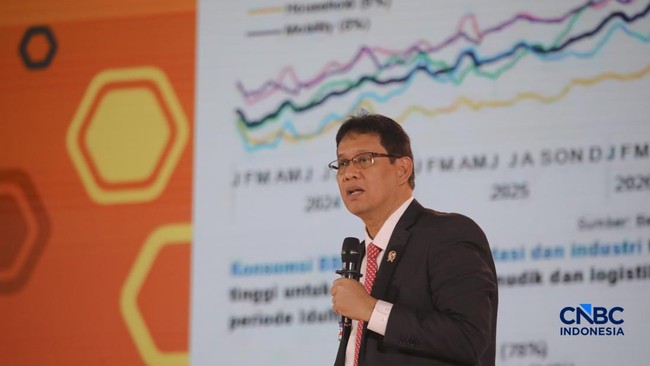
Jakarta, CNBC Indonesia - Finance Minister Purbaya Yudhi Sadewa urged the public and forex market players to promptly dispose of their holdings of United States dollars. He said he is optimistic the rupiah will appreciate to around Rp15,000 per US dollar in the near future.
The statement was delivered by Purbaya at the Jogjakarta Financial Festival at Jogja Expo Centre (JEC), on Friday (21/5/2026), amid the rupiah remaining under pressure.
‘Tell FX players to quickly get rid of their dollars. We will push the rupiah to Rp15,000 per dollar,’ he said.
He even reiterated his message to the public who still hold greenbacks. ‘So I repeat, if you have dollars sell them now,’ he said.
However, the statement raised questions in the market: if the government is so confident the rupiah will strengthen, why has the Garuda currency recently moved weaker?
Purbaya explained that the rupiah’s depreciation at present is influenced more by temporary factors, while the fundamental supply of foreign exchange is believed to improve from June 2026. One of the main drivers is the implementation of the new Devisa Hasil Ekspor Sumber Daya Alam (DHE SDA) rule. The regulation is set out in Government Regulation Number 21 of 2026, which comes into effect on 1 June 2026. In the regulation, exporters are required to place 100% of export proceeds in domestic banks.
For the oil and gas sector, exporters are required to withhold 30% of their DHE for three months. Meanwhile, for the non-oil and gas sector, the retention is 100% for 12 months in a special account.
According to Purbaya, this policy will increase the supply of dollars domestically and thus support rupiah appreciation. ‘The government’s decision to implement this DHE rule is a good and proper step,’ he said.
In addition to relying on DHE SDA, the government is also increasing the dollar supply through the issue of global bonds. Purbaya said the government has just sold global bonds worth US$3.4 billion. The amount comprises US$2 billion in dollar bonds and €1.25 billion in euro bonds.
‘We sold US$3.4 billion, meaning US$2 billion in dollar bonds, and €1.25 billion. If that comes in here, it will add to our dollar supply, so I emphasise again the rupiah will strengthen,’ he said.
He urged the public not to panic amid rupiah fluctuations. ‘If the President says during Purbaya that the economy is good, keep smiling!’ he told the audience, to applause.
Simple Way to Understand Why the Rupiah Weakens
The rupiah exchange rate against the US dollar remains under pressure. In fact, the Garuda currency briefly touched Rp17,725 per USD.
Bank Indonesia Deputy Governor Aida S Budiman explained that the rupiah’s weakness currently arises because demand for the US dollar is far higher than its supply in the domestic market.
‘It weakens because the available supply of US dollars is less than what is demanded, in simple terms,’ Aida said at the Jogjakarta Financial Festival at JEC.
Aida noted this condition is reflected in Indonesia’s current account deficit, which has returned to a deficit at the start of the year.
The current account deficit stood at US4billionoraroundRp70.8trillion(assumingRp17, 700/US) in Q1 2026. The figure is equivalent to 1.1% of GDP, up from Q4-2025’s US$2.5 billion or around Rp44.25 trillion, or 0.7% of GDP.
‘Transactions in our current account imply a deficit, meaning we are net paying more than we receive, this is the problem,’ she said.
To address this, the government and BI have prepared several steps to broaden the domestic supply of dollars. One is the establishment of a state-owned export company, PT Danantara Sumberdaya Indonesia or PT DSI.
‘The President will create a body to ensure export receipts are better and more optimal,’ she said.
In addition, the government and BI are continuing efforts to attract foreign capital inflows into Indonesia so that the dollar supply rises again and can support rupiah stability.
‘And to cover the current account deficit, there are capital transactions. Capital transactions are currently declining and foreign capital inflows must be attracted into Indonesia so that we can meet the needs,’ she added.