
Purbaya to Resolve Licensing Obstacles Behind Stalled Masela Block Project
They can report regularly whenever they need to. We will sort it out here. So, I will treat them as special investors.
Jakarta (ANTARA) – Finance Minister Purbaya Yudhi Sadewa is working to resolve licensing obstacles that have hindered the Abadi Field Project in the Masela Block by INPEX Masela Ltd in the Tanimbar Islands Regency, Maluku.
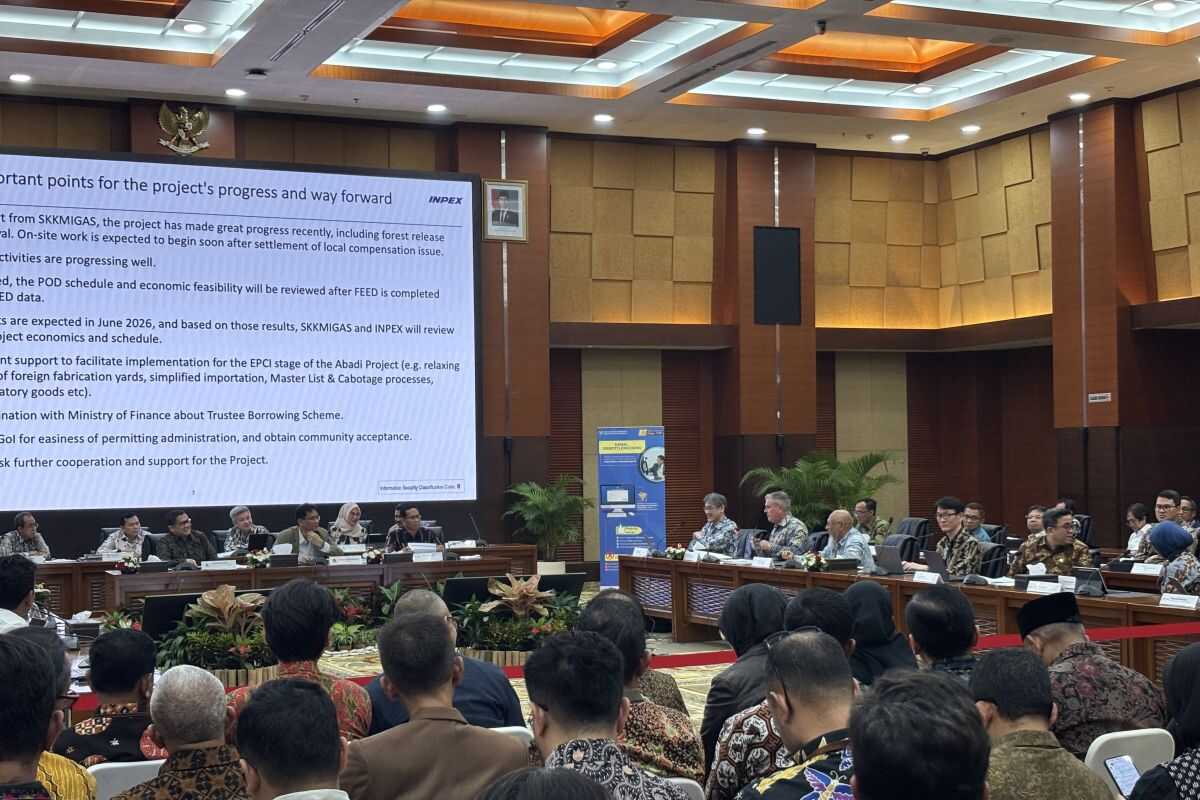
During a meeting on investment obstacles, or ‘debottlenecking’, at the Ministry of Finance in Jakarta on Tuesday, Purbaya gathered representatives from INPEX and related parties to find a solution for the project, which has been ongoing for decades but remains unfinished.
One of the solutions offered by the Minister is a regular reporting channel for INPEX and its consortium partners.
In this regard, Purbaya treats INPEX as a priority investor, given that the Masela Block is a National Strategic Project (PSN) and one of the largest upstream oil and gas projects in Indonesia.
“They can report regularly whenever they need to. We will sort it out here. So, I will treat them as special investors,” said Purbaya.
Regarding the Environmental Impact Assessment (Amdal) documents, Purbaya said he had received reports that the process was almost complete. However, he will still examine the further aspects of the documents.
INPEX has obtained approval for the release of forest areas for the onshore LNG plant from the Ministry of Forestry in January 2026. The follow-up approval for the Amdal from the Ministry of Environment was issued in early February 2026.
During the meeting, INPEX Masela Project Director Harrad Blinco explained that the project’s capital expenditure (capex) for the Masela Block is projected to exceed 20 billion US dollars.
With global inflation and international market dynamics, this figure is expected to be even higher than when the tender process took place.
The Masela Block is targeted to have a production capacity of approximately 9.5 million tons of LNG per year (MTPA), domestic gas distribution of 150 MMSCFD, and condensate production of approximately 35,000 barrels per day.
The project also integrates Carbon Capture and Storage (CCS) technology to produce low-emission LNG. This is in line with global market demands.
In its development, the project involves 11 subsea wells connected to an FPSO (Floating Production Storage and Offloading) facility for initial gas processing before being transported through a 180-kilometre pipeline to the LNG plant on Yamdena Island, near Saumlaki.
Blinco hopes that the government can take intervention measures by simplifying regulations and accelerating the licensing process.
This will allow contractors to enter and build the project more quickly and efficiently in terms of cost.