
Purbaya Plans to Implement Windfall Tax, Initial Target Nickel Industry!
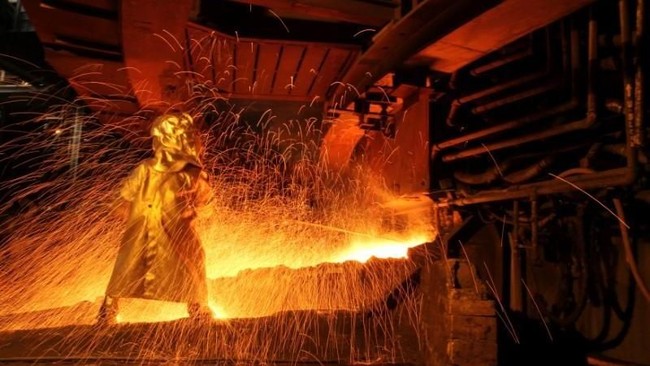
Jakarta, CNBC Indonesia - Finance Minister Purbaya Yudhi Sadewa is prepared to implement a tax on windfall profits in certain industries, commonly known as the windfall profit tax. The initial target is the nickel commodity sector.
The imposition of the windfall tax on the mining and nickel processing sector will be applied alongside export duties. Currently, the policy is still under discussion with the Ministry of Energy and Mineral Resources.
“It will happen, but it’s still being discussed with the Ministry of Energy and Mineral Resources. I’ll accept the money anyway,” said Purbaya at his office in Jakarta on Monday (4/5/2026).
Purbaya explained that the export duties plus windfall profit tax on nickel commodities are intended to compensate for the energy subsidies disbursed by the government amid high fluctuations in global crude oil prices, due to conflicts in the Middle East.
“Clearly, it will be sufficient to cover the increase in our state budget subsidies. And nickel, that’s one of the raw materials for batteries,” he stated.
As compensation for the additional costs, Purbaya assured that incentives will be provided for nickel derivative products to keep domestic demand high.
“We will also encourage battery industry growth here with certain incentives so that they sell well. Basically, products using domestic raw materials will get more incentives, something like that. It’s still under discussion,” said Purbaya.
For information, the performance of nickel commodity exports and related goods (HS75) has become one of the products supporting Indonesia’s trade balance surplus for the January-March 2026 period. The value reached US$3.24 billion.
One of the main destination countries for nickel and related goods exports is China, with a value of US$2.8 billion. The export value even rose 69.01% compared to the January-March 2025 period.
The House of Representatives’ Commission XI had previously urged the government to start implementing the windfall tax scheme, amid the significant potential for rising prices of several of Indonesia’s key export commodities in the global market due to the Iran-US and Israel war in the Middle East region.
Chairman of Commission XI of the House of Representatives, Mukhamad Misbakhun, said that the war not only drives up global crude oil prices, which is one of Indonesia’s main import commodities, but also key RI export commodities, such as crude palm oil (CPO), nickel, coal, aluminium, copper, gold, coffee, and rubber prices.
“Of course, we can prepare the government for the windfall tax scheme,” said Misbakhun on the Squawk Box CNBC Indonesia programme on Tuesday (7/4/2026).
Misbakhun stated that the windfall tax scheme applied to tax windfall profits of commodity exporters is important as a support for state revenues from the tax side.
This is particularly because the need for state revenues is currently increasing to compensate for state expenditure pressures from energy subsidies, as subsidised fuels like Pertalite have been kept from rising despite soaring global crude oil prices to maintain people’s purchasing power.
“Of course, this must be discussed together with business associations, sectorally, partially, that at certain price levels, when it’s called windfall and then how much percentage is imposed. This also creates potential beyond the normal,” explained Misbakhun.
The windfall profit tax is currently a target for several countries to impose on energy companies reaping profits amid commodity price volatility due to disruptions in the Strait of Hormuz, an effect of the Iran-US and Israel war.
Five European Union countries have called for an extraordinary profits tax on energy companies’ earnings or windfall tax in response to rising fuel prices due to the Iran war. This was stated by the finance ministers of Germany, Italy, Spain, Portugal, and Austria.
“Such a step could help fund aid for consumers facing high energy prices and send a signal that ‘we are united and capable of acting’,” they said in a letter to the European Commission, quoted from Reuters on Monday (27/4/2026).
“It would allow for funding temporary aid, especially for consumers, and curb rising inflation without adding to the public budget burden,” the ministers emphasised.
According to the five ministers, this policy is seen as sending a clear message that those profiting from the consequences of war must do their part to ease the burden on the general public.
Oil and gas prices have surged since the US-Israel attack on Iran began on 28 February, creating a price shock similar to the energy crisis Europe experienced after Russia invaded Ukraine in 2022 - although EU countries are now sourcing more energy from renewables.
In a letter addressed to EU Climate Commissioner Wopke Hoekstra, the ministers referred to a similar emergency tax in 2022 to address high energy prices.
“Given the current market distortions and fiscal constraints, the European Commission must promptly develop a similar EU-wide contribution instrument based on a solid legal foundation,” they wrote.