
Purbaya and the Effort to Open the Acute Bureaucratic Blockage
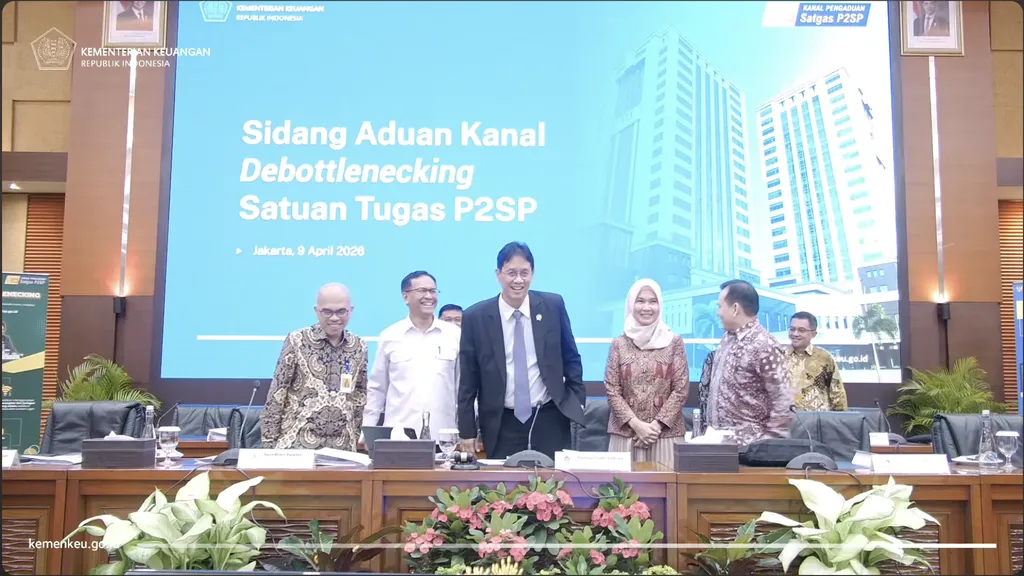
As the old song goes, investment problems are often linked to protracted licensing processes, stalled coordination, and overlapping authority between agencies.
By Dimas Waraditya Nugraha
11 Apr 2026 08:00 WIB · English
The government’s efforts to remove investment barriers are now shifting from the administrative table to the cross-ministerial courtroom. However, behind the acceleration in resolving cases, the fundamental issues of the business climate are considered to remain largely unaddressed.
Since its launch in December 2025, the business obstacle complaint channel managed by the Government Strategic Program Acceleration Task Force (Satgas P2SP) has received 112 reports from business actors. Of that number, 58 complaints have been resolved as of early April 2026.
The majority of complaints, specifically 53 reports, are related to business licensing. This fact indicates that the classic issue of investment in Indonesia still relies heavily on bureaucratic aspects.
Finance Minister Purbaya Yudhi Sadewa emphasized that the debottlenecking forum was formed to accelerate concrete improvements to the investment climate. “This task force was formed to ensure a significant and rapid improvement in the investment climate,” Purbaya said at the Debottlenecking Meeting at the Ministry of Finance Office in Jakarta on Thursday (April 9, 2026).
Several cases being tried show a pattern of recurring obstacles. Like an old song, the issues are not far from prolonged licensing, stalled coordination, and overlapping authorities between agencies, even within the internal structure of the agencies.
One example is the issue faced by PT GBKEK Industrial Park in the development of the Galang Batang Special Economic Zone (KEK). The application for a change in the function of the forest area, submitted since 2022, has yet to receive a decision despite being recommended by various parties.
During the hearing, the Director of Planning, Forest Area Changes, and Region Formation of the Ministry of Forestry, Beni Raharjo, acknowledged that there has been a lack of coordination among the directorates within his ministry. As a result, the request for the GBKEK Industrial Park has not been followed up.
Thus, the strategic project is stalled solely due to an administrative process that has yet to be completed. In the hearing, Purbaya, who also serves as the Deputy Chair of the P2SP Task Force, set a two-week deadline for the issue to be resolved.
“In two weeks, we will check whether the permit for the use of the land has been issued or not. So, once it is decided, it will be continuously monitored. Because if it is not monitored, it will not progress,” said Purbaya, reading the decision of the hearing, followed by a gavel strike.
Another case arose in the logistics sector. PT Asinusa Putra Sekawan complained about the lack of a comprehensive regulatory framework for floating storage unit (FSU) and bunkering activities at Nipah Island Port. The unclear regulations hampered operations and undermined competitiveness.
In the industrial sector, issues also arise in the process of certification for the Indonesian National Standard (SNI) and the import permits for raw materials. Furthermore, for medical needs, such as the production of anesthetic gases, the import permit for explosives in the form of ammonium nitrate is still delayed.
This series of cases shows that investment obstacles are not due to a lack of interest, but rather due to complicated bureaucratic processes.
The business community has welcomed the debottlenecking channel. At the very least, business owners now have a way to report issues without having to go from one agency to another.
The Secretary General of the Indonesian Young Entrepreneurs Association (Hipmi), Anggawira, believes that this mechanism helps to break the bureaucratic deadlock. “This is far better than before when business actors had to move from one agency to another without certainty,” he stated when contacted on Friday (10/4/2026).
However, Anggawira reminded that the Task Force should not stop at merely being a receptacle for complaints. In general, there are five main problem models, namely excessive and fluctuating regulations, inter-ministerial sectoral egos, weak central-regional synchronization, non-integrated digital licensing, and a bureaucratic culture that has yet to provide certainty in timing.
“If this issue is not addressed, the resolution of the case will only be temporary. The task force only resolves cases one by one, but the root of the problem remains,” he stated.
Indonesia’s challenges are growing as it must compete with other countries in the region. During the opening of the socialization of the adjustment of Government Regulation Number 28 of 2025 regarding the Online Single Submission (OSS) system in Jakarta at the end of February 2026, Deputy Minister of Investment and Downstreaming Todotua Pasaribu mentioned that Vietnam is an investment magnet in the ASEAN region.
According to him, the main difference between Vietnam and Indonesia lies in the investment cycle. In Vietnam, the process from commitment to realization is relatively short. Meanwhile, in Indonesia, this process can be lengthy as it must go through various stages of licensing.
“In our country, to be frank, the investment cycle is still relatively 4 to 5 years. One of the reasons is the licensing services that hinder the realization of investments from being executed quickly,” said Todotua.
As a result, investment in Indonesia is often stalled before it is fully realized. In fact, the contribution of investment is crucial for economic growth. Vietnam is projected to achieve growth of around 8 percent by 2025. During the same period, Indonesia is still expected to be in the range of 5 percent.
Regarding the work of the P2SP Task Force, the Head of the Macroeconomics and Finance Center at Indef, M Rizal Taufikurahman, urged the government to recognize that investment barriers are not merely a matter of te